
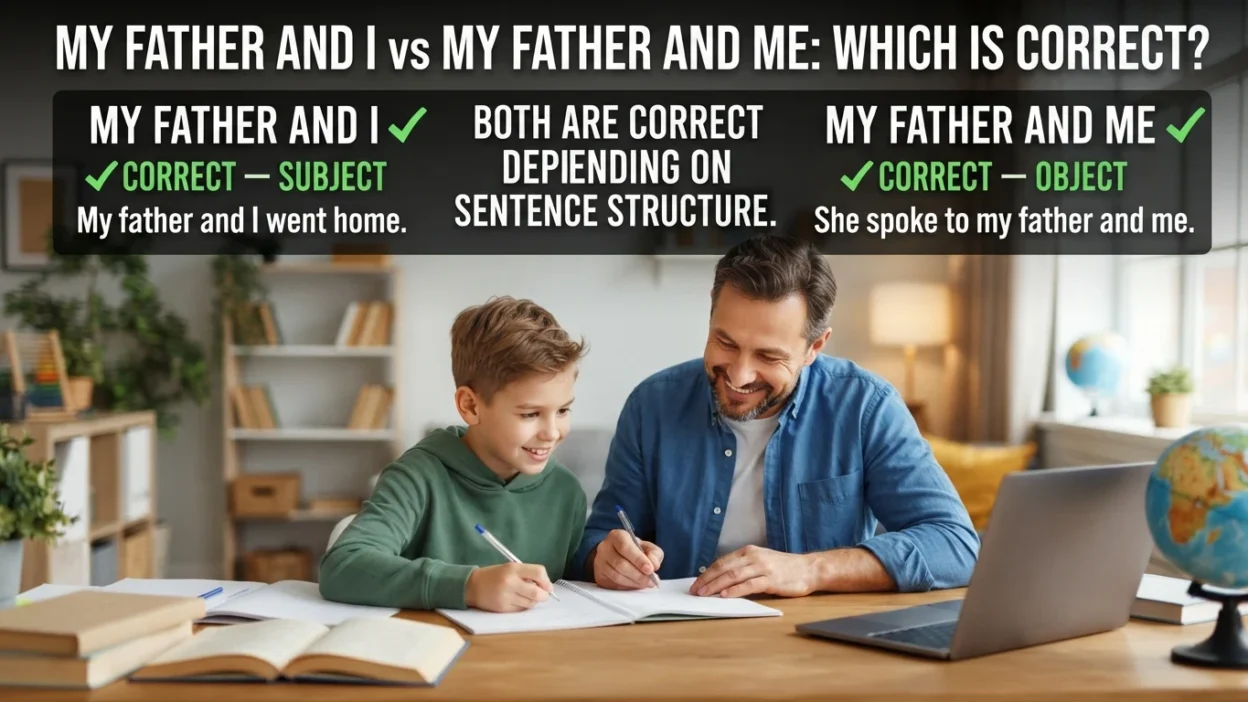
The difference between my father and I vs my father and me is one of the most common grammar questions in English. Many people have been taught that “my father and I” is always correct, while “my father and me” is always wrong. However, the truth is more nuanced: both expressions can be correct, depending on how they function in a sentence.
The key is not whether the phrase comes after another person. The real question is whether the phrase is acting as the subject or the object of the sentence. Once you understand this simple rule, choosing between my father and I and my father and me becomes much easier. Let’s explore the difference with clear examples, common mistakes, and practical grammar tips.
Quick Answer: My Father and I vs My Father and Me
Both my father and I and my father and me can be grammatically correct.
Use my father and I when the phrase is the subject performing the action.
Example:
My father and I went to the market.
Use my father and me when the phrase is the object receiving the action or following a preposition.
Example:
The teacher spoke to my father and me.
The easiest test
Remove “my father and” from the sentence and see which pronoun sounds correct.
My father and I went home.
Remove “my father and”:
I went home.
So, my father and I is correct.
Now consider:
The teacher spoke to my father and me.
Remove “my father and”:
The teacher spoke to me.
So, my father and me is correct.
The simple rule is:
Subject = my father and I
Object = my father and me
What Does “My Father and I” Mean?
My father and I is a compound subject. It refers to the speaker and their father as the people performing an action.
Here, I is a subject pronoun.
For example:
My father and I went to the hospital.
In this sentence, both people performed the action of going to the hospital.
The structure is:
My father + and + I + verb
More examples include:
- My father and I live in the same house.
- My father and I went shopping.
- My father and I watched the football match.
- My father and I visited our relatives.
- My father and I are planning a trip.
- My father and I enjoy gardening.
In each sentence, my father and I are the subjects of the sentence.
What Does “My Father and Me” Mean?
My father and me is used when the phrase functions as an object.
Here, me is an object pronoun.
For example:
My mother invited my father and me to dinner.
In this sentence, the people receiving the invitation are my father and me.
Another example is:
The teacher called my father and me.
The teacher performed the action of calling, while my father and me received that action.
You can also use my father and me after a preposition.
For example:
- The gift was for my father and me.
- She spoke to my father and me.
- The decision affected my father and me.
- They traveled with my father and me.
- The teacher sat between my father and me.
In these sentences, me is correct because it is being used as an object.
My Father and I vs My Father and Me: Comparison Table
| Phrase | Grammatical Role | When to Use | Example |
|---|---|---|---|
| My father and I | Subject | When you and your father perform the action | My father and I went home. |
| My father and me | Object | When you and your father receive the action | She invited my father and me. |
| My father and I | Subject | Before the main verb | My father and I enjoy traveling. |
| My father and me | Object | After a preposition | She spoke to my father and me. |
| My father and I | Subject | Starting the sentence as the doer | My father and I bought a car. |
| My father and me | Object | After verbs such as invited, helped, or called | They helped my father and me. |
When to Use “My Father and I”
Use my father and I when the phrase is the subject of the sentence.
The subject is the person or people who perform the action.
Example 1
My father and I went to the bank.
Who went to the bank?
My father and I.
Therefore, the phrase is the subject.
Example 2
My father and I bought a new television.
Who bought the television?
My father and I.
Therefore, I is correct.
Example 3
My father and I are going on vacation.
Who is going on vacation?
My father and I.
Again, the phrase is the subject.
When to Use “My Father and Me”
Use my father and me when the phrase is the object of the sentence or follows a preposition.
Example 1
The doctor spoke to my father and me.
The phrase follows the preposition to, so me is correct.
Example 2
She invited my father and me to the wedding.
The phrase is the object of the verb invited.
Example 3
The teacher gave my father and me some advice.
The advice was given to my father and me, making the phrase an object.
Example 4
This problem has affected my father and me.
The phrase receives the action of affected, so me is correct.
A Simple Pronoun Test
One of the best ways to decide between my father and I and my father and me is to remove the other person from the sentence.
Consider this sentence:
My father and I went to the store.
Remove “my father and”:
I went to the store.
That sounds correct.
Now consider:
The manager spoke to my father and me.
Remove “my father and”:
The manager spoke to me.
That also sounds correct.
This method works because English speakers sometimes become confused when two people are mentioned together.
Compare:
My father and I visited the museum.
Remove “my father and”:
I visited the museum.
Correct.
The guide showed the museum to my father and me.
Remove “my father and”:
The guide showed the museum to me.
Correct.
Common Mistakes
Mistake 1: Thinking “My Father and I” Is Always Correct
This is probably the most common mistake.
Some people have heard that “my father and I” sounds more formal or polite, so they use it everywhere.
For example:
The teacher called my father and I.
This is incorrect in standard English.
The correct sentence is:
The teacher called my father and me.
Why?
Because the phrase is the object of called.
You would say:
The teacher called me.
Not:
The teacher called I.
Mistake 2: Using “My Father and Me” as the Subject
Another common mistake is:
My father and me went to the market.
This is incorrect in standard English.
The correct version is:
My father and I went to the market.
You would say:
I went to the market.
Not:
Me went to the market.
Mistake 3: Choosing Based on Formality
Some people believe I is always formal and me is always informal.
That is not true.
The choice between I and me depends on grammar, not formality.
For example:
My father and I attended the meeting.
Correct.
The manager spoke with my father and me.
Also correct.
Both sentences can sound formal and professional.
Mistake 4: Forgetting Prepositions
After a preposition, an object pronoun is normally required.
For example:
- with my father and me
- to my father and me
- for my father and me
- between my father and me
- from my father and me
Examples:
The gift was for my father and me.
The teacher spoke with my father and me.
The agreement was between my father and me.
Using my father and I in these sentences would be incorrect in standard English.
My Father and I vs My Father and Me in Questions
The same subject-object rule applies to questions.
Correct:
Did my father and I make a mistake?
Here, my father and I are the people who made the mistake.
Correct:
Did the teacher speak to my father and me?
Here, my father and me are the people the teacher spoke to.
The key is still the grammatical function of the phrase.
American English vs British English
There is no major difference between American and British English when it comes to the basic distinction between I and me.
Both varieties generally follow the same rule:
I is a subject pronoun.
Me is an object pronoun.
For example, both American and British English use:
My father and I went to London.
And:
The teacher spoke to my father and me.
However, in informal speech, some native speakers may occasionally use me in ways that differ from formal standard grammar.
For example, you may hear:
Me and my father went to the store.
This is common in informal conversation for some speakers, but in formal writing, academic work, and professional communication, My father and I went to the store is the preferred form.
My Father and I vs My Father and Me: Which One Is More Formal?
Neither phrase is automatically more formal.
The correct choice depends on the grammatical role.
For example:
My father and I attended the meeting.
This is correct and can be very formal.
The director spoke with my father and me.
This is also correct and can be equally formal.
The important thing is not to choose I simply because you think it sounds more sophisticated.
Correct grammar is determined by the sentence structure.
FAQs
1. Is it “my father and I” or “my father and me”?
Both can be correct. Use my father and I when the phrase is the subject, and my father and me when it is the object.
2. Is “My father and I went to the store” correct?
Yes. My father and I is the subject because they are the people performing the action of going.
3. Is “The teacher called my father and I” correct?
No. The standard correct form is The teacher called my father and me because the phrase is the object of the verb called.
4. Should I say “between my father and I” or “between my father and me”?
The standard correct form is between my father and me because between is a preposition and requires object pronouns.
5. Is “My father and me went shopping” correct?
No, not in standard English. The correct sentence is My father and I went shopping because the phrase is the subject.
6. Is “with my father and I” correct?
In standard English, no. The correct phrase is with my father and me because with is a preposition.
7. Is “my father and I” more formal than “my father and me”?
No. Neither is automatically more formal. The correct choice depends on whether the phrase is functioning as a subject or an object.
8. How can I quickly choose between I and me?
Remove the words my father and from the sentence. If I sounds correct, use my father and I. If me sounds correct, use my father and me.
Final Summary
The difference between my father and I vs my father and me is based on the grammatical role of the pronoun. Use my father and I when you and your father are performing the action. For example, My father and I went to the market is correct because “my father and I” is the subject of the sentence.
Use my father and me when you and your father are receiving the action or when the phrase follows a preposition. For example, The teacher spoke to my father and me is correct because the phrase follows the preposition “to.” Remember that I is a subject pronoun, while me is an object pronoun.