Have you ever written “hence why“ and then wondered if it was grammatically correct? You’re not alone. This phrase appears in conversations, books, news articles, and even professional writing, yet many grammar enthusiasts argue that it’s redundant. So, should you use it, or is there a better alternative?
Understanding hence why grammar can help you write with greater confidence and precision. While many native speakers naturally use hence why, some style guides recommend avoiding it because the word hence already means for this reason or therefore. In this guide, you’ll learn what hence why means, whether it’s correct, when it’s acceptable, common mistakes to avoid, and how to choose the best alternative for different situations.
Quick Answer
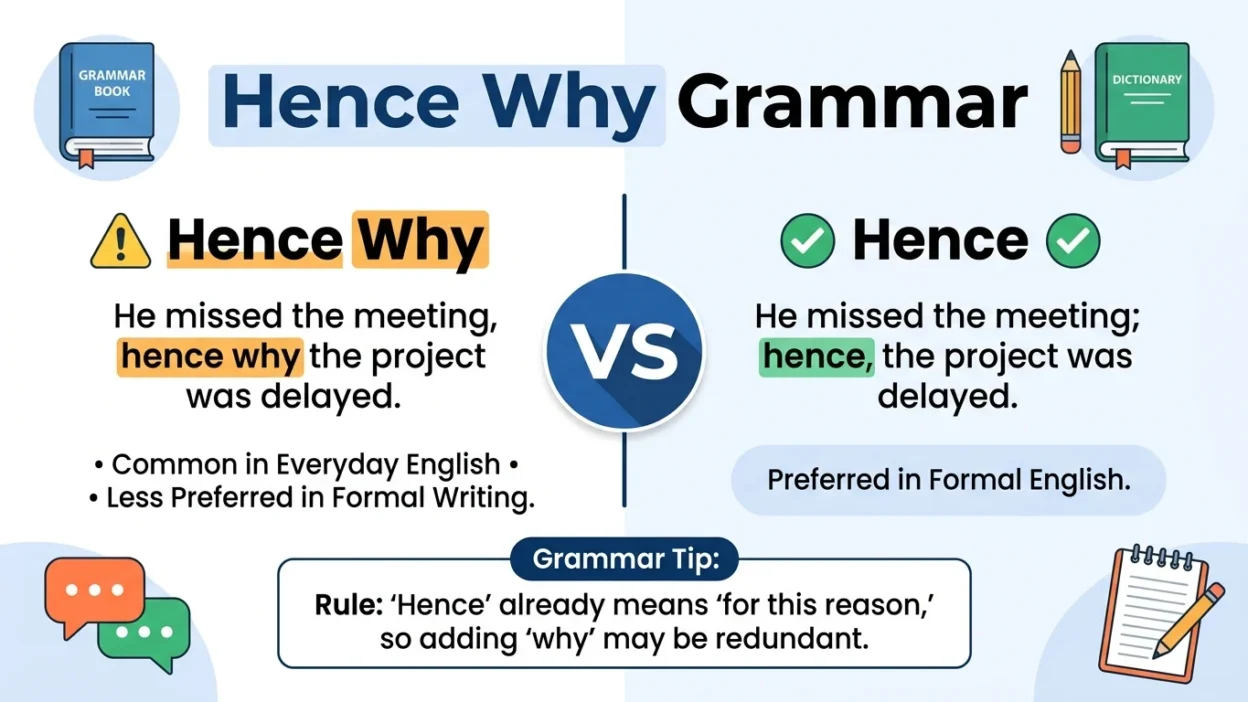
Hence why is widely used in modern English, but many grammar experts consider it redundant because hence already means for this reason.
For formal writing, it’s usually better to use one of these:
- Hence
- Therefore
- This is why
- That is why
Examples
Less preferred:
- He missed the meeting, hence why the project was delayed.
Better:
- He missed the meeting; hence, the project was delayed.
- He missed the meeting. That is why the project was delayed.
Although hence why appears frequently in everyday English, simpler alternatives are generally recommended in formal writing.
What Does “Hence” Mean?
Hence is an adverb that means:
- therefore
- for this reason
- consequently
- as a result
It connects one idea to the logical result of another.
Examples
- The road was flooded; hence, we stayed home.
- Sales increased; hence, profits improved.
- She studied hard; hence, she passed the exam.
In each example, hence already explains the reason and result.
What Does “Hence Why” Mean?
The phrase hence why is commonly used to introduce an explanation.
It generally means:
For example:
- He worked late every night, hence why he was tired.
The speaker simply means:
- He worked late every night. That is why he was tired.
The meaning is clear, but some editors argue that combining hence and why repeats the same idea.
Is “Hence Why” Grammatically Correct?
The answer depends on the context.
In Everyday English
Yes.
Many native speakers naturally say:
- Hence why I called you.
- Hence why we’re leaving early.
These sentences are widely understood.
In Formal English
Many style guides recommend avoiding hence why because it’s considered repetitive.
Instead, choose:
- hence
- therefore
- thus
- this is why
- that is why
These alternatives are shorter and more precise.
Why Do Some People Call It Redundant?
Let’s look at the meanings.
Hence already means:
- therefore
- for this reason
Why introduces a reason.
Combining them can create unnecessary repetition.
Think of it like saying:
- therefore why
or
- for this reason why
Although understandable, the extra word isn’t needed.
Hence Why Grammar: Comparison Table
| Expression | Grammatically Acceptable | Formal Writing | Everyday Conversation |
|---|---|---|---|
| Hence | ✅ Yes | Excellent | Common |
| Hence why | Widely used but often considered redundant | Better avoided | Very common |
| Therefore | ✅ Yes | Excellent | Common |
| That is why | ✅ Yes | Excellent | Very common |
| This is why | ✅ Yes | Excellent | Very common |
For professional writing, simpler alternatives are generally the best choice.
Examples of “Hence”
These examples follow standard grammar.
- The flight was canceled; hence, we stayed overnight.
- Prices increased; hence, demand fell.
- She forgot the password; hence, she couldn’t log in.
- The weather changed suddenly; hence, the match was postponed.
- He arrived early; hence, he secured the best seat.
Examples of “Hence Why”
These examples reflect common spoken English.
- That’s hence why I called.
- We were running late, hence why we skipped breakfast.
- He didn’t prepare, hence why he failed.
- She wasn’t feeling well, hence why she stayed home.
- They invested wisely, hence why they succeeded.
These are widely understood but may be edited in formal writing.
Better Alternatives to “Hence Why”
If you’re writing professionally, consider these options.
Instead of:
- He resigned, hence why the position became vacant.
Write:
- He resigned; hence, the position became vacant.
- He resigned. That is why the position became vacant.
- He resigned. This is why the position became vacant.
- He resigned; therefore, the position became vacant.
Each alternative sounds more concise.
Common Mistakes to Avoid
1. Using “Hence Why” in Academic Writing
Less preferred:
- The sample size was small, hence why the results varied.
Better:
- The sample size was small; hence, the results varied.
2. Mixing Too Many Transition Words
Incorrect:
- Therefore hence why we canceled.
Choose only one connector.
3. Incorrect Punctuation
Correct:
- The train was delayed; hence, we arrived late.
Notice the punctuation around hence.
4. Overusing “Hence”
Instead of repeating hence, vary your writing with:
- therefore
- consequently
- thus
- as a result
- because of this
Variety improves readability.
American vs British English
Does American English treat hence why differently from British English?
Not really.
Both American and British English:
- understand the phrase
- use it in conversation
- sometimes include it in journalism
However, editors in both varieties often recommend replacing it with simpler alternatives in formal writing.
There is no major spelling or grammar difference between the two.
Similar Words and Expressions
You can replace hence with several useful alternatives.
Examples include:
- therefore
- thus
- consequently
- accordingly
- for this reason
- because of this
- as a result
- this is why
- that is why
These expressions can make your writing smoother and more varied.
Tips to Remember the Rule
A simple trick helps.
Ask yourself:
Does hence already explain the reason?
If yes, you probably don’t need why.
Instead of:
- Hence why.
Try:
- Hence.
- Therefore.
- That is why.
This habit makes writing more concise and professional.
FAQs
Is “hence why” grammatically correct?
It is widely used and understood, but many grammar experts consider it redundant because hence already means for this reason.
Why do people say “hence why”?
Many native speakers use it naturally in conversation because it emphasizes the explanation, even though it may repeat the same idea.
Should I avoid “hence why” in formal writing?
Yes. In academic, business, and professional writing, using hence, therefore, or that is why is usually preferred.
Is “hence” the same as “therefore”?
Yes. In most contexts, hence and therefore have similar meanings.
Do American and British English both use “hence why”?
Yes. The phrase appears in both varieties, although editors in both often recommend simpler alternatives.
Can I use “hence why” in conversation?
Absolutely. It’s common in everyday speech and most people will understand it without confusion.
What is the best replacement for “hence why”?
Good alternatives include:
- hence
- therefore
- this is why
- that is why
- as a result
Summary
Understanding hence why grammar comes down to recognizing the role of hence. Since hence already means therefore or for this reason, many editors view hence why as redundant. While the phrase is common in everyday conversation and informal writing, it is generally better to choose more concise alternatives such as hence, therefore, this is why, or that is why in formal contexts.
The important thing to remember is that communication depends on both clarity and audience. If you’re speaking casually, hence why is unlikely to confuse anyone. However, if you’re writing an academic essay, business report, or professional article, using a cleaner alternative will make your writing sound more polished and grammatically precise.