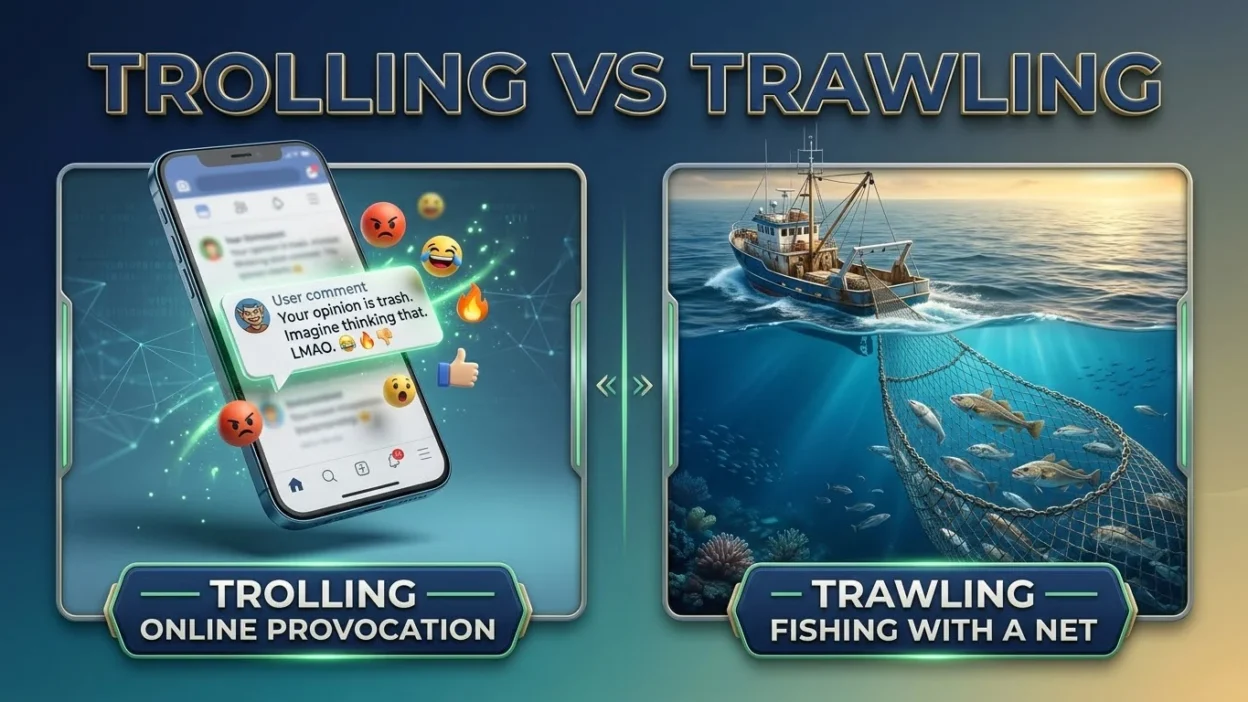
Have you ever confused trolling with trawling? These two words look and sound similar, but they have very different meanings. One is commonly associated with internet behavior and fishing with a line, while the other refers mainly to catching fish by dragging a net through water.
Understanding the difference between trolling and trawling can help you avoid spelling mistakes and use each word correctly. Whether you are writing about social media, fishing techniques, or everyday English, this guide explains their meanings, examples, and common mistakes in simple language.
Quick Answer: Trolling vs Trawling
Trolling and trawling are both correct English words, but they are used in different contexts.
- Trolling: Deliberately provoking or upsetting people, especially online, to get a reaction. In fishing, it also means pulling baited lines through the water from a moving boat.
- Trawling: Catching fish by dragging a large fishing net through the water behind a boat. It can also mean searching through a large amount of information to find something specific.
Easy way to remember: Trolling often involves provoking someone or fishing with lines, while trawling usually involves dragging a net or searching through lots of information.
What Does Trolling Mean?
Trolling is the present participle of the verb troll. Its meaning depends on the context in which it is used.
1. Trolling on the Internet
In online communication, trolling means intentionally posting provocative, offensive, or misleading comments to annoy people, start arguments, or attract attention.
An internet troll may deliberately make controversial statements because they enjoy seeing other people react.
Examples:
- Someone was trolling people in the comments section.
- Stop trolling others just to start an argument.
- The celebrity received hundreds of trolling comments on social media.
- He was accused of trolling other fans during the online discussion.
Trolling is usually intentional. A person who disagrees respectfully with someone is not necessarily trolling.
2. Trolling in Fishing
In fishing, trolling means pulling one or more baited lines or lures through the water while a boat moves.
This technique is used to attract fish that may follow moving bait.
Examples:
- We spent the morning trolling for tuna.
- The fishermen were trolling along the coast.
- They caught several fish while trolling behind the boat.
Notice that trolling in fishing does not require a large net. That is an important difference between trolling and trawling.
What Does Trawling Mean?
Trawling is the present participle of the verb trawl. It most commonly refers to catching fish by dragging a large net, called a trawl, through the water.
Trawling is a commercial fishing method used to catch different kinds of fish and other marine animals. Depending on the equipment and location, the net may be dragged along the seabed or through the water.
Examples:
- The fishing boat was trawling for shrimp.
- Commercial trawling can affect marine ecosystems.
- The fishermen spent several hours trawling in deep water.
- The government introduced restrictions on trawling in certain areas.
Trawling in a Figurative Sense
The word trawling can also mean searching through a large amount of material to find useful information, evidence, or particular items.
Examples:
- The journalist was trawling through old records for evidence.
- She spent hours trawling the internet for reliable information.
- Investigators were trawling through thousands of messages.
- I was trawling through my old photographs to find the picture.
In these examples, nobody is necessarily fishing. The word describes a broad or systematic search.
Trolling vs Trawling: Key Differences
| Feature | Trolling | Trawling |
|---|---|---|
| Main meaning | Provoking people online or fishing with lines | Fishing with a dragged net |
| Online usage | Deliberately provoking reactions | Searching through large amounts of information |
| Fishing equipment | Usually baited lines or lures | A large fishing net |
| Common context | Social media, arguments, recreational fishing | Commercial fishing, research, information searches |
| Example | He was trolling people online. | The boat was trawling for fish. |
Trolling vs Trawling Examples in Sentences
The easiest way to learn these words is to compare them in complete sentences.
Examples of Trolling
- Online: The user was trolling others by posting insulting comments.
- Fishing: The captain spent the afternoon trolling for salmon.
- Social media: Ignore the account; it is only trolling for attention.
- Conversation: She accused him of trolling because he kept making deliberately provocative remarks.
Examples of Trawling
- Fishing: The vessel was trawling for prawns.
- Research: I was trawling through academic articles for relevant studies.
- Journalism: Reporters were trawling through public documents.
- Investigation: The team was trawling through old emails to locate the missing information.
Compare Them Side by Side
- Trolling: The fisherman was trolling with baited lines behind his boat.
- Trawling: The fisherman was trawling with a large net behind his boat.
Both sentences describe fishing, but the equipment and method are different.
Why Do People Confuse Trolling and Trawling?
There are several reasons these words are easy to mix up.
1. Similar Spelling
Both words contain the letters t-r-o-l and end in -ing. Their similar appearance can lead to typing and spelling errors.
2. Similar Pronunciation
The words sound similar in many English accents, although the vowel sounds can vary. Listening carefully to context is often more useful than relying on pronunciation alone.
3. Both Are Used in Fishing
Both trolling and trawling can describe fishing activities. However, they refer to different techniques: trolling generally uses moving baited lines or lures, whereas trawling uses a dragged net.
4. Both Can Describe Searching
Trolling can describe provoking people to get a reaction, while trawling can describe searching extensively through information. Online discussions may involve both concepts, which can add to the confusion.
Common Mistakes to Avoid
Mistake 1: Using Trolling When You Mean Net Fishing
Incorrect for net fishing: The boat was trolling with a large net.
Better: The boat was trawling with a large net.
Use trawling when you mean dragging a fishing net through the water.
Mistake 2: Using Trawling for Online Provocation
Incorrect: He was trawling people in the comments to make them angry.
Better: He was trolling people in the comments to make them angry.
Use trolling when someone deliberately provokes others online.
Mistake 3: Assuming Trolling Always Means Internet Harassment
Trolling also has a legitimate fishing meaning. For example, a person can go trolling for fish without interacting with social media at all.
Mistake 4: Assuming Trawling Only Refers to Fishing
Although fishing is its primary meaning, trawling is also used figuratively for searching through a large collection of documents, records, websites, or messages.
Trolling vs Trawling in American and British English
Both trolling and trawling are standard English words in American and British English. Their basic meanings do not change significantly between the two varieties.
- Trolling: Commonly used in both countries for online provocation and fishing with baited lines or lures.
- Trawling: Commonly used in both countries for net-based fishing and extensive searches through information.
The choice depends on the activity being described, not on whether you are writing in American or British English.
FAQs
1. What is the main difference between trolling and trawling?
Trolling commonly means deliberately provoking people online or fishing with baited lines. Trawling usually means catching fish with a dragged net or searching extensively through information.
2. Is trolling a correct English word?
Yes. Trolling is the correct form of the verb troll in contexts such as online provocation and a particular fishing technique.
3. Is trawling a correct English word?
Yes. Trawling is the correct form of the verb trawl. It is most commonly associated with catching fish using a large net.
4. Can trolling refer to fishing?
Yes. Trolling is a fishing technique in which baited lines or lures are pulled through the water as a boat moves.
5. Does trawling always involve a fishing net?
In its main fishing sense, trawling involves a net. Figuratively, it can mean searching through a large amount of information or material.
6. What does trawling the internet mean?
Trawling the internet means searching through many websites or online sources to find particular information.
7. Is trolling the same as cyberbullying?
Not exactly. Trolling involves provoking people to get a reaction, often online. Cyberbullying involves using digital communication to harass, threaten, humiliate, or harm someone. The behaviors can overlap, but they are not identical.
8. How can I remember the difference between trolling and trawling?
Remember trolling = provoking or baited lines, and trawling = a dragged net or a broad search. The surrounding context will usually tell you which word is correct.
Summary
Trolling and trawling are two different English words that are easy to confuse because they look and sound similar. Trolling often refers to provoking people online, although it can also describe fishing with baited lines or lures. Trawling primarily refers to catching fish with a large net dragged through the water, but it can also mean searching through a large amount of information.

Liam James is a language enthusiast and content writer at Verseslay, specializing in word comparisons, grammar debates, and vocabulary insights. He helps readers understand language nuances through clear, engaging, and practical explanations.