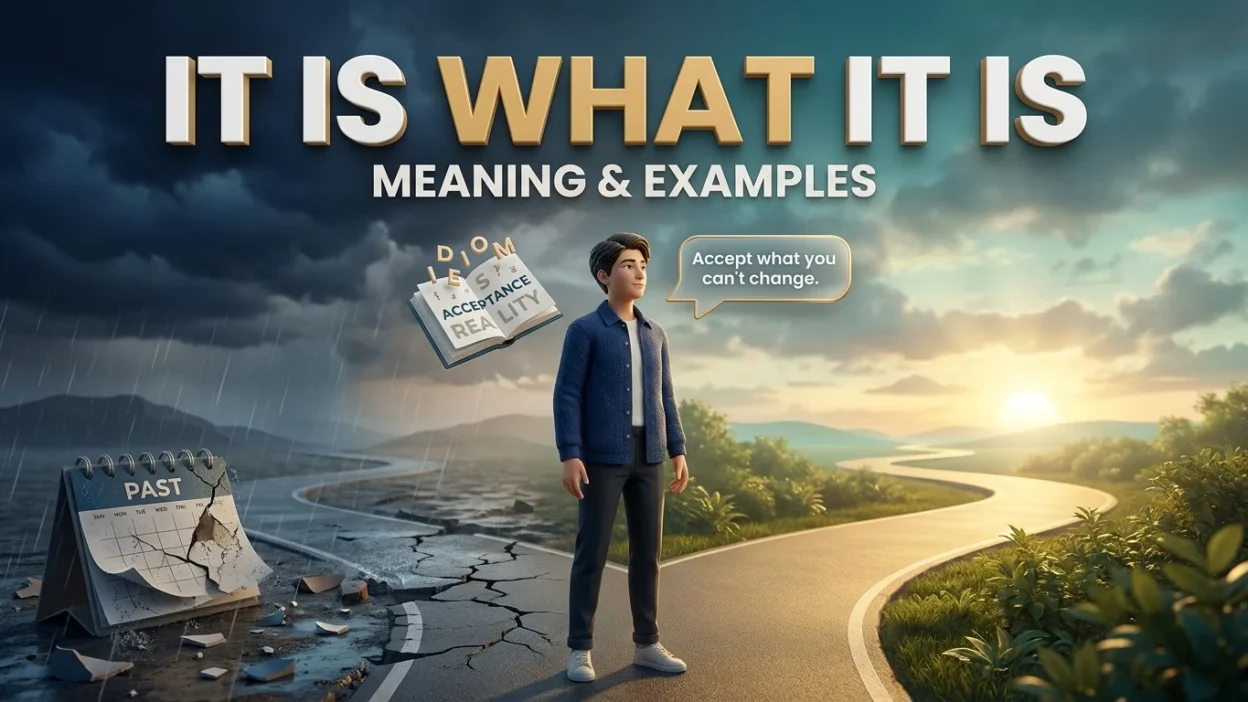
Have you ever faced a situation you cannot change, even though you wish things were different? Perhaps a plan failed, a relationship ended, or something unexpected happened. In moments like these, you might hear someone say, “It is what it is.” This common English expression communicates acceptance of a situation, especially when there is little or nothing you can do to change it.
Understanding the phrase it is what it is can help you sound more natural in everyday English conversations, text messages, and social media posts. Although the expression is short, its meaning can vary depending on the speaker’s tone and the situation. In this guide, you will learn its definition, origin, examples, synonyms, common mistakes, and the best ways to use it naturally.
Quick Answer: What Does “It Is What It Is” Mean?
“It is what it is” means accepting a situation as it exists, even when you dislike it or cannot change it.
People commonly use this expression when something has happened, a decision has been made, or circumstances are beyond their control.
Examples:
- We lost the match, but it is what it is.
- The weather ruined our plans. It is what it is.
- I cannot change the past, so it is what it is.
- The job was not what I expected, but it is what it is.
In simple words, the phrase means accepting reality and moving forward instead of worrying about something you cannot control.
However, it does not always mean that a person is happy about the situation. Sometimes, it expresses disappointment, resignation, frustration, or emotional acceptance.
What Does “It Is What It Is” Mean in Detail?
The phrase it is what it is is an idiomatic expression. Its meaning is not simply the literal meaning of its individual words. Instead, the complete phrase communicates a particular attitude toward a situation.
When someone says it, they usually mean that a situation is what it is, and there may be little benefit in arguing about it or wishing it were different.
For example, imagine that you prepared carefully for an outdoor event, but heavy rain forced the organizers to cancel it. You might feel disappointed, but you cannot control the weather.
You could say:
- I was really looking forward to the event, but it is what it is.
This sentence shows that you are disappointed but recognize the reality of the situation.
The expression can communicate several related ideas:
- Acceptance: Recognizing a situation as it is.
- Resignation: Acknowledging that something cannot easily be changed.
- Realism: Focusing on reality rather than wishing things were different.
- Moving forward: Choosing to continue instead of dwelling on what happened.
The precise meaning depends on the context, facial expression, and tone of voice.
Examples of “It Is What It Is” in Everyday English
The best way to understand an idiom is to see how people use it in real-life situations.
1. After a Disappointment
Suppose you studied hard for an examination but received a lower score than expected.
Example:
“I thought I would get better marks, but it is what it is. I’ll prepare harder next time.”
Here, the speaker acknowledges disappointment and decides to move forward.
2. When Plans Change
Imagine that your friend cancels a planned trip because of an unexpected problem.
Example:
“We were supposed to travel this weekend, but the trip has been canceled. It is what it is.”
The speaker accepts the change rather than continuing to complain about it.
3. In Relationships
Sometimes, relationships change despite a person’s best efforts.
Example:
“We tried to make things work, but we wanted different things. It is what it is.”
In this context, the expression communicates acceptance of an outcome that may be emotionally difficult.
4. At Work
A workplace decision may not be what you wanted, but you may have to accept it.
Example:
“The company decided to postpone the project. It is what it is, so let’s focus on what we can do now.”
This example combines acceptance with a practical decision to move forward.
5. In Sports
Imagine that your team loses an important badminton match.
Example:
“We played well, but our opponents were stronger today. It is what it is. We’ll come back stronger.”
The expression acknowledges the result without allowing disappointment to prevent future improvement.
6. In Daily Conversation
Your friend may complain that the bus arrived late, causing you both to miss an appointment.
Example:
“We missed the first part of the meeting because the bus was late. It is what it is.”
The phrase indicates that the speaker accepts what happened, although they may still be unhappy about it.
Is “It Is What It Is” Positive or Negative?
The expression can be either positive or negative, depending on the context.
It is not inherently pessimistic, optimistic, or rude. It simply expresses acceptance, although the emotional tone can change its effect.
| Context | Possible meaning | Example |
|---|---|---|
| Disappointment | Accepting an unwanted outcome | We didn’t win, but it is what it is. |
| Calm acceptance | Recognizing reality | The decision has been made. It is what it is. |
| Frustration | Feeling there is no point arguing | They changed the schedule again. It is what it is. |
| Moving forward | Focusing on the next step | The opportunity passed. It is what it is; let’s try again. |
| Indifference | Showing little emotional concern | I wasn’t expecting much anyway. It is what it is. |
The same words can sound comforting in one conversation and dismissive in another. If someone is sharing a painful experience, responding with this phrase alone may make them feel that you are minimizing their feelings.
A more empathetic response might be: “I’m sorry that happened. I know it’s difficult, but we’ll figure out what to do next.”
“It Is What It Is” vs. Similar Expressions
Several English phrases express acceptance, but they are not always interchangeable.
| Expression | Meaning | Example |
|---|---|---|
| It is what it is | Accepting reality as it stands | We cannot change the result. It is what it is. |
| That’s life | Accepting that difficulties are a normal part of life | Sometimes things go wrong. That’s life. |
| What will be, will be | Accepting an uncertain future | We’ll see what happens. What will be, will be. |
| Let it go | Stop holding on to something emotionally | You cannot change the past, so let it go. |
| It can’t be helped | A situation cannot reasonably be prevented or changed | The road is closed. It can’t be helped. |
| Move on | Stop dwelling on the past and continue with life | The opportunity is gone. It’s time to move on. |
Which expression should you use?
Use it is what it is when you want to acknowledge a situation as it stands. Use let it go when you want someone to stop dwelling on something, and move on when you want to emphasize taking the next step.
Is “It Is What It Is” Grammatically Correct?
Yes, “it is what it is” is grammatically correct and widely used in conversational English.
The phrase contains two uses of the verb is:
- The first it refers to the situation or circumstance.
- The first is links the subject to the rest of the expression.
- What it is identifies the situation as it actually exists.
Although the phrase may sound repetitive, the repetition is part of its established structure and meaning.
You should not try to rewrite it as it is that it is or it what is what it is. These versions do not preserve the standard idiom.
The phrase can also appear in the middle or at the end of a sentence.
Examples:
- I don’t like the outcome, but it is what it is.
- Sometimes, it is what it is, and we have to accept it.
- The situation is not ideal. It is what it is.
Common Mistakes When Using “It Is What It Is”
Even fluent English speakers sometimes misunderstand the tone or use of this expression. Here are common mistakes to avoid.
Mistake 1: Thinking It Means Everything Is Fine
The expression does not necessarily mean that the speaker is happy.
For example, “I lost my job, but it is what it is” may communicate sadness or resignation rather than happiness.
Mistake 2: Using It to Dismiss Someone’s Feelings
If a friend is upset about a serious problem, saying only “It is what it is” can sound insensitive.
Instead, acknowledge their feelings first:
“I understand why you’re upset. It’s a difficult situation, and I’m sorry you’re going through it.”
Mistake 3: Using It as an Excuse to Avoid Action
Accepting reality does not mean you should never try to improve a situation.
For example, if you fail an examination, you can accept the result while still studying harder for the next one.
A balanced response is: “I didn’t get the result I wanted. It is what it is, but I can learn from it.”
Mistake 4: Confusing It With “What It Is”
The full idiom is it is what it is. The shorter phrase what it is has other grammatical uses.
For example:
- Full idiom: The situation is disappointing, but it is what it is.
- Different use: I want to understand what it is.
These sentences serve different purposes.
Mistake 5: Forgetting the Apostrophe in the Contraction
The phrase can be shortened to it’s what it is in casual conversation, but this is less common as a fixed expression than the full version.
When writing the standard expression, use “It is what it is.” In ordinary conversation, you may also hear “It’s what it is,” though the full idiom is the more established form.
American vs. British English: Is There a Difference?
There is no significant difference between American and British English in the meaning or standard usage of it is what it is.
Speakers in both varieties use it to acknowledge circumstances that cannot easily be changed. The phrase is common in informal conversations, workplace discussions, interviews, and popular culture.
Examples in American English:
- The game was postponed, but it is what it is.
- I didn’t get the promotion. It is what it is.
Examples in British English:
- The plans have changed, but it is what it is.
- We didn’t get the result we wanted. It is what it is.
The grammar and meaning remain the same. Any difference is more likely to come from individual speaking style or context than from regional English rules.
FAQs
1. What does “it is what it is” mean in simple words?
It means accepting a situation as it is, even if you do not like it or cannot change it. In simple words, it means accepting reality and moving forward.
2. Is “it is what it is” a positive phrase?
It can be positive, neutral, or negative. It may express calm acceptance, disappointment, frustration, or resignation, depending on the speaker’s tone and the situation.
3. Is “it is what it is” an idiom?
Yes. It is a common English idiom used to express acceptance of circumstances that cannot easily be changed.
4. What is another way to say “it is what it is”?
You can say “That’s life,” “It can’t be helped,” or “We have to accept it.” The best alternative depends on whether you want to express acceptance, resignation, or the need to move forward.
5. Can I use “it is what it is” in a text message?
Yes. It is very common in casual text messages, WhatsApp chats, and social media conversations. For example, “The plan didn’t work out, but it is what it is.”
6. Is “it is what it is” rude?
Not necessarily. However, it can sound dismissive if you use it when someone is expressing pain or disappointment. Acknowledge their feelings before using the phrase.
7. Can “it is what it is” mean giving up?
Sometimes it suggests resignation, but it does not always mean giving up. A person can accept an outcome and still make an effort to improve things in the future.
8. Should I write “it is what it is” or “it’s what it is”?
The standard and most recognizable form of the idiom is “it is what it is.” Although “it’s what it is” can appear in informal speech, the full version is generally the safer choice when writing the expression.
Summary
The phrase it is what it is is a widely used English idiom that means accepting a situation as it exists, even when the outcome is disappointing or beyond your control. It can express calm acceptance, frustration, or resignation, depending on the context. The expression is grammatically correct and is used in both American and British English, especially in everyday conversations, text messages, and informal discussions.
Actionable takeaway: Use “it is what it is” when you want to acknowledge reality and focus on what comes next. For example, “I didn’t get the opportunity I wanted, but it is what it is. I’ll keep trying.” Remember that accepting a situation does not mean you have to stop improving it, and when someone is hurting, empathy should come before advice.