
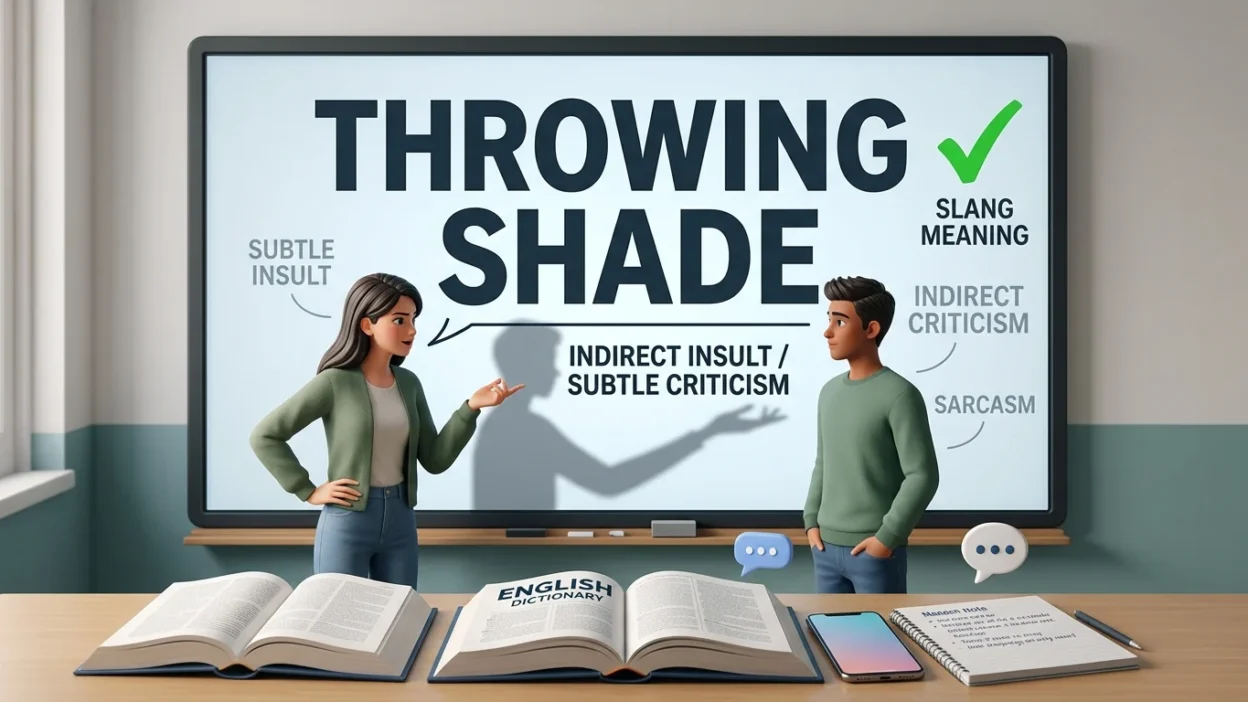
If someone says that a person is throwing shade, they usually mean that the person is making a subtle insult, criticism, or negative comment about someone else. The expression is common in social media, everyday conversation, entertainment, and informal American English.
Unlike a direct insult, throwing shade often involves saying something indirectly. A person may use sarcasm, a clever comment, a facial expression, or a seemingly innocent remark to criticize someone without openly saying that they are attacking them. Understanding the context is therefore important when interpreting this popular slang phrase.
Quick Answer
Throwing shade means indirectly insulting, criticizing, mocking, or expressing disapproval toward someone.
For example:
- She was throwing shade at her former coworker.
- I think he was throwing shade when he commented on my old car.
- They kept throwing shade at each other during the interview.
In simple words:
Throwing shade = making a subtle or indirect negative comment about someone.
It can be playful between friends or genuinely hostile, depending on the situation and tone.
What Does Throwing Shade Mean?
The slang expression throwing shade describes the act of making a subtle insult or critical remark toward another person.
The criticism does not always have to be obvious. In fact, the indirect nature of the comment is often what makes it shade.
For example, imagine someone says:
- That outfit is certainly a bold choice.
Depending on the speaker’s tone and the situation, this could be a genuine compliment or a subtle criticism. If it is clearly intended to mock the person’s clothing, the speaker may be throwing shade.
The expression is therefore closely associated with:
- Subtle insults
- Sarcasm
- Mockery
- Indirect criticism
- Passive-aggressive comments
- Public digs
- Social-media drama
What Does Shade Mean in Slang?
In slang, shade refers to an insult, criticism, or expression of disrespect, especially when it is delivered indirectly.
This meaning is different from the ordinary meaning of shade, such as protection from sunlight.
For example:
Literal shade:
We sat in the shade of a tree.
Slang shade:
She threw shade at her rival during the interview.
The first meaning relates to darkness or shelter from light. The second describes a subtle negative remark.
What Does Throwing Shade Mean on Social Media?
On social media, throwing shade often refers to posting a comment, caption, story, meme, or response that indirectly criticizes another person.
Sometimes the target is obvious even though the person is not named.
For example, someone might post:
- Some people suddenly remember you when they need something.
If everyone knows who the post is about, people might say the person is throwing shade.
Social media has made this type of indirect communication especially noticeable because people can criticize someone publicly without directly mentioning their name.
Throwing Shade vs Insulting Someone
Although throwing shade and insulting someone are related, they are not exactly the same.
A direct insult is usually obvious.
For example:
- You are rude.
That is a straightforward insult.
Throwing shade can be much more subtle:
- Some people really need to learn how to speak to others.
If the comment is clearly aimed at a particular person but does not directly name or confront them, it may be described as throwing shade.
| Expression | Meaning | Style |
|---|---|---|
| Throwing shade | Indirect criticism or insult | Subtle, sarcastic |
| Insulting | Directly saying something offensive or disrespectful | Direct |
| Mocking | Making fun of someone | Often obvious |
| Teasing | Making playful jokes about someone | Usually friendly |
| Criticizing | Pointing out faults or problems | Can be direct or indirect |
| Gossiping | Talking about someone behind their back | May or may not involve insults |
The important distinction is that throwing shade usually has an indirect or subtly dismissive quality.
Examples of Throwing Shade
Here are some everyday examples:
- He was throwing shade at his former boss during the interview.
- She threw shade at her ex in her latest post.
- I think that comment was meant to throw shade.
- They were throwing shade at each other all evening.
- She smiled while throwing shade at her rival.
- His response sounded like he was throwing shade.
- Why are you throwing shade at me?
- That was definitely some serious shade.
These examples show how the expression can work as both a verb phrase and a noun-like slang expression.
Throw Shade at Someone
The common grammatical pattern is:
throw shade at + person
Examples:
- She threw shade at her competitor.
- He is throwing shade at his brother.
- They were throwing shade at each other.
- Don’t throw shade at me.
You can also use shade more independently:
- That was some serious shade.
- She is known for throwing shade.
- I can see the shade you’re throwing.
These patterns are especially common in informal speech and online conversations.
Is Throwing Shade Always Negative?
Usually, throwing shade involves some degree of negativity, criticism, or disrespect. However, it does not always represent serious hostility.
Friends may throw shade at one another jokingly.
For example:
- You finally arrived on time. I’m impressed.
If a friend normally arrives late and the comment is playful, it could be friendly shade rather than a serious insult.
The tone, relationship, facial expression, and context all matter.
A comment that sounds harmless on paper could be insulting in one situation and funny in another.
Throwing Shade vs Sarcasm
Sarcasm and throwing shade often overlap, but they are not identical.
Sarcasm involves saying something that often means the opposite of the literal words, usually to mock or criticize.
Throwing shade is broader. It can involve sarcasm, but it can also involve indirect criticism, dismissive remarks, facial expressions, captions, or subtle public comments.
For example:
- Wow, what a brilliant decision.
If the speaker clearly means the decision was terrible, that is sarcasm.
If the person makes a subtle public comment designed to criticize someone, it may be described as throwing shade.
Throwing Shade vs Being Passive-Aggressive
These expressions can also overlap.
A passive-aggressive person may express anger or criticism indirectly instead of openly addressing the problem.
Throwing shade can be passive-aggressive, but it does not have to be.
Someone might throw shade simply as a joke or witty remark.
For example:
- Some people should check their facts before giving advice.
This could be passive-aggressive if it is intended to attack someone indirectly. It could also simply be a humorous comment, depending on the context.
Common Mistakes
Mistake 1: Thinking shade always means literal shade
In ordinary English, shade can mean an area protected from direct sunlight.
In slang, however, shade can mean subtle criticism or disrespect.
The context tells you which meaning is intended.
Mistake 2: Assuming throwing shade always means serious hatred
Not necessarily.
Friends, celebrities, coworkers, and family members may throw shade jokingly. The expression can describe anything from playful teasing to genuinely hostile criticism.
Mistake 3: Confusing throwing shade with gossip
Gossip usually involves talking about someone, often when they are not present.
Throwing shade specifically emphasizes criticism, disrespect, or an insulting remark.
Someone can gossip without throwing shade.
Mistake 4: Thinking the person must be named
A person can throw shade without mentioning the target by name.
In fact, indirect references are often an important part of what makes something shade.
Mistake 5: Using it in formal writing
Throwing shade is informal slang.
It works well in:
- Social media
- Casual conversation
- Text messages
- Informal articles
- Entertainment discussions
For formal reports, academic writing, or professional documents, expressions such as criticizing, disparaging, expressing disapproval, or making an indirect criticism are usually more appropriate.
American vs British English
Throwing shade is strongly associated with American English and American popular culture, particularly informal speech and social-media language.
The expression is also understood in British English and other varieties of English, especially among people familiar with American media and internet slang.
However, it is not equally natural in every formal or regional context.
In British English, speakers may also use expressions such as:
- Taking a dig at someone
- Having a go at someone
- Making a snide remark
- Taking a swipe at someone
These expressions can overlap with the meaning of throwing shade, although their exact tone can vary.
Is Throwing Shade Formal or Informal?
Throwing shade is informal slang.
It is appropriate when discussing:
- Social media
- Pop culture
- Celebrity interviews
- Friendships
- Online arguments
- Casual conversations
For formal communication, consider alternatives such as:
- Indirectly criticizing
- Making a subtle criticism
- Making a disparaging remark
- Expressing disapproval
- Taking an indirect dig at someone
Choosing the right expression depends on your audience and the situation.
Synonyms and Related Expressions
Depending on the context, similar expressions include:
- Taking a dig at someone
- Throwing a jab
- Taking a swipe
- Making a snide remark
- Insulting someone
- Mocking someone
- Criticizing someone
- Disparaging someone
- Making a sarcastic comment
- Being passive-aggressive
These expressions are not perfect synonyms, but they can describe similar forms of negative or indirect communication.
How to Remember Throwing Shade
A simple way to remember the slang meaning is:
Throwing shade = throwing a negative comment toward someone without necessarily attacking them directly.
Imagine someone tossing a shadow rather than throwing a physical object. The criticism is indirect, subtle, and sometimes cleverly disguised.
That is why the expression is often used when someone makes a clever public remark that seems innocent but clearly targets another person.
FAQs
What does throwing shade mean?
Throwing shade means indirectly criticizing, insulting, mocking, or expressing disapproval toward someone. It is informal slang and often involves sarcasm or a subtle dig.
Is throwing shade an insult?
It can be. Throwing shade usually involves some form of criticism or disrespect, but it can also be playful between friends.
What does it mean to throw shade at someone?
To throw shade at someone means to make an indirect negative or insulting comment about that person.
Is throwing shade the same as sarcasm?
Not exactly. Sarcasm can be a form of throwing shade, but throwing shade can also involve indirect criticism without sarcasm.
Is throwing shade rude?
It can be rude, especially when the comment is intended to embarrass, insult, or disrespect someone. However, friends sometimes use the expression playfully.
Is throwing shade formal English?
No. Throwing shade is informal slang. It is common in casual conversation, social media, and popular culture but is generally unsuitable for formal academic or professional writing.
Where did throwing shade come from?
The slang sense of shade is associated with Black LGBTQ+ ballroom culture, where subtle or indirect forms of insult and criticism became part of the culture’s language. The expression later spread widely through popular culture and social media.
What is another way to say throwing shade?
Depending on the context, you can say taking a dig, taking a swipe, making a snide remark, criticizing someone, or throwing a jab.
Summary
The meaning of throwing shade is relatively simple: it means making a subtle, indirect, or sarcastic criticism of another person. Someone may throw shade through a clever comment, social-media post, joke, facial expression, or indirect reference. Unlike a straightforward insult, shade often leaves the target and the audience to recognize the hidden criticism.
The expression is informal slang and is especially common in American English, entertainment, social media, and online conversations. It can describe genuine hostility, but it can also be playful between friends. Context and tone are therefore essential when deciding whether a comment is truly insulting or simply humorous.
Actionable Takeaway
Remember throwing shade = making an indirect negative comment or subtle insult. If someone criticizes another person without openly confronting them, especially through sarcasm or a clever remark, you can describe it as throwing shade.
Because it is slang, use the expression mainly in casual situations. In formal writing, choose clearer alternatives such as indirect criticism, disparaging remark, or expressing disapproval.