
If you have ever explored a cave or seen pictures of spectacular underground formations, you may have wondered about the difference between a stalactite vs stalagmite. The two names sound remarkably similar, and both are formed from mineral deposits inside caves. That similarity makes them easy to confuse.
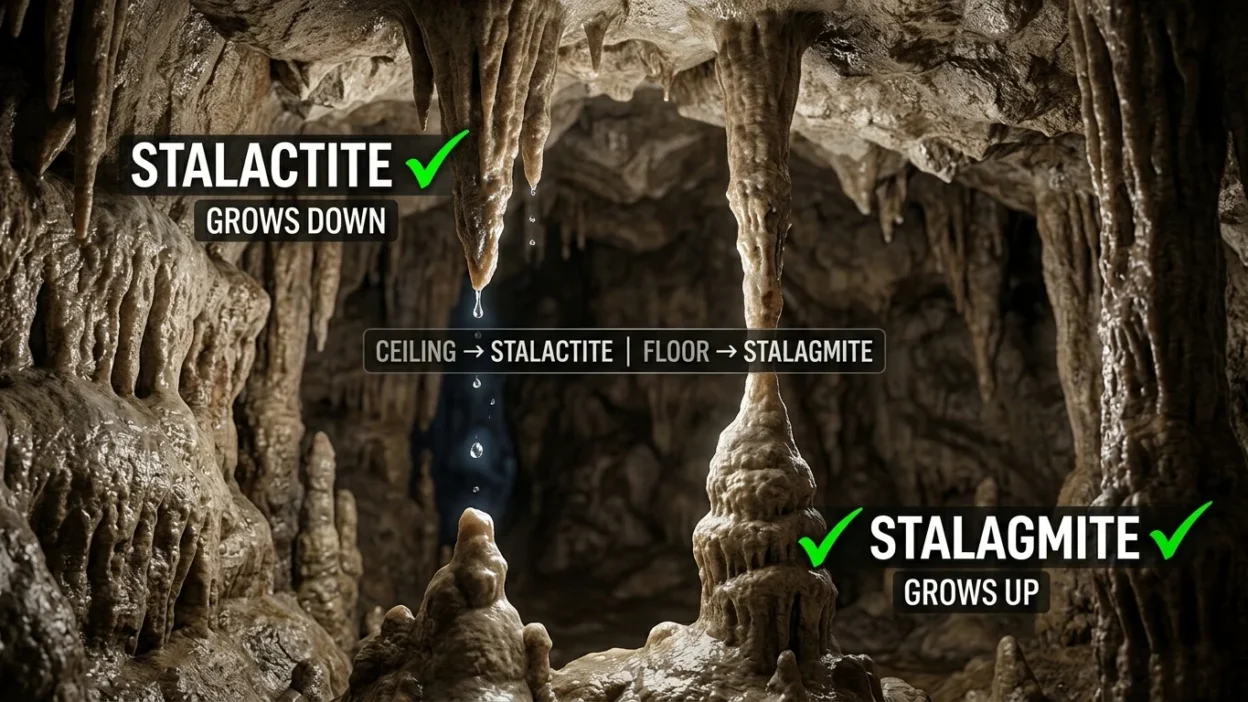
The good news is that the difference is actually very simple. Stalactites hang down from the ceiling of a cave, while stalagmites grow upward from the cave floor. Once you learn this basic distinction and a simple memory trick, you will probably never mix them up again.
Quick Answer
The easiest way to distinguish them is by where they grow:
- Stalactite → grows down from the cave ceiling
- Stalagmite → grows up from the cave floor
A useful memory trick is:
Stalactite = ceiling
Stalagmite = ground
You can also remember the phrase stalactites hold tight to the ceiling, while stalagmites might reach the ceiling as they grow upward.
Both formations are created when mineral-rich water deposits minerals, especially calcium carbonate, over long periods.
What Is a Stalactite?
A stalactite is a mineral formation that develops on the ceiling of a cave and extends downward.
It often has a pointed, cone-like, icicle-shaped, or irregular appearance. Stalactites form when water containing dissolved minerals enters a cave through cracks and pores in the rock above.
As water reaches the cave ceiling, small amounts of mineral material can be left behind. Over thousands or even millions of years, these deposits can accumulate and create a visible formation.
Stalactites are especially common in limestone caves, where the deposited mineral is often calcite, a crystalline form of calcium carbonate.
Examples include:
- A long, thin stalactite hanging from a cave ceiling
- A cone-shaped mineral formation extending downward
- A cluster of formations growing from the roof of a limestone cave
The key feature is always the same: a stalactite grows downward from above.
What Is a Stalagmite?
A stalagmite is a mineral formation that grows upward from the floor of a cave.
When mineral-rich water drips from the ceiling, it may land on the cave floor. As the water evaporates or releases carbon dioxide, minerals can remain behind.
Over a very long period, these deposits build up and create a formation that grows upward.
Stalagmites can be short and rounded, tall and narrow, broad and mound-shaped, or irregular depending on the conditions inside the cave.
Examples include:
- A cone-shaped formation rising from a cave floor
- A broad mineral mound beneath a dripping ceiling
- A tall formation growing toward the cave roof
The key point is simple:
A stalagmite grows upward from the ground.
Stalactite vs Stalagmite: Main Difference
The main difference is their direction of growth and location.
| Feature | Stalactite | Stalagmite |
|---|---|---|
| Location | Cave ceiling | Cave floor |
| Direction | Grows downward | Grows upward |
| Water source | Water reaches the ceiling | Water drips onto the floor |
| Typical shape | Icicle-like or pointed | Cone-like or mound-shaped |
| Memory clue | Hangs from above | Might rise toward the ceiling |
| Common mineral | Calcite | Calcite |
| Formation | Mineral deposits accumulate on the roof | Mineral deposits accumulate on the ground |
The simplest way to remember the difference is:
Stalactites come down. Stalagmites go up.
How Do Stalactites and Stalagmites Form?
Both formations develop through a slow geological process involving water, rock, minerals, and time.
In many limestone caves, rainwater absorbs carbon dioxide as it moves through soil and rock. This slightly acidic water can dissolve small amounts of limestone.
The mineral-rich water then travels through cracks in the rock and eventually enters an underground cave.
When water reaches the cave ceiling, conditions change. Carbon dioxide can escape from the water, causing some dissolved calcium carbonate to be deposited.
A tiny mineral deposit may remain on the ceiling.
Over time, repeated dripping and mineral deposition can make that deposit grow downward into a stalactite.
When droplets fall onto the cave floor, they can leave behind additional mineral deposits. These deposits gradually accumulate upward, producing a stalagmite.
This process is extremely slow. Some cave formations grow only a fraction of an inch over many years, although growth rates vary considerably depending on environmental conditions.
What Is the Difference Between Stalactites and Stalagmites?
Although both formations are created through similar processes, their positions are opposite.
A stalactite begins on the cave roof and grows downward.
A stalagmite begins on the cave floor and grows upward.
Think of a dripping cave ceiling:
Ceiling → stalactite → dripping water → stalagmite → floor
If a stalactite and stalagmite continue growing toward one another, they may eventually meet and form a single column-like structure connecting the cave ceiling and floor.
Can a Stalactite and Stalagmite Meet?
Yes.
If the conditions remain suitable for mineral deposition over a very long period, a stalactite growing downward and a stalagmite growing upward can eventually connect.
When they join, they can form a column or pillar.
However, this does not happen quickly. Cave formations generally develop very slowly, and the rate of growth depends on factors such as water availability, mineral concentration, temperature, humidity, and cave conditions.
Not every stalactite and stalagmite will eventually meet.
Common Examples
Here are some easy examples to make the difference clear:
- The stalactite hung from the cave ceiling.
- We walked carefully around the large stalagmite on the cave floor.
- Water dripping from the roof helped form the stalactite.
- The mineral deposit on the ground developed into a stalagmite.
- The cave contained hundreds of stalactites and stalagmites.
- Some formations had grown together to create massive columns.
Notice how the words describe opposite directions.
Common Mistakes
Mistake 1: Mixing up the directions
This is the most common mistake.
People sometimes remember that both formations are cave structures but forget which one grows upward and which one grows downward.
Remember:
Stalactite = ceiling
Stalagmite = floor
Mistake 2: Thinking the longer word means the taller formation
The number of letters does not tell you which direction the formation grows.
The names are derived from Greek roots related to dripping or dropping, but you do not need to know the etymology to remember the difference.
Mistake 3: Assuming all cave formations are stalactites
Caves contain many different geological formations.
Besides stalactites and stalagmites, caves may contain flowstone, columns, curtains, soda straws, helictites, and other formations.
So it is not correct to call every mineral formation in a cave a stalactite.
Mistake 4: Assuming they form instantly
Cave formations develop gradually.
The exact growth rate varies greatly. Some may develop relatively faster under favorable conditions, while others grow extremely slowly.
Mistake 5: Believing stalactites are made of ice
Their appearance can resemble icicles, but stalactites in limestone caves are usually mineral deposits, commonly involving calcite.
They are geological formations, not frozen water.
Stalactite vs Stalagmite Memory Trick
One of the most popular memory tricks is:
Stalactites hold tight to the ceiling.
The C in stalactite can remind you of the ceiling.
For stalagmites, think:
Stalagmites might grow up.
The G sound in stalagmite can help you think of ground.
Another simple trick is:
T = top
M = middle/floor
A stalacTite is at the top, while a stalagMite is at the bottom.
The first memory trick is generally the easiest:
Stalactites hang tight. Stalagmites might rise.
Stalactite vs Stalagmite vs Column
A column is different from either a stalactite or stalagmite.
A column forms when a stalactite and stalagmite grow together and connect.
The basic sequence can be visualized as:
- Stalactite → ceiling to floor
- Stalagmite → floor to ceiling
- Column → ceiling and floor connected
This distinction is useful when learning about cave geology and speleology.
Why Are Stalactites and Stalagmites Important?
These cave formations are more than beautiful natural decorations.
They can provide valuable information about the history of underground environments and past climate conditions. Scientists can sometimes study mineral layers within cave formations to investigate changes in rainfall, temperature, vegetation, and other environmental conditions over long periods.
Because they can take extremely long periods to develop, cave formations are also important natural heritage features.
This is why visitors are often asked not to touch or damage them. Even a small formation that looks insignificant may have taken many years to develop.
American vs British English
There is essentially no spelling difference between American and British English for stalactite and stalagmite.
Both varieties use:
- stalactite
- stalagmite
- stalactites
- stalagmites
The pronunciation can vary slightly between speakers, but the spelling and basic meaning remain the same.
So unlike words such as traveling/travelling or color/colour, there is no major American-versus-British spelling issue here.
FAQs
What is the difference between a stalactite and a stalagmite?
A stalactite grows downward from the ceiling of a cave, while a stalagmite grows upward from the floor.
Which one hangs from the ceiling?
A stalactite hangs from the cave ceiling. A simple memory aid is that stalactites hang tight from above.
Which one grows from the ground?
A stalagmite grows upward from the cave floor or ground.
Can stalactites and stalagmites touch?
Yes. If they continue growing toward each other and eventually connect, they can form a column-like structure.
Are stalactites made of rock?
They are mineral formations. In many limestone caves, they are primarily composed of calcite, although cave formations can contain different minerals depending on the geological environment.
Which grows faster, a stalactite or a stalagmite?
Neither is automatically faster. Their growth rates depend on local conditions, including water supply, mineral concentration, temperature, and cave chemistry.
Are stalactites and stalagmites found only in limestone caves?
They are especially common in limestone caves, but cave mineral formations can occur in other geological settings as well.
How can I easily remember stalactite vs stalagmite?
Remember: stalactites hang from the ceiling, while stalagmites rise from the ground. You can also use stalactites hold tight to the ceiling; stalagmites might grow up.
Summary
The difference between stalactite vs stalagmite is much easier than their similar names suggest. A stalactite forms on the ceiling of a cave and grows downward, while a stalagmite forms on the floor and grows upward. Both are created when mineral-rich water deposits minerals over long periods, especially in limestone caves.
These formations can take a very long time to develop and can provide scientists with useful information about geological and environmental history. If a stalactite and stalagmite eventually connect, they may form a column. Their spellings and meanings are the same in both American and British English.
Actionable Takeaway
The easiest rule to remember is stalactite = ceiling and stalagmite = ground. If you can remember where each formation starts, you will never need to guess again.
For an even stronger memory aid, think stalactites hold tight to the ceiling, while stalagmites might grow upward. This simple trick makes the difference easy to recall whenever you encounter these fascinating cave formations.

Liam James is a language enthusiast and content writer at Verseslay, specializing in word comparisons, grammar debates, and vocabulary insights. He helps readers understand language nuances through clear, engaging, and practical explanations.