
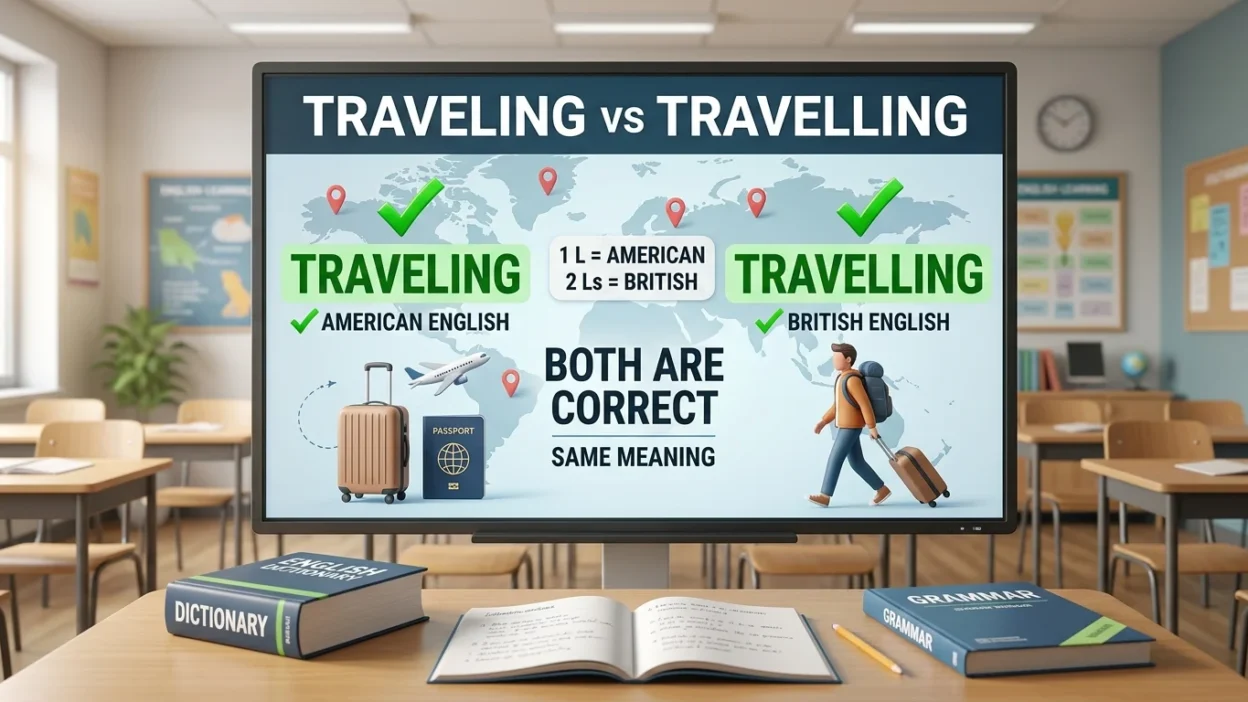
If you have ever typed traveling and wondered whether it should actually be travelling, you are not alone. This is one of the most common spelling differences between American and British English. Both forms look almost identical, but the extra l can make English learners wonder which version is correct.
The simple answer is reassuring: traveling and travelling are both correct spellings. The difference is mainly based on the variety of English you are using. American English generally uses traveling, while British English and several other varieties commonly use travelling. Once you know this rule, choosing the right spelling becomes much easier.
Quick Answer
Traveling and travelling have exactly the same meaning. The difference is spelling.
- Traveling = standard American English
- Travelling = standard British English
- Both mean going from one place to another, usually for work, leisure, or another purpose.
- The same spelling pattern applies to related forms such as traveled/travelled and traveler/traveller.
Examples:
- I am traveling to Lahore next week. — American English
- I am travelling to Lahore next week. — British English
Neither spelling is wrong. Your choice should depend on the English variety and the audience you are writing for.
What Does Traveling Mean?
Traveling is the present participle or gerund form of the verb travel in American English.
It means going from one location to another.
For example:
- She is traveling around Europe.
- I enjoy traveling with my family.
- He is traveling for work this month.
- We are traveling by train.
The word can describe short journeys, long trips, international travel, business travel, vacations, or general movement between places.
What Does Travelling Mean?
Travelling has exactly the same meaning as traveling. The only difference is the spelling.
It is the standard form commonly used in British English.
Examples:
- She is travelling around Europe.
- I enjoy travelling with my family.
- He is travelling for work this month.
- We are travelling by train.
So, if you see travelling in a British newspaper, website, book, or email, it is not a different word. It is simply the British spelling of traveling.
Traveling vs Travelling: Main Difference
The main difference between traveling vs travelling is regional spelling.
| Word | English Variety | Example |
|---|---|---|
| Traveling | American English | I am traveling tomorrow. |
| Travelling | British English | I am travelling tomorrow. |
| Traveled | American English | We traveled last summer. |
| Travelled | British English | We travelled last summer. |
| Traveler | American English | He is an experienced traveler. |
| Traveller | British English | He is an experienced traveller. |
The meaning does not change. The spelling changes according to the English variety.
Why Does Traveling Have One L in American English?
The difference comes from spelling conventions.
In American English, some words ending in a stressed final syllable generally do not double the final consonant when adding a suffix if the base word contains a vowel-consonant pattern that differs from the British convention.
With travel, American English commonly uses:
- traveling
- traveled
- traveler
British English traditionally uses:
- travelling
- travelled
- traveller
This is why you may notice an extra l in British English.
It is not a random spelling difference. It follows a broader pattern in which British English often retains or uses doubled consonants in certain words.
Traveling vs Travelling in American English
If you are writing for an American audience, use traveling.
Examples:
- I love traveling.
- She is traveling abroad.
- We traveled to New York last year.
- He is a frequent traveler.
This spelling is standard in American English and is commonly found in American books, newspapers, websites, educational materials, and professional communication.
If your website targets readers in the United States, maintaining the American spelling throughout your content can also make your writing feel more consistent.
Traveling vs Travelling in British English
If you are writing in British English, use travelling.
Examples:
- I love travelling.
- She is travelling abroad.
- We travelled to London last year.
- He is a frequent traveller.
This spelling is standard in British English and is also commonly used in countries and regions influenced by British spelling conventions.
The important thing is consistency. If you choose British English, it is generally better to maintain British spelling throughout the same piece of writing.
American vs British English
This is where the difference becomes especially important.
American English
American English commonly uses:
- traveling
- traveled
- traveler
- traveling experience
British English
British English commonly uses:
- travelling
- travelled
- traveller
- travelling experience
Other English varieties may follow British spelling conventions, although usage can vary by country and individual publication.
The important point is that traveling is not an incorrect version of travelling, and travelling is not an incorrect version of traveling.
They are regional spelling variants.
Examples of Traveling
Here are some natural examples using the American spelling:
- I am traveling to Canada next month.
- She enjoys traveling alone.
- They are traveling by plane.
- He has been traveling for several months.
- We spent the summer traveling across the country.
- Traveling can teach you a lot about different cultures.
- My brother is traveling for business.
- She is traveling with her friends.
These sentences are suitable for American English.
Examples of Travelling
Here are the same types of sentences using British spelling:
- I am travelling to Canada next month.
- She enjoys travelling alone.
- They are travelling by plane.
- He has been travelling for several months.
- We spent the summer travelling across the country.
- Travelling can teach you a lot about different cultures.
- My brother is travelling for business.
- She is travelling with her friends.
The meaning remains exactly the same.
Traveling vs Travelling in SEO and Online Writing
If you are writing online, spelling consistency matters.
Suppose your website is designed primarily for an American audience. In that case, using traveling consistently may be the better choice.
If your audience is mainly British, travelling may be more appropriate.
Search engines can understand both spelling variants, and neither spelling is inherently better for SEO. However, matching your content to the language conventions of your target audience can improve readability and make your content feel more natural.
For example, an American travel website may naturally use:
Best traveling tips for beginners
A British travel website might use:
Best travelling tips for beginners
The important thing is to understand your audience rather than trying to force one spelling everywhere.
Common Mistakes
Mistake 1: Thinking travelling is always wrong
Some American English learners see the extra l and assume it is a spelling mistake.
It is not.
Travelling is the standard British spelling.
Mistake 2: Thinking traveling is always wrong
The opposite mistake is also common.
If you normally use British English, you may be taught travelling, but traveling is perfectly correct in American English.
Mistake 3: Mixing spelling styles
A common problem in longer articles is inconsistent spelling.
For example:
- traveling
- travelled
- traveller
This mixes American and British conventions.
It is better to choose one style and use it consistently.
Mistake 4: Changing the meaning
Some learners think traveling and travelling describe different types of travel.
They do not.
Both words have the same meaning.
Mistake 5: Assuming the extra L is optional
It is better to think of these as established regional spellings rather than randomly adding or removing a letter.
Use traveling for American English and travelling for British English.
Traveling vs Travelling and Related Words
The same regional difference appears in several related words.
| American English | British English |
|---|---|
| traveling | travelling |
| traveled | travelled |
| traveler | traveller |
| traveling abroad | travelling abroad |
| traveled widely | travelled widely |
Learning these forms together can help you avoid inconsistent spelling.
For example, if you write traveling, it is natural to also use traveled and traveler in American English.
If you write travelling, you will generally use travelled and traveller in British English.
Is Traveling or Travelling More Common?
There is no single answer because it depends heavily on where the English is being used.
Traveling is standard in American English.
Travelling is standard in British English and other varieties that follow similar spelling conventions.
Rather than asking which one is universally more common, ask which English variety your audience uses.
That is the more useful question for students, writers, bloggers, teachers, and content creators.
A Simple Memory Trick
Here is an easy way to remember the difference:
American English = traveling
British English = travelling
Think of the British version as keeping the extra l:
travel → travelling
If you are writing for an American audience:
travel → traveling
This simple association can help you remember the spelling without memorizing complicated grammar rules.
FAQs
Is traveling or travelling correct?
Both are correct. Traveling is the standard American English spelling, while travelling is the standard British English spelling.
Is traveling American or British English?
Traveling is the standard spelling in American English. British English generally uses travelling with two Ls.
Is travelling with two Ls correct?
Yes. Travelling is the standard British English spelling and is completely correct.
Which spelling should I use in an American English article?
Use traveling. Related forms should generally follow the same American spelling pattern, such as traveled and traveler.
Which spelling should I use in British English?
Use travelling, along with travelled and traveller, to maintain British spelling conventions.
Does traveling and travelling have the same meaning?
Yes. They have exactly the same basic meaning. The difference is regional spelling, not meaning.
Is traveler or traveller correct?
Both are correct depending on the English variety. Traveler is American English, while traveller is British English.
Does Google consider traveling and travelling different keywords?
They are spelling variants of the same word. Search engines are generally capable of understanding the relationship between them. For content, it is best to use the spelling that matches your target audience while maintaining consistency.
Summary
The difference between traveling vs travelling is simple: both words are correct, but they belong to different spelling conventions. Traveling is the standard American English spelling, while travelling is the standard British English spelling. Both describe the act of going from one place to another and have exactly the same meaning.
The same pattern appears in related words such as traveled/travelled and traveler/traveller. If you are writing for an American audience, choose the version with one l. If you are following British English, choose the version with two ls. Most importantly, stay consistent throughout your writing