If you’ve ever wondered whether the correct plural of passerby is passersby or passerbyers, you’re not alone.
English has many irregular plural forms, and words like passerby often confuse even native speakers.
Since all three terms—passersby, passerbyers, and passerby—look similar, it’s easy to choose the wrong one.
The good news is that the rule is simpler than it seems. In this guide, you’ll learn the difference between passersby vs passerbyers vs passerby, discover which form is grammatically correct, see real-life examples, avoid common mistakes, and understand how these words are used in both American and British English.
Quick Answer
Here’s the simple answer:
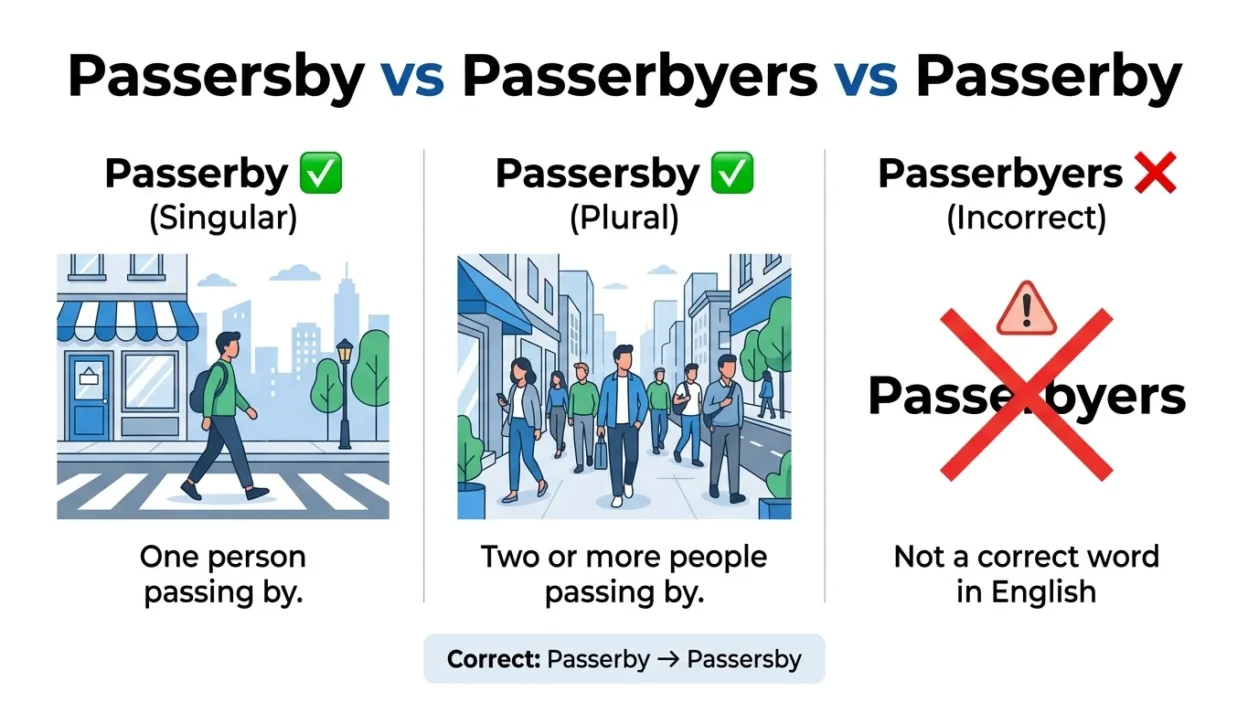
- Passerby = Singular (one person passing by) ✅
- Passersby = Correct plural (more than one person passing by) ✅
- Passerbyers = Incorrect and not a standard English word ❌
If you’re referring to one person walking past, use passerby. If you’re referring to several people walking past, use passersby. Never use passerbyers in standard English.
What Does “Passerby” Mean?
A passerby is a person who happens to be walking or passing near a place, often by chance.
The word is commonly used when describing someone who witnesses an event, notices something unusual, or simply walks past a location.
Simple Definition
Passerby means:
Examples
- A passerby called the police after seeing the accident.
- The lost child asked a passerby for directions.
- One passerby stopped to help the elderly man.
- A friendly passerby returned the missing wallet.
- The street musician smiled at every passerby.
In each example, only one person is being described.
What Does “Passersby” Mean?
Passersby is the correct plural form of passerby.
It refers to two or more people who are passing a place.
Examples
- Several passersby stopped to watch the performance.
- Curious passersby gathered around the artist.
- The firefighters thanked the passersby who offered assistance.
- Many passersby took photos of the parade.
- The loud noise attracted dozens of passersby.
Notice that passersby refers to multiple people.
Is “Passerbyers” a Real Word?
No.
Passerbyers is not considered a correct English word.
It sometimes appears online because people assume they can make the word plural by adding -ers. However, English does not form the plural this way.
Instead, the noun passer becomes plural:
- passer → passers
while by remains unchanged.
Correct:
- passersby ✅
Incorrect:
- passerbyers ❌
- passerbys ❌
Passersby vs Passerbyers vs Passerby: Key Difference
Although these words look similar, only two are grammatically correct.
| Word | Correct? | Meaning |
|---|---|---|
| Passerby | ✅ Yes | One person passing by |
| Passersby | ✅ Yes | More than one person passing by |
| Passerbyers | ❌ No | Incorrect plural form |
The only accepted plural in standard English is passersby.
Why Is the Plural “Passersby”?
Many English compound nouns have unusual plural forms.
Instead of making the last word plural, English often pluralizes the main noun.
Examples include:
| Singular | Plural |
|---|---|
| Passerby | Passersby |
| Mother-in-law | Mothers-in-law |
| Attorney general | Attorneys general |
| Brother-in-law | Brothers-in-law |
| Court-martial | Courts-martial |
Since passer is the main noun, it becomes plural.
The word by stays exactly the same.
Examples of “Passerby”
Use passerby when talking about one person.
Examples
- A passerby heard someone calling for help.
- The police interviewed one passerby.
- Every passerby admired the beautiful mural.
- A passerby picked up the dropped keys.
- The dog barked at every passerby.
Examples of “Passersby”
Use passersby when referring to several people.
Examples
- Hundreds of passersby watched the fireworks.
- Several passersby reported the incident.
- Friendly passersby helped push the broken car.
- The street performer entertained many passersby.
- Curious passersby stopped to ask questions.
Common Situations Where These Words Appear
You’ll often see these words in:
- News reports
- Police statements
- Traffic incidents
- Travel writing
- City guides
- Literature
- Newspaper articles
- Public safety announcements
Example:
Common Mistakes to Avoid
English learners frequently make these errors.
1. Saying “Passerbyers”
Incorrect:
- Several passerbyers helped.
Correct:
- Several passersby helped.
2. Writing “Passerbys”
Incorrect:
- Many passerbys watched.
Correct:
- Many passersby watched.
3. Treating “By” as the Main Word
Remember:
The noun is passer.
The word by is simply part of the compound expression.
Therefore, only passer changes in the plural.
4. Forgetting the Singular Form
Incorrect:
- One passersby stopped.
Correct:
- One passerby stopped.
American vs British English
One helpful fact is that there is no spelling difference between American and British English.
Both varieties use:
- passerby
- passersby
Neither standard American nor British English accepts passerbyers.
The pronunciation is also essentially the same.
Similar Compound Nouns
Learning similar words makes the grammar rule easier to remember.
Examples include:
- passerby → passersby
- mother-in-law → mothers-in-law
- father-in-law → fathers-in-law
- attorney general → attorneys general
- commander-in-chief → commanders-in-chief
- editor-in-chief → editors-in-chief
These compound nouns all pluralize the main noun rather than the final word.
Related Words and Synonyms
Depending on the context, you can also use:
- pedestrian
- bystander
- witness
- observer
- spectator
- onlooker
- walker
- traveler
- stranger
- member of the public
These alternatives improve variety while keeping your writing natural and engaging.
Tips to Remember the Correct Plural
A simple trick makes this easy.
Think about who is doing the action.
The passer is the person.
The word by only describes the action of passing.
So:
- one passer → one passerby
- many passers → many passersby
Never add -ers to the end of the whole word.
FAQs
Is “passersby” the correct plural of passerby?
Yes. Passersby is the only accepted plural form in standard English.
Is “passerbyers” a real word?
No. It is not recognized by dictionaries or grammar guides.
Can I say “passerbys”?
No. The correct plural is passersby, not passerbys.
Why isn’t the plural “passerbyers”?
Because English pluralizes the main noun passer, not the word by.
Is “passerby” singular or plural?
Passerby is singular.
Do American and British English use different forms?
No. Both use passerby and passersby with the same spelling and meaning.
Where is the word “passersby” commonly used?
It frequently appears in newspapers, police reports, news articles, books, travel writing, and everyday conversations.
Summary
Understanding passersby vs passerbyers vs passerby becomes easy once you know how English compound nouns form their plurals. Passerby refers to one person passing a location, while passersby is the correct plural form for two or more people. The form passerbyers is not accepted in standard English and should be avoided in all types of writing.
This rule is the same in both American and British English, making it easy to apply regardless of the variety of English you use. By remembering that passer is the main noun and by stays unchanged, you’ll confidently use the correct form in conversations, articles, academic work, and professional writing.
Actionable Takeaway
The next time you’re unsure which word to use, remember this simple rule: one person is a passerby, many people are passersby. Never write passerbyers or passerbys in standard English. Keeping this grammar rule in mind will help your writing sound more natural, accurate, and polished.