Have you ever come across the words bright and brite and wondered whether they mean the same thing?
At first glance, they sound identical, which makes it easy to assume they’re simply different spellings of the same word. However, that’s not quite the case.
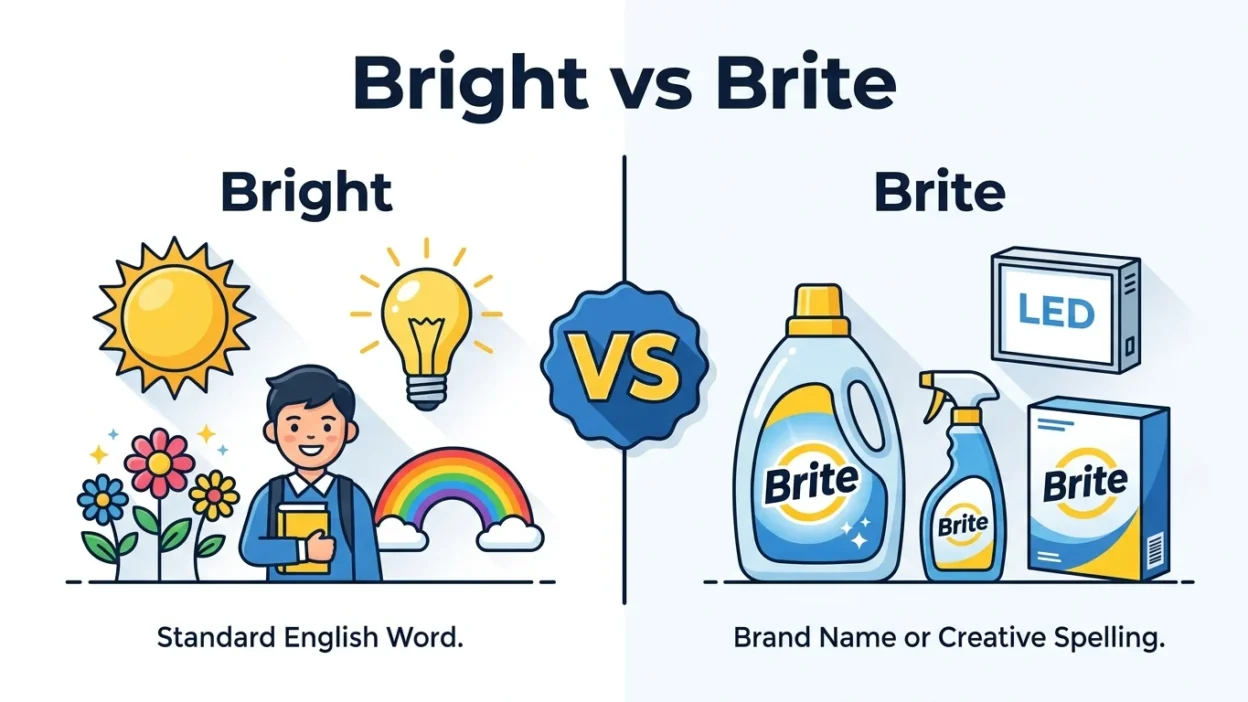
While bright is a standard English word, brite is usually a brand name, a creative spelling, or a proper noun.
Understanding the difference between bright vs brite is important, especially if you’re writing emails, school assignments, blog posts, or professional content.
In this guide, you’ll learn the meaning of each term, when to use them, common mistakes to avoid, real-life examples, and whether American and British English treat these spellings differently.
Quick Answer
Bright is the correct standard English spelling.
Brite is not a standard dictionary spelling. It is mainly used as:
- A brand name
- A product name
- A company name
- A creative or marketing spelling
If you’re writing in standard English, always use bright unless you’re referring to a specific brand or official product called Brite.
What Does “Bright” Mean?
Bright is an adjective that describes something that gives off a lot of light, is intelligent, cheerful, vivid, or promising.
Depending on the context, it can describe:
- Light
- Colors
- Intelligence
- Personality
- Future success
- Ideas
Common Meanings of Bright
1. Full of Light
- The sun is very bright today.
- She turned on the bright lamp.
2. Intelligent
- He’s one of the brightest students in the class.
- Sarah is a bright young engineer.
3. Cheerful
- She has a bright smile.
- His bright personality makes everyone feel welcome.
4. Hopeful
- The company has a bright future.
- There are many bright opportunities ahead.
What Does “Brite” Mean?
Unlike bright, brite is generally not recognized as a standard English word.
Instead, it commonly appears as:
- A trademark
- A company name
- A product brand
- A stylized spelling for marketing purposes
Examples include:
- Brite toothpaste
- Brite cleaning products
- Brite LED lights
- Brite software
- Brite hair color
Businesses often choose brite because it is shorter, distinctive, and easier to trademark than the common word bright.
Bright vs Brite: Key Difference
Although they sound exactly the same, their usage is very different.
| Feature | Bright | Brite |
|---|---|---|
| Standard English word | Yes | No |
| Dictionary spelling | Yes | Usually no |
| Common meaning | Light, intelligent, cheerful | Usually a brand name |
| Formal writing | Preferred | Only for official names |
| Academic writing | Yes | No |
| Marketing use | Sometimes | Very common |
The pronunciation remains the same.
The difference lies entirely in spelling and purpose.
Which Spelling Is Correct?
For normal English writing, bright is always the correct choice.
Use bright when referring to:
- Sunlight
- Colors
- Intelligence
- Happiness
- Hope
- Ideas
- Future success
Use brite only when you’re writing the official name of a business, company, product, or brand.
Correct Examples
- The room is bright.
- She has a bright future.
- The child is very bright.
- We painted the walls a bright yellow.
Brand Examples
- I bought Brite laundry detergent.
- The company launched Brite LED bulbs.
In these examples, Brite is part of a proper name.
Why Do Companies Use “Brite”?
Many businesses intentionally replace bright with brite.
There are several reasons for this.
Branding
Unique spellings help brands stand out.
Easier Trademarks
Common dictionary words are often harder to trademark.
Modern Appearance
Creative spellings can make a company seem more contemporary.
Simplicity
Removing one letter creates a shorter logo and domain name.
This practice is common in marketing and advertising.
Examples of “Bright” in Sentences
Here are natural examples of the standard spelling.
- The stars looked bright last night.
- She wore a bright blue dress.
- He has a bright future ahead of him.
- My office has bright lighting.
- The teacher praised her bright ideas.
- We need a bright flashlight.
- The flowers have bright colors.
- His bright attitude inspires others.
Examples of “Brite” in Sentences
These examples refer to official names.
- I ordered Brite cleaning spray.
- Their office installed Brite lighting systems.
- Brite Technologies released a new software update.
- We use Brite paper for printing.
- The store sells Brite paint products.
Notice that Brite functions as a proper noun rather than an adjective.
Common Mistakes to Avoid
Many English learners confuse these spellings because they sound identical.
1. Using “Brite” in Formal Writing
Incorrect:
- She has a brite future.
Correct:
- She has a bright future.
2. Assuming Both Are Dictionary Words
Only bright is standard English.
Brite is usually a brand or creative spelling.
3. Capitalization Errors
Brand names are typically capitalized.
Correct:
- Brite Paint
Incorrect:
- brite paint (unless that’s the company’s official style)
4. Using “Brite” in Academic Papers
Unless discussing a specific brand, always use bright in essays, reports, and exams.
Bright in Common Expressions
The word bright appears in many everyday expressions.
Examples include:
- bright future
- bright idea
- bright colors
- bright light
- bright student
- bright morning
- bright smile
- bright personality
- bright prospects
- bright sunshine
Learning these expressions helps improve both vocabulary and natural English usage.
Related Words and Synonyms
Depending on the context, you can also use:
For light:
- luminous
- radiant
- brilliant
- glowing
- shining
For intelligence:
- clever
- smart
- intelligent
- gifted
- sharp
For personality:
- cheerful
- optimistic
- positive
- lively
- energetic
These related words make your writing more varied while supporting SEO naturally.
American vs British English
Unlike words such as color and colour or center and centre, bright has the same spelling in both American and British English.
Both varieties use:
- bright ✅
Neither standard American English nor British English replaces it with brite.
The only exception is when referring to official company or product names.
Tips to Remember the Difference
A simple memory trick makes this easy.
Think about the extra letters.
Bright contains “gh.”
That’s the standard English spelling you’ll find in dictionaries.
Brite removes the “gh” for branding purposes.
If you’re writing a sentence rather than a product name, choose bright.
FAQs
Is “brite” a real English word?
Not as a standard dictionary word. It is mainly used as a brand name or creative spelling.
Is “bright” always the correct spelling?
Yes, for standard English writing, bright is the correct spelling.
Why do companies spell it “brite”?
Businesses often choose brite to create a distinctive, memorable, and trademark-friendly brand name.
Are “bright” and “brite” pronounced differently?
No. They are pronounced exactly the same.
Does American English use “brite”?
Only in official brand names. Standard American English uses bright.
Does British English spell “bright” as “brite”?
No. British English also uses bright as the standard spelling.
Can I use “brite” in school assignments?
No, unless you’re referring to a specific company or product named Brite.
Summary
Understanding bright vs brite is straightforward once you know the purpose of each spelling. Bright is the standard English word used to describe light, intelligence, cheerful personalities, vivid colors, and hopeful futures. It is the correct spelling in both American and British English and should be used in all formal, academic, and everyday writing.
On the other hand, brite is typically a creative spelling used in brand names, company names, and product marketing. While it shares the same pronunciation as bright, it is not considered a standard English spelling. Choosing the correct form depends on whether you’re writing ordinary English or referring to an official brand.
Actionable Takeaway
Whenever you write the word, ask yourself one simple question: Am I referring to a regular English adjective or a brand name? If it’s describing light, intelligence, color, or positivity, use bright. If it’s the official name of a product or company, use Brite exactly as the brand spells it. Following this simple rule will help you avoid one of the most common spelling mistakes in English.