
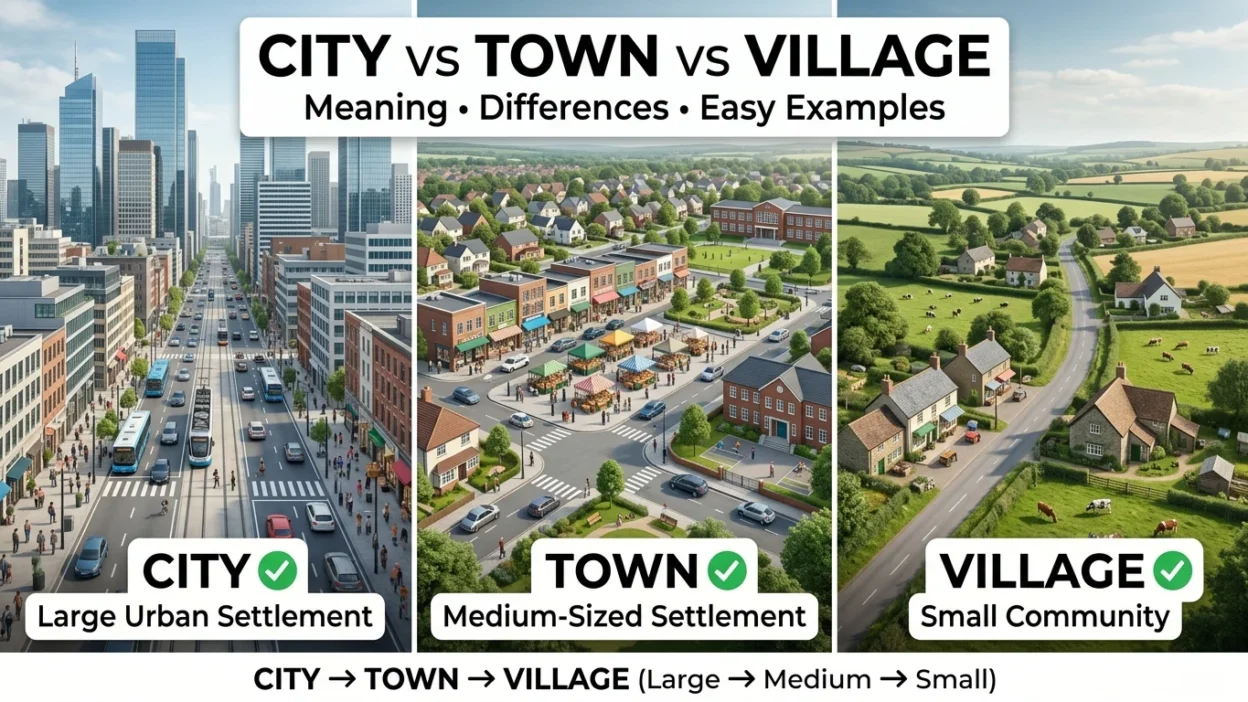
The words city vs town vs village are often used to describe places where people live, but they do not always mean exactly the same thing. If you are learning English, you may wonder whether a place should be called a city, town, or village and what separates one from another.
The answer is a little more complicated than simply counting the number of residents. Population, local government, services, history, geography, and regional laws can all affect how a settlement is classified. In everyday English, however, there are some useful differences that can make these terms much easier to understand.
Quick Answer: City vs Town vs Village
In simple terms:
- City = a larger and more developed urban settlement, usually with many services, businesses, and residents.
- Town = a settlement smaller than a city but generally larger and more developed than a village.
- Village = a smaller settlement, often with fewer residents, businesses, and public services.
A simple way to remember the general idea is:
City → largest
Town → medium-sized
Village → smaller
However, these are general descriptions rather than universal legal rules.
What Is a City?
A city is a relatively large and developed human settlement. Cities usually have a significant population, extensive infrastructure, numerous businesses, schools, hospitals, transportation networks, and other public services.
Examples of things commonly associated with cities include:
- Large shopping areas
- Hospitals and universities
- Public transportation
- Office buildings
- Major roads
- Government institutions
- Restaurants and entertainment venues
- Large residential areas
For example:
London is a major city in the United Kingdom.
New York City is one of the best-known cities in the United States.
Lahore is a major city in Pakistan.
The word city can also appear in names, such as New York City, Kansas City, or Mexico City.
What Is a Town?
A town is generally a settlement that is smaller than a city but larger or more developed than a village.
Towns can have many of the same features as cities, but usually on a smaller scale.
A town may have:
- Local shops
- Schools
- Medical facilities
- Restaurants
- Markets
- Offices
- Places of worship
- Local government services
- Residential neighborhoods
For example:
They moved to a small town in the countryside.
The town has a busy market and several schools.
We stopped in a nearby town during our journey.
A town can be quite large, and in some countries, a place called a town may have more residents than a place officially classified as a city somewhere else.
What Is a Village?
A village is generally a smaller settlement, often associated with a rural or semi-rural area.
Villages usually have fewer residents and fewer facilities than towns or cities.
A village may contain:
- Houses
- Small shops
- A local school
- A mosque, church, temple, or other place of worship
- Small businesses
- Farms or agricultural land nearby
- Local roads
Examples:
My grandparents live in a small village.
The village is surrounded by farmland.
We visited a peaceful village near the mountains.
The word village often creates an image of a smaller, quieter community, although actual villages can vary considerably in size.
City vs Town vs Village Comparison Table
| Feature | City | Town | Village |
|---|---|---|---|
| General size | Large | Medium | Small |
| Population | Usually larger | Usually moderate | Usually smaller |
| Infrastructure | Extensive | Moderate | More limited |
| Businesses | Many | Several | Usually fewer |
| Public services | Extensive | Moderate to extensive | Usually limited |
| Setting | Mostly urban | Urban or semi-urban | Often rural or semi-rural |
| Lifestyle | Often busy | Often moderate-paced | Often quieter |
| Legal definition | Varies by country | Varies by country | Varies by country |
This table gives the general meaning, but it should not be treated as a universal legal classification.
City vs Town
The main difference between a city and a town is usually scale.
A city generally has a larger population, more extensive infrastructure, and a greater concentration of businesses and services.
A town is typically smaller and may have a more local or community-focused character.
Compare:
She lives in a large city with millions of residents.
She lives in a small town with a few thousand residents.
However, population alone does not always determine whether a place is officially a city or town.
Some places receive city status because of historical, political, or legal reasons.
Town vs Village
The difference between a town and a village is usually easier to understand in everyday English.
A town generally has more residents, businesses, services, and infrastructure than a village.
For example:
The town has several supermarkets, schools, and a hospital.
The village has a small shop and one local school.
That said, there is no single worldwide population number that automatically changes a village into a town.
The classification can depend on local traditions, government rules, and historical development.
City vs Village
A city and a village represent opposite ends of the general settlement scale.
A city is typically larger, busier, and more densely developed.
A village is generally smaller and often has a stronger connection to rural surroundings.
Compare:
The city has a large public transportation system.
The village has only a few local roads.
A city may have thousands or millions of residents, while a village may have only a small community.
Again, these descriptions are general rather than strict worldwide rules.
Is a City Always Bigger Than a Town?
Not necessarily.
This is one of the most important things to understand about these words.
There is no universal international rule saying that every city must have more residents than every town.
Different countries and regions use different legal definitions.
A place can sometimes have city status because of historical or administrative reasons even if another town has a larger population.
Therefore, when speaking generally, it is reasonable to think of a city as larger than a town. But when discussing official classifications, you need to consider the specific country’s rules.
Is a Town Always Bigger Than a Village?
Generally, a town is larger or more developed than a village in everyday usage.
However, the exact boundary between the two can vary.
A village may grow significantly over time while continuing to be called a village because of historical usage.
Similarly, some settlements may be officially classified as towns even though they have a relatively small population.
This means that the words can describe both the physical settlement and its official or traditional status.
Population Does Not Tell the Whole Story
It is tempting to define these words only by population, but that can lead to mistakes.
Imagine two settlements:
- Place A has 20,000 residents and is officially called a town.
- Place B has 15,000 residents but has city status because of its legal history.
Population alone would not explain the difference.
Other factors can include:
- Legal status
- Historical importance
- Local government
- Infrastructure
- Economic activity
- Geographic location
- Administrative boundaries
This is why city, town, and village definitions differ around the world.
Urban vs Rural Meaning
The terms also have different associations with urban, suburban, and rural environments.
A city is generally associated with an urban environment.
A town can be urban, suburban, or semi-rural depending on its location.
A village is often associated with rural or semi-rural surroundings.
For example:
Urban city: A large metropolitan center with extensive buildings and transportation.
Small town: A developed settlement surrounded by countryside.
Rural village: A small community surrounded by farmland.
These are common associations rather than absolute rules.
City, Town, and Village as Adjectives
These words can also be used to describe the character of a place.
For example:
city life
town center
village community
city streets
town market
village school
Some common expressions include:
- City center
- City life
- Town hall
- Town center
- Town square
- Village life
- Village community
- Village road
Learning these common combinations can help English learners use the vocabulary naturally.
American vs British English Differences
The basic meanings of city, town, and village exist in both American and British English, but their official classifications can differ.
In British English, the term city can have a specific official status granted to a settlement. A place may be officially recognized as a city for historical or constitutional reasons.
In American English, city and town are often determined by state or local government systems. The legal meaning can therefore vary from one state to another.
The word village also has different legal meanings in different parts of the United States.
So, while English speakers generally understand the basic distinction, the official definition is not identical across the United States and the United Kingdom.
Common Mistakes
Mistake 1: Thinking Every City Has More People Than Every Town
This is not always true.
Official status and population do not necessarily match perfectly.
Mistake 2: Treating Village as Meaning Poor or Underdeveloped
A village simply describes a type or scale of settlement. It does not automatically mean that the people who live there are poor or that the area lacks development.
Mistake 3: Assuming the Definitions Are Universal
Different countries have different administrative systems.
The general meanings are useful for everyday English, but official definitions vary.
Mistake 4: Using Town and Village as Exact Synonyms
Although both can describe smaller settlements, a town is generally larger or more developed than a village in everyday usage.
How to Remember City, Town, and Village
Use this simple mental picture:
CITY → Large urban community
Think of tall buildings, major roads, shopping centers, hospitals, and busy streets.
TOWN → Medium-sized community
Think of local markets, schools, shops, offices, and residential areas.
VILLAGE → Small community
Think of houses, small local businesses, farmland, and a close-knit community.
This is not a legal definition, but it is an easy way to remember the general meanings.
FAQs
1. What is the difference between a city, town, and village?
Generally, a city is larger and more developed, a town is medium-sized, and a village is smaller. However, official definitions vary by country.
2. Is a town bigger than a village?
Usually, yes. In everyday English, towns are generally larger or more developed than villages.
3. Is a city bigger than a town?
Usually, but not always. Official classifications can depend on government rules, history, and legal status rather than population alone.
4. What is smaller than a village?
Terms such as hamlet or settlement can describe places smaller than a village, depending on the region.
5. Is village a rural word?
Often, yes. Village commonly refers to a small rural or semi-rural settlement, although not every village is completely rural.
6. Do American and British English use these words differently?
Both varieties use city, town, and village with broadly similar meanings. However, their official legal classifications can differ.
7. Can a town have more people than a city?
Yes, depending on the legal definitions used in a particular country or region.
8. What is the easiest way to remember the difference?
Think of the general scale:
City = large
Town = medium
Village = small
Final Summary
The difference between city vs town vs village is mainly about the size, development, services, and character of a settlement. A city is generally a large and highly developed urban area, a town is usually smaller and more locally focused, and a village is generally a smaller community that is often rural or semi-rural.
However, there is no single worldwide rule that determines exactly when a village becomes a town or when a town becomes a city. Governments may use population, legal status, history, administrative structure, and other factors. This is why the official meaning of these terms can vary from one country to another.

Liam James is a language enthusiast and content writer at Verseslay, specializing in word comparisons, grammar debates, and vocabulary insights. He helps readers understand language nuances through clear, engaging, and practical explanations.