
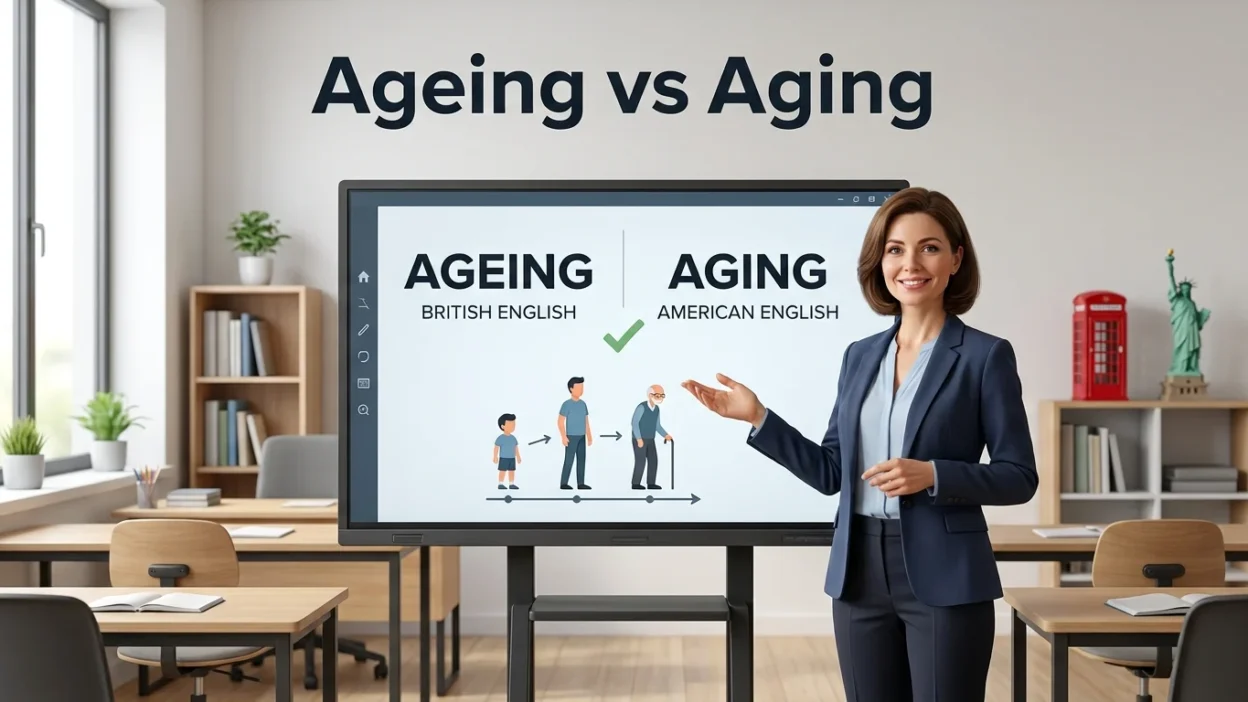
If you have ever wondered whether ageing vs aging is the correct spelling, you are dealing with a classic difference between British and American English. Both forms are correct, but the preferred spelling depends mainly on which variety of English you are using.
The good news is that the meaning does not change. Ageing and aging both describe the natural process of becoming older or the gradual development of something over time. In this guide, we will explain the difference, provide clear examples, discuss common mistakes, and show you when to use each spelling.
Quick Answer
Ageing and aging have the same meaning.
The main difference is spelling:
- Ageing → preferred in British English
- Aging → preferred in American English
Simple examples
British English:
My grandparents are ageing gracefully.
American English:
My grandparents are aging gracefully.
Both sentences are grammatically correct and mean the same thing.
What Does Ageing Mean?
Ageing is the British English spelling of the present participle and gerund form of age.
It means the process of becoming older or developing characteristics associated with the passage of time.
Examples:
- Ageing is a natural part of life.
- The ageing population needs better healthcare services.
- She is ageing gracefully.
- The ageing building needs repairs.
- Ageing can affect the body in many ways.
The spelling ageing follows the traditional British pattern of keeping the e before adding -ing.
What Does Aging Mean?
Aging is the American English spelling of the same word.
It has exactly the same basic meaning as ageing.
Examples:
- Aging is a natural process.
- The aging population is increasing.
- She is aging gracefully.
- The aging building requires maintenance.
- Scientists are studying the aging process.
There is no difference in pronunciation or basic meaning between ageing and aging.
Ageing vs Aging: Main Difference
The easiest way to understand the difference is to remember that this is primarily a British vs American spelling difference.
| Feature | Ageing | Aging |
|---|---|---|
| Meaning | Becoming older | Becoming older |
| British English | Preferred | Less common |
| American English | Less common | Preferred |
| Pronunciation | Same | Same |
| Grammar | Same | Same |
| Meaning difference | None | None |
| Example | Ageing population | Aging population |
So, if you are writing for a British audience, ageing is generally the better choice.
If you are writing for an American audience, aging is generally preferred.
Why Does British English Use Ageing?
British English traditionally keeps the final e in age when forming ageing.
This spelling pattern can be seen in other words as well, although English spelling rules are not always completely consistent.
For example:
- age → ageing
- agree → agreeing
- see → seeing
However, American English commonly simplifies ageing to aging.
This is part of the broader history of spelling differences between British and American English.
Why Does American English Use Aging?
American English generally prefers aging without the e.
This spelling is especially common in:
- American newspapers
- American websites
- Medical writing
- Academic publications
- Business documents
- Government publications
- General American English
For example:
The study examines the effects of aging on memory.
This is the standard spelling for most American English contexts.
Ageing vs Aging in Medical Writing
Both spellings are used in medical and scientific contexts, depending on the publication’s preferred variety of English.
For example, a British publication may write:
The researchers studied the effects of ageing on the human body.
An American publication may write:
The researchers studied the effects of aging on the human body.
The scientific meaning remains exactly the same.
If you are writing for a particular journal, always follow its style guide. Consistency is more important than trying to mix spelling systems.
Ageing vs Aging Population
One of the most common phrases involving this spelling difference is ageing population or aging population.
British English:
The country has an ageing population.
American English:
The country has an aging population.
Both mean that the proportion of older people in the population is increasing.
Other related expressions include:
- Ageing population
- Aging population
- Ageing society
- Aging society
- Older population
- Elderly population
- Population ageing
- Population aging
The choice depends on your target audience and preferred English variety.
Ageing vs Aging Gracefully
Another common phrase is ageing gracefully or aging gracefully.
British English:
She believes in ageing gracefully.
American English:
She believes in aging gracefully.
The expression generally means growing older in a healthy, confident, or positive way.
It can be used when discussing appearance, lifestyle, health, personal development, or simply one’s attitude toward getting older.
Ageing vs Aging Process
Both forms can be used with process.
British English:
The ageing process affects everyone differently.
American English:
The aging process affects everyone differently.
The phrase refers to the biological, physical, psychological, or social changes associated with growing older.
You may also encounter related phrases such as:
- Natural ageing process
- Natural aging process
- Healthy ageing
- Healthy aging
- Signs of ageing
- Signs of aging
- Effects of ageing
- Effects of aging
Common Mistakes With Ageing and Aging
Mistake 1: Thinking One Spelling Is Wrong
A common misconception is that either ageing or aging is incorrect.
Both are correct.
The difference is mainly regional spelling preference.
Mistake 2: Mixing British and American Spelling
If you are writing an article in British English, using ageing in one paragraph and aging in another can make your writing look inconsistent.
Choose one spelling system and use it throughout your content.
Mistake 3: Assuming the Meaning Is Different
There is no meaningful difference in definition.
Ageing = aging
The spelling changes, but the meaning remains the same.
Mistake 4: Using Aging for a British Audience Without Considering Style
Aging can certainly be understood in Britain, especially because American English is widespread online. However, ageing is traditionally preferred in standard British English.
If you are writing specifically for a British publication, ageing is generally the safer choice.
Mistake 5: Forgetting Related Words
The same regional preference can appear in related expressions.
For example:
British English:
- Ageing
- Ageing population
- Ageing process
American English:
- Aging
- Aging population
- Aging process
Keeping the spelling consistent improves the overall quality of your writing.
Is Ageing or Aging More Common?
The answer depends on the audience and location.
Aging is especially common in American English and is widely used internationally because of the global influence of American media and online content.
Ageing remains standard and common in British English and other varieties that traditionally follow British spelling conventions.
If you are creating online content, consider your target audience.
For a US-focused website, use aging.
For a UK-focused website, use ageing.
Ageing vs Aging in SEO Content
If you are writing SEO content, spelling matters because users may search for either version.
For example, people may search for:
- ageing vs aging
- ageing meaning
- aging meaning
- ageing population
- aging population
- ageing process
- aging process
- ageing gracefully
- aging gracefully
If your article targets a specific keyword, use that spelling naturally.
You can also mention the alternative spelling where relevant. This helps readers understand the difference without making the content repetitive or unnatural.
Ageing vs Aging: Which Should You Use?
Use ageing when:
- Writing primarily in British English
- Targeting UK readers
- Following a British style guide
- Writing for a British publication
- Maintaining British spelling throughout an article
Use aging when:
- Writing primarily in American English
- Targeting US readers
- Following an American style guide
- Writing for an American publication
- Maintaining American spelling throughout your content
If you are writing for an international audience, either form can work, but consistency is essential.
Ageing vs Growing Older
Although ageing and growing older are closely related, they are not always interchangeable stylistically.
Ageing is more concise and can sound formal or scientific.
Growing older is often more conversational.
For example:
The ageing process is natural.
Growing older is a normal part of life.
Both communicate a similar general idea, but the wording and tone are different.
Other related terms include:
- Getting older
- Growing older
- Maturing
- Advancing in age
- Becoming older
- Senescence
The appropriate term depends on the context.
Ageing vs Aging Pronunciation
There is essentially no pronunciation difference between ageing and aging.
Both are generally pronounced with the same sound.
The difference is visible in writing rather than something you normally hear in speech.
This is why someone speaking American English and someone speaking British English can use different spellings while pronouncing the word in essentially the same way.
American vs British English Differences
This is one of the clearest examples of an American-British spelling difference.
British English
Ageing
Example:
The ageing population presents new challenges.
American English
Aging
Example:
The aging population presents new challenges.
Both are standard within their respective varieties.
The same general distinction appears throughout many forms of English spelling, so understanding regional spelling conventions can help you write more naturally for your intended audience.
FAQs
1. Is ageing or aging correct?
Both are correct. Ageing is generally preferred in British English, while aging is preferred in American English.
2. What is the difference between ageing and aging?
There is no significant difference in meaning. They are different spellings of the same word.
3. Is ageing British English?
Yes. Ageing is the traditional and preferred spelling in British English.
4. Is aging American English?
Yes. Aging is the standard spelling in American English.
5. Can I use ageing in American English?
It can be understood, but aging is the standard American spelling and is generally the better choice for US-focused writing.
6. Can I use aging in British English?
Yes, British readers will understand it, but ageing is traditionally preferred in British English.
7. Is there a pronunciation difference between ageing and aging?
No significant pronunciation difference exists. The main difference is spelling.
8. Which spelling should I use in an SEO article?
Use the spelling that matches your target audience and keyword. If your audience is primarily American, use aging. If it is primarily British, use ageing.
Summary
The difference between ageing vs aging is simple: both words have the same meaning, but they belong to different spelling conventions. Ageing is the traditional British English spelling, while aging is the standard American English spelling. Both describe the process of becoming older or developing over time.
There is no meaningful difference in pronunciation or definition. Whether you write ageing population, aging population, ageing process, or aging process, the choice should depend on your target audience and the English variety you are following. The most important thing is to remain consistent throughout your writing.