
Have you ever read a passage made up of short, punchy sentences that instantly grabbed your attention? That writing style is often described as staccato. Although the term originally comes from music, it has become an important concept in literature and everyday writing. Understanding the staccato sentence meaning can help you recognize powerful writing techniques and use them to make your own work more engaging.
If you’re a student, writer, blogger, or English learner, knowing when and how to use staccato sentences can improve clarity, create emphasis, and add emotional impact. In this guide, you’ll learn the meaning of staccato sentences, explore real-world examples, compare them with longer sentence styles, avoid common mistakes, and discover practical tips for using them effectively.
Quick Answer
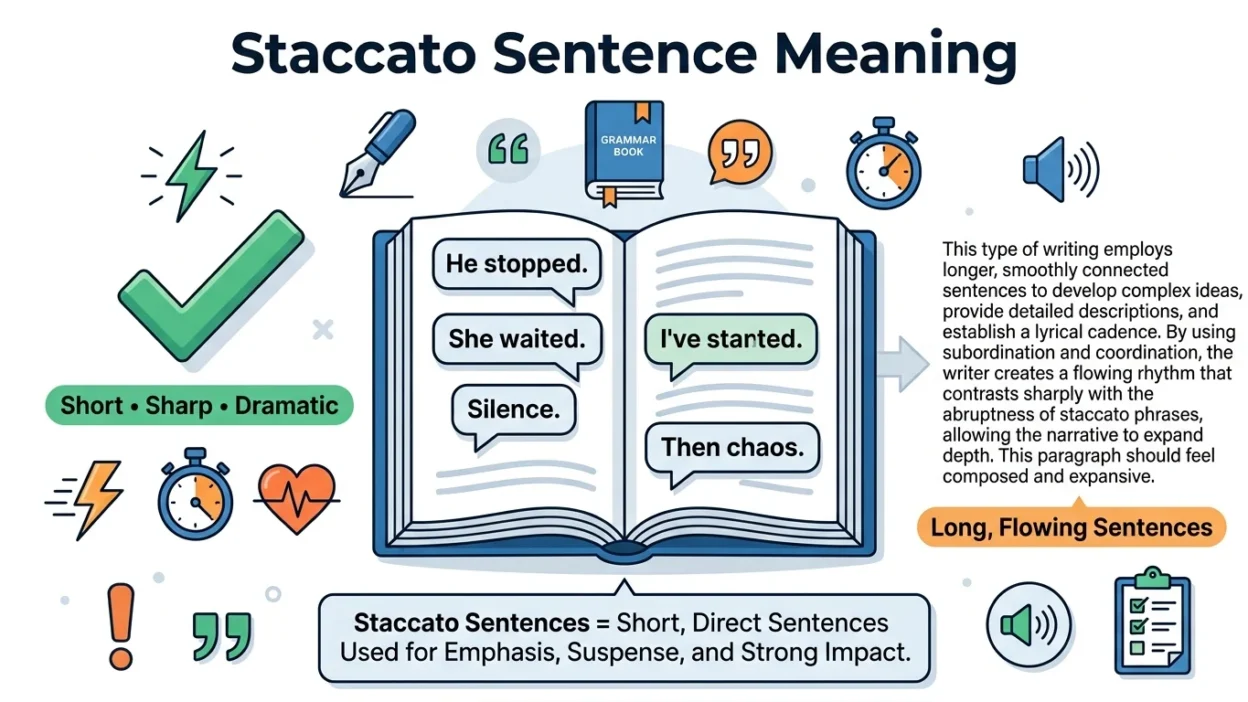
A staccato sentence is a short, brief, and often abrupt sentence used to create emphasis, tension, urgency, or dramatic effect.
The term staccato comes from music, where it means notes are played in a short, detached manner. In writing, it describes a series of concise sentences that create a similar rhythm.
Example
These short sentences build suspense and keep the reader engaged.
What Is a Staccato Sentence?
A staccato sentence is a sentence that is intentionally short and direct. Writers use it to create a quick rhythm, highlight important ideas, or increase emotional intensity.
Unlike long, flowing sentences, staccato sentences move the reader rapidly from one thought to the next.
Simple Definition
A staccato sentence is:
It is commonly found in:
- Fiction
- Journalism
- Speeches
- Advertising
- Creative writing
- Crime novels
- Action scenes
Where Does the Word “Staccato” Come From?
The word staccato comes from Italian and originally refers to a musical style in which notes are played separately rather than smoothly connected.
In writing, the idea is similar.
Instead of long, flowing sentences, the writer uses brief statements that stand apart, creating a sharp and memorable rhythm.
Examples of Staccato Sentences
Here are several examples.
Suspense
- The lights went out.
- Silence.
- A scream.
- Then nothing.
Action
- He jumped.
- He landed.
- He sprinted.
- No hesitation.
Emotion
- She waited.
- No answer.
- Tears followed.
Motivation
- Start today.
- Stay focused.
- Never quit.
These examples show how short sentences create intensity and maintain reader attention.
Why Do Writers Use Staccato Sentences?
Writers choose staccato sentences for many reasons.
To Create Suspense
Short sentences slow the reader just enough to build anticipation.
Example:
To Add Drama
Brief sentences often feel more powerful than long explanations.
Example:
To Increase Speed
Action scenes often rely on quick, concise sentences.
Example:
To Emphasize Important Ideas
A short sentence naturally stands out.
Example:
Characteristics of Staccato Sentences
Most staccato sentences share several features.
- Short length
- Clear wording
- Strong verbs
- Minimal detail
- Fast rhythm
- Direct structure
- Emotional impact
Because they are brief, readers process them quickly.
Staccato Sentences vs Long Sentences
Both styles have advantages.
| Feature | Staccato Sentences | Long Sentences |
|---|---|---|
| Length | Short | Long |
| Reading pace | Fast | Slower |
| Emotional impact | High | Moderate |
| Detail | Limited | Extensive |
| Best for | Action, suspense, emphasis | Description, explanation, storytelling |
Good writers often combine both styles to create rhythm and variety.
Examples in Literature
Many famous authors use staccato sentences during dramatic moments.
Example:
Although these sentences are simple, they create tension by forcing readers to pause between ideas.
Modern thriller writers, journalists, and speechwriters frequently use this technique.
Staccato Sentences in Everyday Writing
You don’t have to be a novelist to use staccato sentences.
They work well in:
Blogging
- Keep reading.
- You’ll understand why.
Marketing
- Buy today.
- Save more.
Public Speaking
- We can change.
- We will succeed.
Social Media
- Dream big.
- Stay humble.
- Keep going.
The short format makes messages easier to remember.
Common Mistakes to Avoid
Although staccato sentences are effective, overusing them can reduce their impact.
1. Writing Every Sentence the Same Way
Example:
This becomes repetitive.
Instead, mix short and long sentences.
2. Removing Too Much Detail
Incorrect:
Better:
Short sentences work best when balanced with context.
3. Using Staccato in Formal Reports
Academic papers and business reports usually require varied sentence structures.
Use staccato sparingly for emphasis rather than throughout the entire document.
How to Use Staccato Sentences Effectively
Here are some practical tips.
Use Them for Key Moments
Save short sentences for important ideas.
Example:
Combine with Longer Sentences
Example:
The contrast makes the shorter sentence more powerful.
Focus on Strong Verbs
Instead of:
Write:
Concise wording strengthens the effect.
American vs British English
The concept of a staccato sentence is the same in both American and British English.
Writers in both varieties use the technique to:
- create suspense
- emphasize ideas
- increase pace
- improve readability
There are no significant spelling or grammatical differences related to the term itself.
The only differences you may notice involve general spelling conventions unrelated to staccato writing, such as color/colour or organize/organise.
Related Terms and LSI Keywords
Learning related writing concepts helps deepen your understanding.
Useful related terms include:
- sentence variety
- writing style
- concise writing
- short sentences
- sentence rhythm
- literary devices
- prose style
- dramatic effect
- pacing in writing
- sentence structure
- rhetorical techniques
- emphasis in writing
These concepts naturally complement the main keyword while strengthening your overall writing skills.
Tips to Remember the Meaning
Here’s an easy memory trick.
Think about music.
In music:
- Staccato = short, detached notes.
In writing:
- Staccato = short, detached sentences.
If the writing feels quick, sharp, and punchy, it’s probably using a staccato style.
FAQs
What is a staccato sentence?
A staccato sentence is a short, direct sentence used to create emphasis, suspense, or dramatic effect.
Why is it called “staccato”?
The term comes from music, where staccato means notes are played separately and briefly.
Are staccato sentences grammatically correct?
Yes. They are fully grammatical when used appropriately and intentionally.
When should I use staccato sentences?
They work best in action scenes, emotional moments, speeches, marketing, and creative writing.
Can I use staccato sentences in academic writing?
Yes, but sparingly. Academic writing generally benefits from varied sentence lengths rather than frequent staccato structures.
Do British and American English use staccato sentences differently?
No. The writing technique is the same in both varieties of English.
Can every sentence be staccato?
Technically yes, but doing so often makes writing feel repetitive. Mixing sentence lengths creates a more engaging reading experience.
Summary
Understanding the staccato sentence meaning can help you become a stronger reader and a more effective writer. A staccato sentence is short, direct, and intentionally concise, making it ideal for creating suspense, emphasizing key ideas, or increasing the pace of a passage. Borrowed from music, the concept brings a sharp, rhythmic quality to writing that captures the reader’s attention.
The key to using staccato sentences well is balance. While they can add power and emotion, relying on them too heavily may make your writing feel repetitive or abrupt. Combining short, impactful sentences with longer, more descriptive ones creates a natural rhythm that keeps readers engaged and enhances the overall flow of your writing.