Have you ever paused while writing a business email or report and wondered whether to use companywide or company wide? You’re not alone. This spelling difference appears frequently in workplace communication, HR policies, corporate announcements, and professional writing. Because both forms are widely seen online, it’s easy to become unsure about which one is actually correct.
The good news is that both companywide and company wide can be correct—but their usage depends on style, context, and editorial preferences. In this comprehensive guide, you’ll learn the difference between companywide vs company wide, see practical examples, discover common mistakes to avoid, and understand how American and British English treat these terms.
Quick Answer
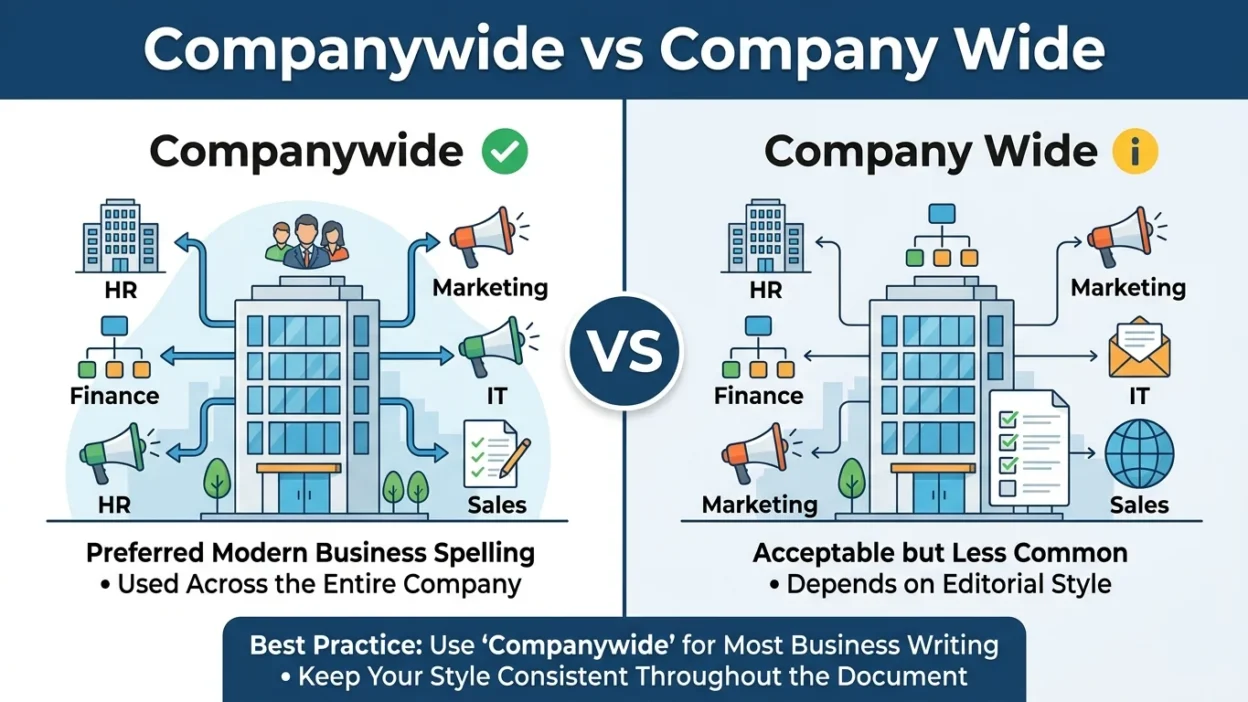
Both companywide and company wide are acceptable in modern English.
However:
- Companywide (one word) is the preferred spelling in most modern dictionaries, style guides, and business writing.
- Company wide (two words) is also acceptable, especially in older publications or organizations that follow a specific house style.
Examples
- We introduced a companywide training program. ✅
- The CEO announced a companywide policy update. ✅
- The company launched a company wide initiative. ✅ (Less common but acceptable)
If you’re unsure, companywide is generally the safest and most modern choice.
What Does “Companywide” Mean?
Companywide is an adjective that means:
It describes something that reaches every department, office, employee, or business unit.
Simple Definition
Companywide means:
- Across the entire company
- Throughout the organization
- Applicable to all employees
It is commonly used in:
- Corporate announcements
- HR documents
- Employee handbooks
- Internal emails
- Business reports
- Company policies
Examples of “Companywide”
Here are some natural examples.
- The company announced a companywide salary review.
- We held a companywide meeting on Monday.
- The new software will be introduced through a companywide rollout.
- Management launched a companywide safety initiative.
- Employees participated in a companywide survey.
In each example, the action affects the entire organization.
What Does “Company Wide” Mean?
Company wide has the same meaning as companywide.
The only difference is spelling.
Some organizations, editors, and publications still prefer writing the term as two separate words.
Examples
- A company wide celebration is planned next month.
- The company announced a company wide hiring freeze.
- Managers attended a company wide conference.
Although these examples are grammatically acceptable, many modern style guides recommend the one-word form.
Companywide vs Company Wide: Key Difference
The meanings are identical.
The primary distinction lies in spelling and style preference.
| Feature | Companywide | Company Wide |
|---|---|---|
| Meaning | Entire company | Entire company |
| Modern business writing | ✅ Preferred | Acceptable |
| Dictionary preference | Usually one word | Less common |
| Professional documents | Common | Occasionally used |
| Meaning difference | None | None |
There is no difference in meaning—only presentation.
Why Is “Companywide” More Common Today?
English often combines frequently used word pairs into compound words over time.
Examples include:
- nationwide
- worldwide
- statewide
- systemwide
- organization-wide (hyphenated in some styles)
Similarly, companywide has become increasingly common because it is:
- Shorter
- Easier to read
- Consistent with modern business writing
- Preferred by many dictionaries and corporate style guides
When Should You Use “Companywide”?
Use companywide when writing:
- Business emails
- Employee communications
- Company newsletters
- HR documents
- Press releases
- Annual reports
- Corporate websites
Examples
- A companywide bonus program begins next quarter.
- We’re implementing a companywide cybersecurity policy.
- Employees completed companywide compliance training.
- The CEO announced companywide changes.
- A companywide audit starts next week.
This spelling looks polished and professional.
When Can You Use “Company Wide”?
Although less common, company wide is still acceptable when:
- Following an organization’s style guide
- Matching older documents
- Maintaining consistency in existing publications
Some businesses intentionally separate the words because of editorial preference.
As long as you’re consistent, readers will understand your meaning.
What About “Company-Wide”?
You may also see the hyphenated form:
- company-wide
Many respected style guides recommend using a hyphen when the compound adjective appears before a noun.
Examples:
- company-wide initiative
- company-wide meeting
- company-wide policy
Others prefer the closed compound:
- companywide initiative
Both are widely accepted depending on the style guide.
Common Mistakes to Avoid
Even though the spellings are similar, writers sometimes make avoidable errors.
1. Switching Spellings in the Same Document
Incorrect:
- companywide policy
- company wide announcement
- companywide meeting
Choose one style and remain consistent.
2. Assuming One Form Is Wrong
Neither spelling is incorrect.
The difference is editorial preference.
3. Forgetting Hyphenation Rules
Some style guides require:
- company-wide policy
Others accept:
- companywide policy
Check your organization’s preferred style.
Companywide in Business Communication
You’ll frequently encounter companywide in professional settings.
Examples include:
- companywide announcement
- companywide strategy
- companywide meeting
- companywide policy
- companywide initiative
- companywide survey
- companywide training
- companywide standards
- companywide compliance
- companywide communication
Because it appears so often in business English, many readers now expect the one-word form.
American vs British English
One common question is whether regional English changes the spelling.
In practice, there is very little difference.
American English
American publications increasingly favor:
- companywide
Many corporate communications use the closed compound.
British English
British English also accepts:
- companywide
- company-wide
Some British publishers are slightly more likely to hyphenate compound adjectives before nouns, but both forms are understood.
Overall, neither variety shows a strong preference for company wide as two separate words.
Related Words and LSI Keywords
To better understand this topic, here are related terms commonly used in business writing:
- organization-wide
- enterprise-wide
- business-wide
- company policy
- corporate communication
- workplace terminology
- internal communication
- company announcement
- business English
- corporate writing
- office communication
- professional writing
These related expressions naturally strengthen the topic while supporting SEO.
Tips to Remember the Difference
Here’s an easy rule.
Think of these familiar words:
- nationwide
- worldwide
- statewide
Most modern writers use them as one word.
Likewise:
- companywide
If your organization prefers hyphenation, use:
- company-wide
Avoid switching between styles within the same document.
FAQs
Which is correct: companywide or company wide?
Both are correct, but companywide is generally the preferred modern spelling.
Is “companywide” one word?
Yes. Most modern dictionaries and business style guides recognize companywide as a single word.
Can I write “company wide”?
Yes. It is acceptable, although it is less common than companywide.
What about “company-wide”?
Many style guides recommend company-wide when the compound adjective appears before a noun.
Do American and British English use different spellings?
Not significantly. Both varieties commonly use companywide or company-wide.
Which spelling is best for professional writing?
Companywide is usually the safest and most widely accepted choice unless your organization’s style guide specifies otherwise.
Should I use different spellings in the same document?
No. Choose one style and use it consistently throughout your writing.
Summary
Understanding companywide vs company wide is mostly a matter of style rather than grammar. Both forms communicate the same idea—something that affects the entire organization. However, companywide has become the preferred spelling in modern business writing because it is concise, easy to read, and widely recognized by dictionaries and corporate style guides. You may also encounter the hyphenated form company-wide, particularly in publications that follow specific editorial conventions.
The most important rule is consistency. Whether you’re drafting HR policies, company announcements, internal emails, or business reports, selecting one preferred form and using it throughout your document creates a more professional appearance. For most writers, companywide is the safest and most practical choice.