The difference between if she was vs if she were can be confusing, even for people who speak English fluently. Both phrases are grammatically possible, but they are used in different situations. The key is understanding whether you’re talking about a real or possible situation in the past or an imaginary, hypothetical, or unlikely situation.
If you are unsure whether to say “If she was here” or “If she were here,” you’re in the right place. This guide explains the difference in simple language, gives plenty of real-world examples, compares American and British English usage, and highlights common mistakes so you can confidently choose the correct form.
Quick Answer: If She Was vs If She Were
Both “if she was” and “if she were” can be correct, but they usually express different ideas.
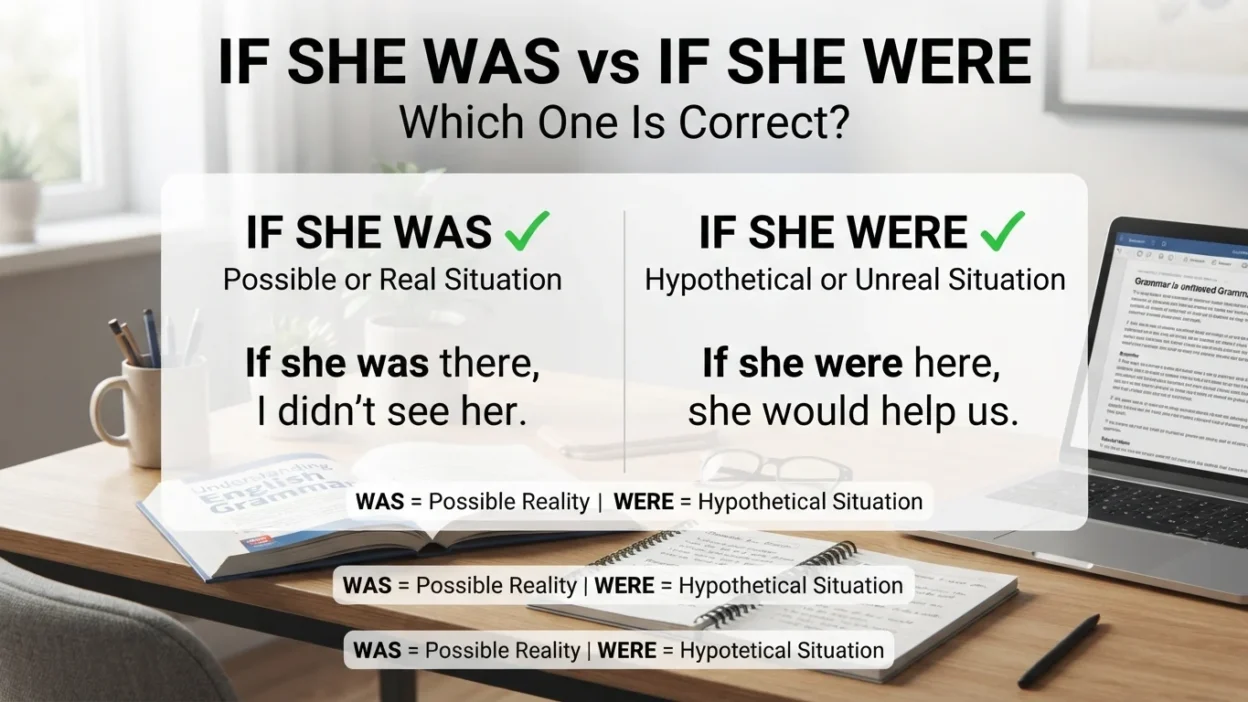
If she was is generally used when discussing a real possibility or something that may have actually happened, especially in the past.
If she were is traditionally used for an imaginary, hypothetical, or contrary-to-fact situation.
Examples
If she was at the meeting yesterday, I didn’t see her.
This suggests that she may actually have been at the meeting.
If she were here, she would help us.
This suggests that she is not here now; the situation is hypothetical.
Simple Rule
Use if she was for a possible or real past situation.
Use if she were for a hypothetical or unreal situation.
However, modern English sometimes allows if she was in hypothetical contexts, especially in informal American English. The traditional and more formal choice remains if she were.
What Does “If She Was” Mean?
If she was uses the past tense of the verb be.
It is often used when the speaker is unsure whether something actually happened or whether a past condition was true.
For example:
If she was at school yesterday, she may have seen the teacher.
The speaker doesn’t know whether she was at school. It is a genuine possibility.
Another example:
If she was tired, she probably went home early.
The speaker is considering a possible past condition.
The important point is that if she was often refers to something that could have been true in reality.
What Does “If She Were” Mean?
If she were is traditionally used for hypothetical, imaginary, or contrary-to-fact situations.
For example:
If she were here, she would know what to do.
The implication is that she is not here.
Another example:
If she were the manager, she would change the policy.
The speaker is imagining a situation in which she is the manager, even though she is not.
This use of were is known as the subjunctive mood or, more specifically, the past subjunctive in traditional grammar.
The form were is used with all subjects in these hypothetical constructions:
If I were
If he were
If she were
If it were
If we were
If they were
For example:
If I were you, I would apologize.
If he were here, he could help us.
If she were older, she could travel alone.
If She Was vs If She Were: Comparison Table
| Phrase | Typical Use | Meaning | Example |
|---|---|---|---|
| If she was | Possible or real past situation | Maybe it was true | If she was at home, she heard the noise. |
| If she were | Hypothetical or unreal situation | Imagining something | If she were here, she would help. |
| If she was | Informal hypothetical usage | Common in modern speech | If she was my boss, I’d be nervous. |
| If she were | Formal hypothetical usage | Traditional subjunctive | If she were my boss, I’d be nervous. |
The most important distinction is real possibility versus hypothetical situation.
Examples of “If She Was”
Let’s look at some examples to understand when if she was is appropriate.
Example 1: Possible Past Event
If she was at the party last night, I didn’t see her.
The speaker is unsure whether she attended.
Example 2: Possible Location
If she was at home, she probably heard the phone ring.
The speaker doesn’t know whether she was home.
Example 3: Possible Condition
If she was sick yesterday, she should stay home today.
The speaker is considering whether she was actually sick.
Example 4: Asking About a Past Situation
Do you know if she was at the office yesterday?
Here, if she was introduces an indirect question about a possible past fact.
Example 5: Possible Reason
If she was upset, that might explain why she left early.
The speaker is considering a possible explanation.
Examples of “If She Were”
Now let’s look at hypothetical situations.
Example 1: Imaginary Present Situation
If she were here, she would help us.
She is not here, but the speaker imagines what would happen if she were.
Example 2: Imaginary Role
If she were the manager, she would change the rules.
She is not the manager; this is a hypothetical situation.
Example 3: Giving Advice
If she were you, she would accept the offer.
This is similar to the common expression “If I were you.”
Example 4: Imaginary Condition
If she were taller, she might play basketball.
The speaker is imagining a different situation.
Example 5: Unreal Possibility
If she were able to come, we would invite her.
The sentence presents a hypothetical condition.
The Famous Expression: “If I Were You”
One of the most common examples of the subjunctive is:
If I were you, I would…
For example:
If I were you, I would talk to her.
This means:
If I were in your position, I would talk to her.
Although I was is normally used for past situations, the traditional form in this hypothetical expression is I were.
The same principle applies to:
If she were you…
However, since someone cannot literally be another person, this construction is naturally hypothetical.
Is “If She Was” Ever Correct for Hypothetical Situations?
Yes, this is where modern English can become complicated.
In everyday speech, especially in informal American English, many speakers use was instead of were in hypothetical sentences.
For example:
If she was my boss, I would probably be nervous.
This sentence is common in informal conversation.
However, traditional grammar would prefer:
If she were my boss, I would probably be nervous.
The second version clearly marks the sentence as hypothetical and is often preferred in formal writing.
Therefore:
Formal or traditional: If she were my boss…
Informal or conversational: If she was my boss…
Both may be heard in modern English, but were is the safer choice when you want to clearly express an unreal or hypothetical situation.
American English vs British English
Both American and British English use if she was and if she were.
The traditional grammatical distinction is the same in both varieties:
If she was = possible or real past situation.
If she were = hypothetical or unreal situation.
However, modern spoken English in both countries can sometimes use was in hypothetical situations.
For example:
If she was here, she would help us.
You may hear this in casual conversation.
The more traditional and formal version is:
If she were here, she would help us.
In formal writing, academic English, professional communication, and grammar exercises, if she were is generally the safest option when the situation is clearly hypothetical.
Common Mistakes
Mistake 1: Using “Were” for Every “If” Sentence
Not every sentence beginning with if requires were.
Incorrect for a possible past situation:
If she were at the meeting yesterday, I didn’t see her.
Better:
If she was at the meeting yesterday, I didn’t see her.
The speaker is considering whether she actually attended.
Mistake 2: Using “Was” in Formal Hypothetical Writing
Informal:
If she was my manager, I’d be worried.
Traditional/formal:
If she were my manager, I’d be worried.
The second version is generally preferred in formal writing.
Mistake 3: Thinking “Were” Always Refers to the Past
In hypothetical sentences, were does not necessarily refer to past time.
For example:
If she were here now, she would help us.
The situation is about the present, not the past.
Mistake 4: Confusing “If She Was” With “Whether She Was”
In indirect questions, if can mean whether.
For example:
I don’t know if she was at home.
This means:
I don’t know whether she was at home.
Here, was is correct because you’re asking about a possible fact.
How to Choose Between “If She Was” and “If She Were”
Ask yourself one simple question:
Am I talking about something that may have actually happened, or am I imagining an unreal situation?
If it may have actually happened:
If she was…
Example:
If she was at the store, she may have bought some milk.
If you’re imagining an unreal or hypothetical situation:
If she were…
Example:
If she were at the store, she would buy some milk.
This simple test will help you make the right choice in most situations.
FAQs
1. Which is correct: “if she was” or “if she were”?
Both can be correct. Use if she was for a possible or real past situation and traditionally use if she were for a hypothetical or unreal situation.
2. Is “if she were” grammatically correct?
Yes. If she were is the traditional subjunctive form used for hypothetical or contrary-to-fact situations.
3. Can I say “if she was” for a hypothetical situation?
Yes, especially in informal modern English. However, if she were is generally preferred in formal writing when the situation is clearly hypothetical.
4. Is “if she were” more formal?
Generally, yes. If she were clearly marks a hypothetical situation and is often preferred in formal and academic writing.
5. What is the difference between “if she was here” and “if she were here”?
If she was here can suggest uncertainty about whether she was actually present.
If she were here usually suggests that she is not here and you’re imagining what would happen if she were present.
6. Is “if she were” used in American English?
Yes. It is standard in American English, particularly in formal writing and clearly hypothetical situations.
7. Is “if she were” used in British English?
Yes. British English also uses were for traditional hypothetical and subjunctive constructions.
8. What is the easiest way to remember the difference?
Think of was as a possible fact and were as an imagined situation.
If she was there = Maybe she was there.
If she were there = Imagine that she was there.
Final Summary
The difference between if she was vs if she were depends mainly on whether the situation is real or possible versus hypothetical or unreal. Use if she was when discussing a past situation that may genuinely have happened or when asking whether something was true. For example, “If she was at the meeting, I didn’t see her” suggests that her attendance is uncertain.
Use if she were for a hypothetical, imaginary, or contrary-to-fact situation. For example, “If she were here, she would help us” suggests that she is not currently here. This traditional distinction is recognized in both American and British English, although if she was is also increasingly common in informal hypothetical speech.

Liam James is a language enthusiast and content writer at Verseslay, specializing in word comparisons, grammar debates, and vocabulary insights. He helps readers understand language nuances through clear, engaging, and practical explanations.