
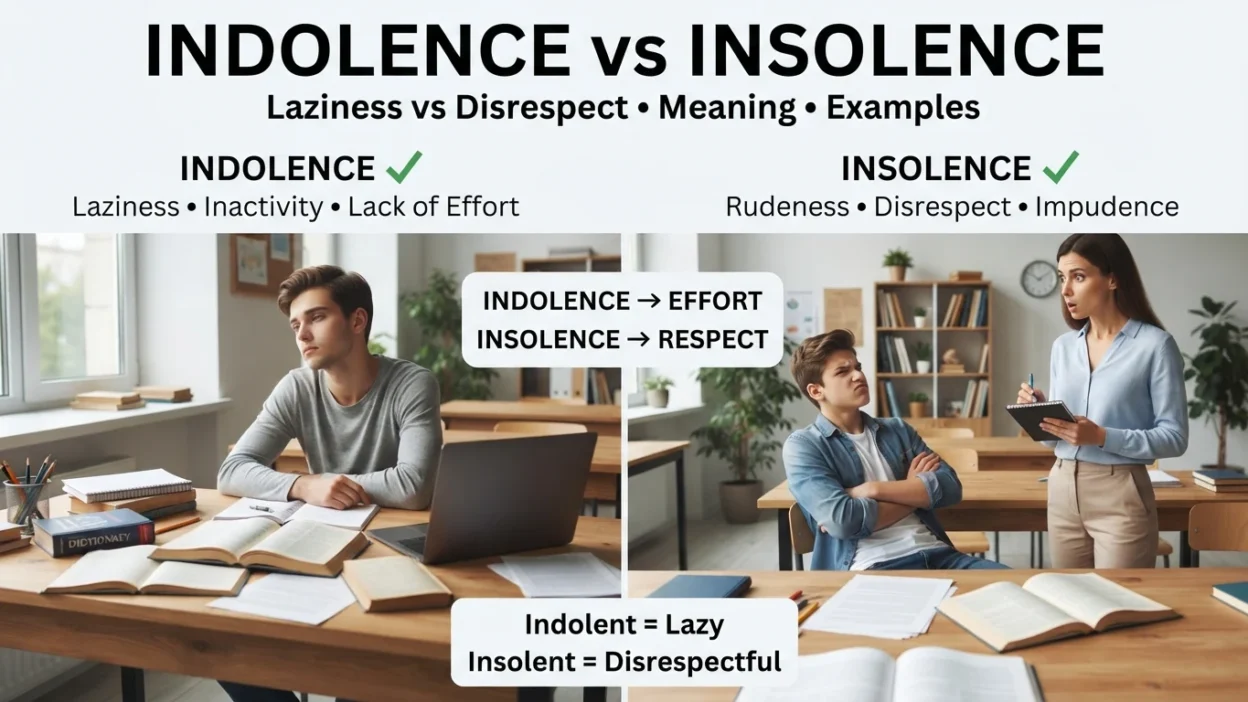
The words indolence vs insolence look and sound somewhat similar, but they describe two completely different qualities. Because both words are relatively formal and contain similar letters, it is easy to confuse them when reading or writing.
The distinction becomes much easier once you connect each word with its core idea. Indolence is about laziness or an unwillingness to work, while insolence is about disrespectful or rude behavior toward someone. Learning the difference will help you use both words accurately in formal English, academic writing, and everyday descriptions.
Quick Answer: Indolence vs Insolence
The simplest distinction is:
- Indolence = laziness, inactivity, or unwillingness to make an effort.
- Insolence = disrespectful, rude, or boldly impudent behavior.
For example:
His indolence prevented him from completing the project.
This means his laziness or lack of effort caused the problem.
The student was punished for his insolence.
This means the student behaved disrespectfully or rudely.
A quick memory trick is:
Indolence = lazy
Insolence = disrespectful
What Does Indolence Mean?
Indolence is a noun meaning a tendency to avoid work, effort, or activity. It describes laziness, inactivity, or a lack of motivation to make an effort.
The word is generally formal and is more common in books, essays, journalism, and serious discussions than in casual conversation.
For example:
His indolence made it difficult for him to keep up with his responsibilities.
The manager criticized the employee’s indolence.
Years of indolence had weakened his motivation to pursue his goals.
In these examples, indolence refers to a pattern of avoiding effort rather than simply taking a short break.
Common synonyms for indolence
Depending on the context, related words include:
- Laziness
- Idleness
- Inactivity
- Sloth
- Inertia
- Lack of motivation
- Passivity
- Listlessness
These words are related, although their meanings are not always identical.
What Does Insolence Mean?
Insolence is a noun describing rude, disrespectful, arrogant, or boldly impudent behavior.
It is often used when someone speaks or behaves toward another person in a way that shows a lack of respect.
For example:
The teacher was surprised by the student’s insolence.
His insolence toward his supervisor caused serious problems.
The official would not tolerate such insolence.
Insolence can involve words, attitude, or behavior. It often suggests that someone is being disrespectful toward a person who expects or deserves respect.
Common synonyms for insolence
Related words include:
- Disrespect
- Rudeness
- Impudence
- Arrogance
- Impertinence
- Audacity
- Defiance
- Boldness
The best synonym depends on the situation.
Indolence vs Insolence Comparison Table
| Feature | Indolence | Insolence |
|---|---|---|
| Part of speech | Noun | Noun |
| Basic meaning | Laziness or inactivity | Disrespectful or rude behavior |
| Main idea | Lack of effort | Lack of respect |
| Related adjective | Indolent | Insolent |
| Common context | Work, motivation, activity | Behavior, speech, authority |
| Example | His indolence affected his work. | His insolence offended the teacher. |
The easiest distinction is:
Indolence concerns effort.
Insolence concerns respect.
Indolence in a Sentence
Indolence is usually used to describe a person’s tendency to avoid effort or remain inactive.
Examples:
His indolence kept him from reaching his goals.
The coach warned the team against indolence during training.
Her natural ability was weakened by indolence.
The company struggled because of widespread indolence among some employees.
He blamed his poor progress on indolence rather than lack of ability.
These examples show that indolence is generally associated with inactivity, laziness, or insufficient effort.
Insolence in a Sentence
Insolence is used when someone’s behavior or speech is disrespectful, particularly toward another person.
Examples:
The manager was offended by the employee’s insolence.
The teacher would not tolerate insolence in the classroom.
His insolence toward his parents caused an argument.
The official responded firmly to the man’s insolence.
She considered his comments an example of unacceptable insolence.
The focus is not on laziness. Instead, the focus is on disrespectful behavior.
Indolent vs Insolent
The adjectives indolent and insolent follow the same distinction.
Indolent means lazy, inactive, or unwilling to work.
Insolent means rude, disrespectful, or boldly impudent.
Compare:
The indolent worker avoided his responsibilities.
The insolent worker spoke disrespectfully to his supervisor.
The first sentence focuses on a lack of effort. The second focuses on disrespect.
This distinction is especially useful because the adjective forms are often confused just like the nouns.
Why Are Indolence and Insolence Confused?
There are several reasons these words cause confusion.
First, they have very similar spellings.
Second, both words are relatively formal, so English learners may encounter them mainly in books, articles, or academic writing.
Third, their adjective forms are also similar:
Indolent
Insolent
However, their meanings are completely different.
One concerns effort, while the other concerns respect.
A useful way to separate them is to focus on the middle of each word:
Indolence → inactivity
Insolence → impudence or disrespect
Indolence vs Laziness
Indolence and laziness are closely related.
Laziness is the more common everyday word, while indolence is more formal.
Compare:
His laziness prevented him from finishing the work.
His indolence prevented him from finishing the work.
The basic meaning is similar, but indolence can sound more formal, literary, or serious.
If you are having a casual conversation, laziness is usually more natural.
If you are writing a formal essay or discussing someone’s persistent lack of effort, indolence can be appropriate.
Insolence vs Rudeness
Similarly, insolence and rudeness are closely related.
Rudeness is a broad term for behavior that lacks politeness or consideration.
Insolence often suggests a stronger element of disrespect, defiance, or bold impudence.
For example:
His rudeness upset the customer.
His insolence toward the senior official was considered unacceptable.
Insolence can therefore carry a more formal or severe tone.
Common Mistakes
Mistake 1: Using Indolence for Rude Behavior
This is incorrect.
If someone is behaving disrespectfully, the appropriate word is insolence.
Incorrect idea: His indolence toward the teacher was unacceptable.
Correct: His insolence toward the teacher was unacceptable.
Mistake 2: Using Insolence for Laziness
If someone refuses to work or avoids effort, indolence is the appropriate word.
Correct: His indolence affected his performance.
Insolence would suggest disrespect rather than laziness.
Mistake 3: Confusing Indolent and Insolent
Remember:
Indolent = lazy
Insolent = disrespectful
These adjective forms are just as important as the nouns.
Mistake 4: Treating Them as Synonyms
They are not synonyms.
A person can be indolent without being insolent.
Someone can also be insolent without being indolent.
For example, a hardworking person could still behave disrespectfully. Likewise, a very polite person could simply be unwilling to work.
American vs British English
There is no major difference between American and British English in the meanings of indolence and insolence.
Both varieties use the words with essentially the same definitions.
However, both words are relatively formal. In ordinary conversation, American and British speakers are more likely to use simpler words such as:
- Laziness
- Idleness
- Rudeness
- Disrespect
For formal writing, literature, essays, and serious descriptions, indolence and insolence remain useful vocabulary choices.
How to Remember the Difference
A simple memory trick can make these words much easier to remember.
Think:
INDOLENCE = INACTIVE
Both ideas are connected with a lack of activity or effort.
Then:
INSOLENCE = INSULTING
Both ideas are connected with disrespectful behavior or speech.
So remember:
Indolence → effort problem
Insolence → respect problem
This distinction will help you choose the correct word quickly.
FAQs
1. What is the difference between indolence and insolence?
Indolence means laziness or a lack of effort, while insolence means rude, disrespectful, or impudent behavior.
2. What does indolence mean?
Indolence means a tendency to avoid work, effort, or activity. It is a formal word for laziness or idleness.
3. What does insolence mean?
Insolence means disrespectful, rude, arrogant, or boldly impudent behavior, especially toward another person.
4. What is the difference between indolent and insolent?
Indolent means lazy or inactive. Insolent means rude or disrespectful.
5. Is indolence a synonym for laziness?
Yes. Indolence is a formal synonym for laziness, although the two words can have slightly different tones depending on context.
6. Is insolence a synonym for rudeness?
They are closely related. Insolence generally suggests particularly bold, disrespectful, or impudent behavior.
7. Are indolence and insolence used in American English?
Yes. Both words are recognized in American English as well as British English.
8. How can I easily remember the difference?
Remember indolence = inactivity and insolence = disrespect. One is about effort, while the other is about respect.
Final Summary
The difference between indolence vs insolence becomes clear once you focus on what each word describes. Indolence refers to laziness, inactivity, or an unwillingness to make an effort. It is often used in formal contexts and is closely related to words such as laziness, idleness, and passivity.
Insolence, on the other hand, refers to disrespectful, rude, arrogant, or impudent behavior. It is related to words such as rudeness, disrespect, impudence, and impertinence. Although the two words look similar, their meanings are entirely different.