Have you ever wondered what people mean when they say someone should let one’s hair down? At first glance, the expression sounds like it has something to do with hairstyles. However, this common English idiom has a much more interesting meaning.
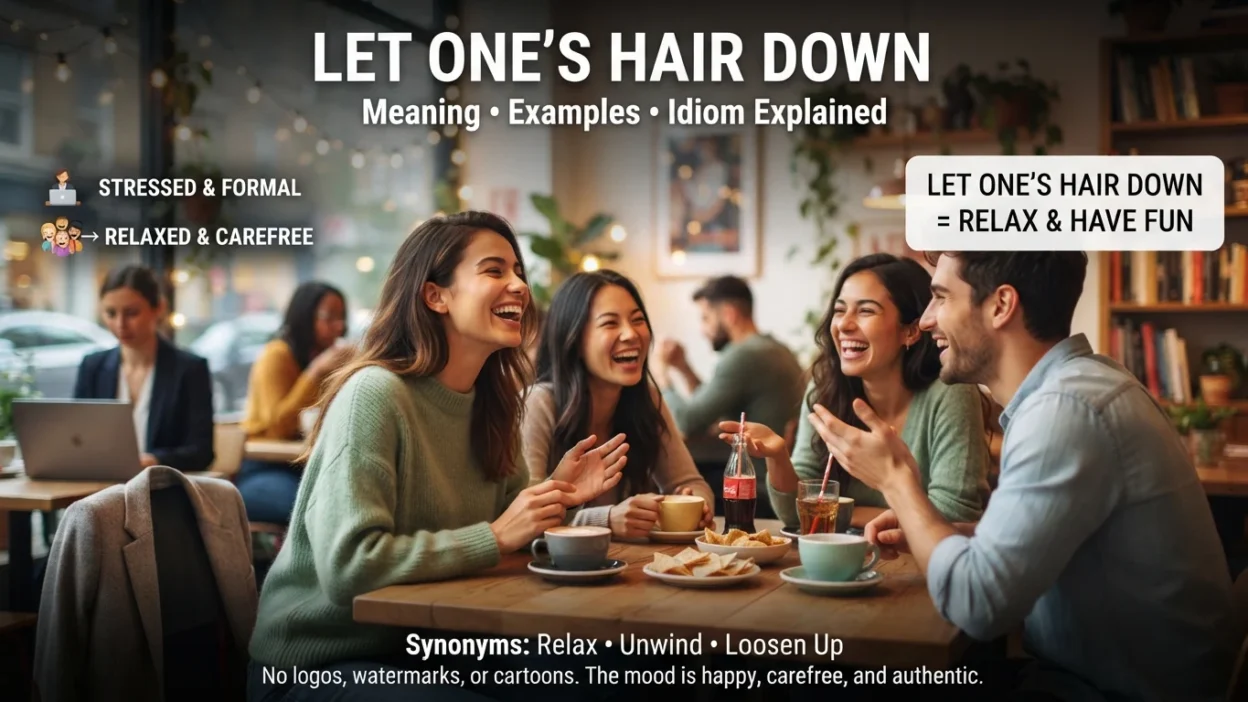
Let one’s hair down means to relax, stop worrying about being formal or serious, and enjoy yourself freely. It is commonly used when someone takes a break from responsibilities, behaves more casually, or allows themselves to have fun. In this guide, you will learn the meaning, origin, examples, common mistakes, synonyms, and differences between American and British English.
Quick Answer: What Does Let One’s Hair Down Mean?
Let one’s hair down means to relax, loosen up, stop being overly serious, and enjoy yourself without worrying too much about rules or expectations.
For example:
After finishing their exams, the students decided to let their hair down and enjoy the evening.
Here, the expression means they wanted to relax and have fun after a stressful period.
The phrase can also describe someone who normally behaves in a serious or reserved way but becomes more relaxed in a comfortable environment.
In simple terms:
- Let one’s hair down = relax
- Let one’s hair down = have fun
- Let one’s hair down = loosen up
- Let one’s hair down = be less formal
- Let one’s hair down = enjoy yourself
What Does Let One’s Hair Down Mean?
The idiom let one’s hair down describes the act of relaxing and behaving in a more natural, carefree, or informal way.
Someone might spend all day working, studying, attending meetings, or dealing with responsibilities. When they finally have free time, they may decide to let their hair down.
For example:
After a busy week at work, she wanted to let her hair down with her friends.
The sentence does not literally mean that she released her hair. It means she wanted to relax and enjoy herself.
The expression can also suggest temporarily putting aside seriousness, pressure, or social expectations.
Why Does Let One’s Hair Down Have This Meaning?
The expression is believed to come from the idea that wearing the hair up was traditionally associated with being dressed formally or being prepared for work and social situations.
Letting the hair down suggested becoming more relaxed and informal.
Although the expression has historical connections to hairstyles and social customs, modern speakers generally use it figuratively.
Today, let one’s hair down simply means to relax and enjoy yourself.
Let One’s Hair Down Examples
Understanding examples is one of the easiest ways to learn this idiom.
After the wedding ceremony, everyone let their hair down at the reception.
This means everyone relaxed and enjoyed the celebration.
I have been working all week, so I am ready to let my hair down this weekend.
The speaker wants to relax after a busy week.
She is very serious at work, but she really lets her hair down when she is with her friends.
This shows a contrast between her professional behavior and her relaxed behavior.
The team decided to let their hair down after completing the difficult project.
The team celebrated and relaxed after finishing their work.
It is nice to let your hair down once in a while.
This means that taking a break and enjoying yourself occasionally is a good idea.
Let One’s Hair Down in Different Situations
The idiom can be used in many everyday situations.
After Work
Someone may work long hours and want to relax afterward.
After work, he likes to let his hair down by spending time with his friends.
After Exams
Students may use the expression after completing stressful exams.
Once the exams were over, the students finally let their hair down.
At a Celebration
People often become more relaxed during parties, weddings, festivals, and other celebrations.
Everyone let their hair down during the celebration.
With Close Friends
A person who is quiet or formal around strangers may behave differently around close friends.
She is reserved around new people, but she lets her hair down with her closest friends.
Let One’s Hair Down vs Relax
The expression let one’s hair down and the verb relax are closely related, but they are not always identical.
Relax is a general word for becoming calmer or less tense.
Let one’s hair down often carries the additional idea of becoming more informal, carefree, or playful.
Compare:
I relaxed after finishing my work.
This simply means the person became less tense.
I let my hair down after finishing my work.
This suggests the person did more than simply rest. They may have gone out, socialized, had fun, or behaved more freely.
Let One’s Hair Down vs Loosen Up
Loosen up is another close expression.
It can mean becoming less tense, serious, shy, or formal.
For example:
You should loosen up and enjoy the party.
Similarly:
You should let your hair down and enjoy the party.
Both expressions can work in this context.
However, loosen up can also be used when someone needs to become physically or emotionally less tense, while let one’s hair down usually emphasizes relaxing and having fun.
Comparison Table
| Expression | Meaning | Typical Use |
|---|---|---|
| Let one’s hair down | Relax and enjoy yourself | Social or informal situations |
| Relax | Become calm or less tense | General situations |
| Loosen up | Become less tense or serious | Social and personal situations |
| Have fun | Enjoy an activity | Very general |
| Unwind | Relax after effort or stress | After work or responsibilities |
| Take it easy | Avoid stress or excessive effort | Casual everyday situations |
The most important point is that let one’s hair down has a particularly informal and carefree feeling.
Common Mistakes With Let One’s Hair Down
Mistake 1: Taking the Idiom Literally
The phrase usually does not refer to physically releasing someone’s hair.
If someone says:
You need to let your hair down.
They are normally suggesting that you relax and enjoy yourself.
Mistake 2: Using It for Serious Situations
The idiom is generally associated with relaxation, enjoyment, and informal behavior.
It would sound unusual to use it when describing a serious emergency, formal meeting, or important professional task.
Mistake 3: Forgetting the Possessive Form
The expression changes according to the subject.
For example:
I let my hair down.
She let her hair down.
He let his hair down.
They let their hair down.
When discussing the expression generally, let one’s hair down is the dictionary-style form.
Mistake 4: Changing Let to Lets
Remember that after certain subjects, the verb changes appropriately.
I let my hair down.
She lets her hair down.
But after a past-tense subject, the verb remains let:
She let her hair down at the party.
Let One’s Hair Down in American English
The idiom is well established in American English.
American speakers commonly use it to describe relaxing, having fun, or behaving more freely after being serious or responsible.
For example:
We have been studying all week, so we are going to let our hair down tonight.
It is especially natural in casual conversation and informal writing.
Let One’s Hair Down in British English
The expression is also common in British English and has essentially the same meaning.
For example:
After a long week at work, she decided to let her hair down with her friends.
There is no major difference in the meaning or standard spelling of the idiom between American and British English.
The expression may sound slightly informal in both varieties, so it is generally more appropriate for conversational, lifestyle, and casual writing than highly formal documents.
Is Let One’s Hair Down Formal or Informal?
Let one’s hair down is an idiomatic and generally informal expression.
It is perfectly natural in:
- Everyday conversations
- Blogs
- Lifestyle articles
- Personal writing
- Interviews
- Informal emails
- Social media
- Stories and dialogue
For highly formal academic or professional writing, alternatives such as relax, unwind, or take a break may be more appropriate.
For example:
Informal:
The employees wanted to let their hair down after completing the project.
More formal:
The employees wanted to relax after completing the project.
Synonyms and Related Expressions
Several words and phrases can express a similar idea.
Useful alternatives include:
- Relax
- Unwind
- Loosen up
- Take it easy
- Have fun
- Enjoy yourself
- Take a break
- Be carefree
- Forget your worries
- Have a good time
- Take a breather
The best alternative depends on the context.
For example, unwind works particularly well after work or a stressful activity, while have fun is more general.
FAQs
1. What does let one’s hair down mean?
It means to relax, become less formal or serious, and enjoy yourself freely.
2. Is let one’s hair down a literal expression?
Usually, no. It is an idiom. The phrase normally describes relaxing or having fun rather than physically releasing someone’s hair.
3. What is an example of let one’s hair down?
After finishing her exams, she decided to let her hair down with her friends.
The meaning is that she wanted to relax and enjoy herself.
4. Is let one’s hair down American or British?
The idiom is used in both American and British English and has essentially the same meaning in both varieties.
5. Is let one’s hair down informal?
Yes. It is generally an informal or conversational idiom, although it can also appear naturally in articles, stories, and other forms of general writing.
6. What is another way to say let one’s hair down?
Depending on the context, you can say relax, unwind, loosen up, take it easy, or have fun.
7. Can you say let his hair down?
Yes. The expression changes according to the person.
He let his hair down.
She let her hair down.
They let their hair down.
8. Does let one’s hair down mean to stop working?
Not necessarily. It means to relax and enjoy yourself. Stopping work may be part of the situation, but it is not the complete meaning.
Final Summary
The idiom let one’s hair down means to relax, loosen up, and enjoy yourself without being overly serious or formal. It is commonly used after work, exams, stressful responsibilities, or during social occasions. The expression can also describe someone who normally behaves seriously but becomes more relaxed and carefree around friends or in a comfortable environment.
The phrase is used in both American and British English and has essentially the same meaning in both varieties. Although it is not usually considered highly formal, it is a natural and useful expression for everyday conversations, informal writing, lifestyle content, and storytelling. Similar expressions include relax, unwind, loosen up, and take it easy, but let one’s hair down often carries a stronger sense of having fun and behaving freely.