If you have ever searched for hassle vs hastle, you are probably wondering which spelling is correct. These words look almost identical, and the extra s in one version can be easy to miss when typing quickly.
The answer is straightforward: hassle is the correct standard spelling. Hastle is generally a misspelling and should not be used in standard English. In this guide, you will learn what hassle means, how to use it naturally, why hastle is incorrect, and how to avoid this common spelling mistake.
Quick Answer: Hassle vs Hastle
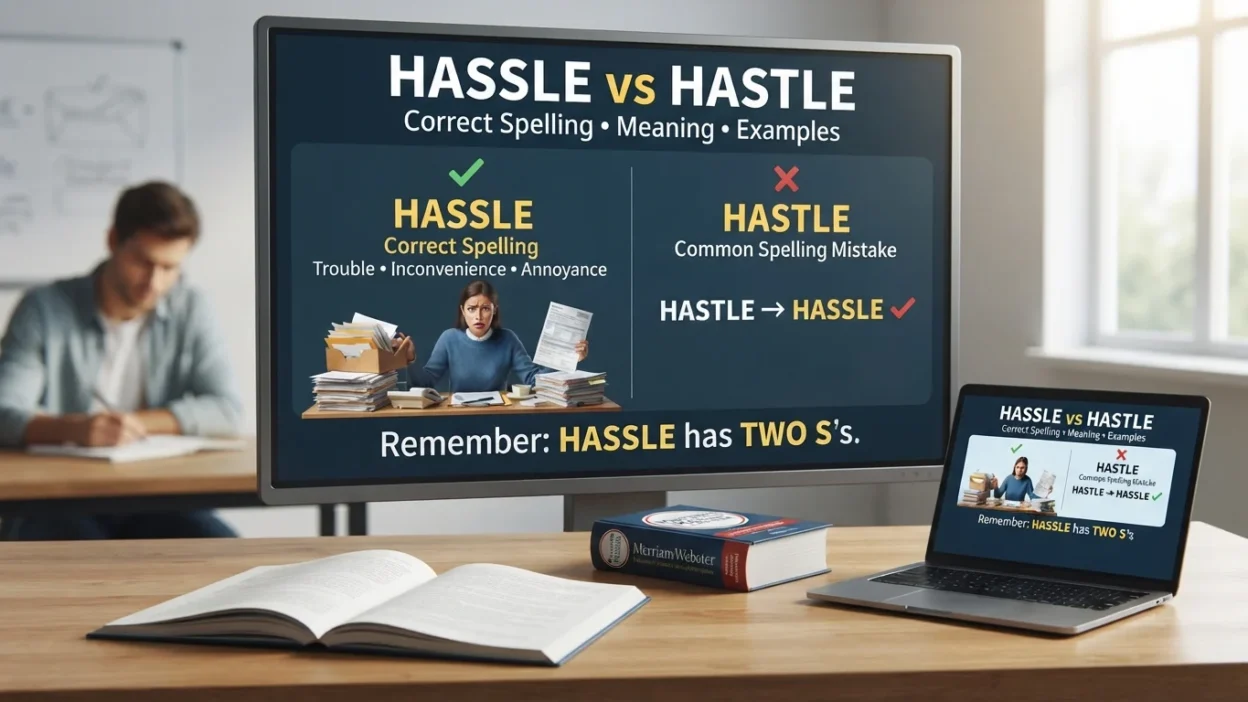
Hassle is the correct spelling.
Hastle is a common spelling mistake.
The word hassle can be a noun or a verb.
As a noun, it means trouble, inconvenience, difficulty, or an annoying situation.
Example:
Getting a refund was such a hassle.
As a verb, hassle means to bother, annoy, or cause someone unnecessary difficulty.
Example:
The constant paperwork hassled the customers.
The safest rule is simple:
HASSLE ✓
HASTLE ✗
What Does Hassle Mean?
Hassle is an English word used for an annoying difficulty, inconvenience, or problem.
It can describe something that requires extra effort or causes frustration.
For example:
Traveling with too much luggage can be a hassle.
Finding parking downtown is always a hassle.
I do not want the hassle of changing hotels.
In these sentences, hassle describes something inconvenient or troublesome.
The word is common in everyday English and is often used when someone wants to emphasize that a situation is more complicated or annoying than it should be.
Hassle as a Noun
When hassle is used as a noun, it refers to trouble, inconvenience, or an annoying experience.
Examples:
The paperwork was a hassle.
Moving to a new house can be a big hassle.
I want to avoid the hassle of waiting in line.
Returning the product was no hassle at all.
Common expressions include:
- A big hassle
- A lot of hassle
- Such a hassle
- Avoid the hassle
- Deal with the hassle
- Without the hassle
- The hassle of something
For example:
You can order online without the hassle of visiting the store.
Hassle as a Verb
Hassle can also function as a verb.
As a verb, it means to bother, annoy, pressure, or cause someone unnecessary trouble.
Examples:
The salesperson kept hassling me to buy something.
Stop hassling your brother.
Customers were hassled by repeated delays.
In everyday English, hassle as a verb often has the sense of bothering or repeatedly pressuring someone.
The verb can be used in different grammatical forms:
Hassle
Hassles
Hassled
Hassling
For example:
They hassled him about the payment.
She does not want to be hassled while shopping.
What Does Hastle Mean?
Hastle is generally not the correct standard spelling of the word you are looking for.
If you want to describe trouble, inconvenience, annoyance, or an irritating situation, the correct spelling is:
Hassle
Not:
Hastle
For example:
Correct: The paperwork was a hassle.
Incorrect: The paperwork was a hastle.
The mistake is understandable because English spelling does not always make pronunciation obvious. However, adding the second s is essential in the standard spelling.
Hassle vs Hastle Comparison Table
| Feature | Hassle | Hastle |
|---|---|---|
| Correct standard spelling | Yes | No |
| Meaning | Trouble, inconvenience, annoyance | No standard meaning in this context |
| Part of speech | Noun and verb | Usually a misspelling |
| Example | The trip was a hassle. | Incorrect spelling |
| Recommended for formal writing | Yes | No |
The key point is simple:
Hassle is the correct word.
Why Do People Spell Hassle as Hastle?
The spelling mistake usually happens because people write words according to how they think they sound.
When spoken naturally, hassle may not make the double s especially noticeable.
Another reason is that English contains many words where consonants are doubled in spelling, while other similar-looking words use only one consonant.
For example:
- Hassle
- Castle
- Hostile
- Hustle
Because of these patterns, it is easy to accidentally write hastle instead of hassle.
The best solution is simply to remember the spelling visually.
How to Remember the Correct Spelling
A useful memory trick is:
HASSLE has two S’s.
Think of the word as:
HAS + SLE = HASSLE
Another easy reminder is:
Hassle = annoying situation
When you mean trouble or inconvenience, remember the double s.
Examples:
No hassle.
A big hassle.
Avoid the hassle.
These common expressions can help reinforce the correct spelling.
Common Synonyms for Hassle
Depending on the context, you can replace hassle with several related words.
Useful synonyms include:
- Trouble
- Problem
- Difficulty
- Inconvenience
- Annoyance
- Nuisance
- Bother
- Complication
- Irritation
- Frustration
However, these words are not always exact replacements.
For example:
The paperwork was a hassle.
could become:
The paperwork was an inconvenience.
But the tone changes slightly.
Hassle is often informal and conversational, making it particularly common in everyday speech and online writing.
Common Phrases With Hassle
Learning common phrases can make it easier to use the word naturally.
A hassle
Getting a visa can be a hassle.
A big hassle
Moving house was a big hassle.
No hassle
You can return the item with no hassle.
Avoid the hassle
Book online to avoid the hassle of waiting.
The hassle of
I do not want the hassle of dealing with extra paperwork.
Hassle-free
The website promises a hassle-free booking process.
The adjective hassle-free is particularly common in advertisements and customer-service language.
Hassle-Free Meaning
Hassle-free means without trouble, difficulty, inconvenience, or unnecessary complications.
Examples:
We offer hassle-free returns.
The process was quick and hassle-free.
She wanted a hassle-free way to pay the bill.
Notice that hassle-free uses the correct spelling of hassle.
Hassle vs Trouble
Hassle and trouble are closely related, but they can have slightly different tones.
Trouble is a broad word that can describe serious or minor problems.
Hassle usually emphasizes inconvenience, annoyance, or unnecessary effort.
Compare:
My car has a serious problem.
Finding a parking space is a hassle.
The first can involve a significant difficulty, while the second usually suggests an irritating inconvenience.
Hassle vs Nuisance
A nuisance is something or someone that causes annoyance or inconvenience.
A hassle often focuses more on the effort or difficulty involved.
For example:
The paperwork was a hassle.
The constant noise was a nuisance.
Both words can describe annoying experiences, but their emphasis is slightly different.
American vs British English
Hassle is used in both American and British English.
There is no major spelling difference between the two varieties.
American English:
It was such a hassle.
British English:
It was such a hassle.
The word is common in everyday conversation in both varieties.
Hastle is not a standard American or British spelling of hassle.
Therefore, if you are writing for an American or British audience, use:
Hassle
Common Mistakes With Hassle
Mistake 1: Writing Hastle
The most common mistake is dropping one of the s’s.
Incorrect: This is such a hastle.
Correct: This is such a hassle.
Mistake 2: Confusing Hassle With Hustle
Hassle means trouble or inconvenience.
Hustle can mean to move quickly, work energetically, or push or pressure someone, depending on context.
For example:
The paperwork was a hassle.
We had to hustle to catch the train.
These are completely different words.
Mistake 3: Using Hassle Only as a Noun
Hassle can also be a verb.
Noun: The delay was a hassle.
Verb: The salesperson kept hassling us.
Remember that the verb form becomes hassled in the past tense and hassling in the -ing form.
FAQs
1. Is hassle or hastle correct?
Hassle is the correct standard spelling. Hastle is generally a misspelling.
2. What does hassle mean?
Hassle means trouble, inconvenience, annoyance, or an irritating difficulty. As a verb, it can mean to bother or pressure someone.
3. Is hastle a word?
Hastle is not the standard spelling when you mean trouble or inconvenience. In normal English writing, use hassle.
4. What is an example of hassle?
Getting all the paperwork completed was a hassle.
Here, hassle means an annoying or inconvenient task.
5. What does hassle-free mean?
Hassle-free means easy to manage and without unnecessary trouble, inconvenience, or complications.
6. Is hassle American or British English?
Hassle is used in both American and British English. The spelling is the same in both varieties.
7. What is the difference between hassle and trouble?
Trouble is a broad term for a problem or difficulty. Hassle often emphasizes inconvenience, annoyance, or unnecessary effort.
8. How do you remember the spelling of hassle?
Remember that hassle has two s’s. When you mean inconvenience or annoyance, write H-A-S-S-L-E.
Final Summary
The difference between hassle vs hastle is straightforward: hassle is the correct standard spelling, while hastle is generally a spelling mistake. Hassle can be used as both a noun and a verb. As a noun, it describes trouble, inconvenience, or annoyance. As a verb, it means to bother, annoy, or pressure someone.
The word is common in everyday American and British English, especially in expressions such as a big hassle, avoid the hassle, no hassle, and hassle-free. If you are writing an article, email, school assignment, business document, or social media post, choosing hassle will ensure that your spelling is clear and standard.