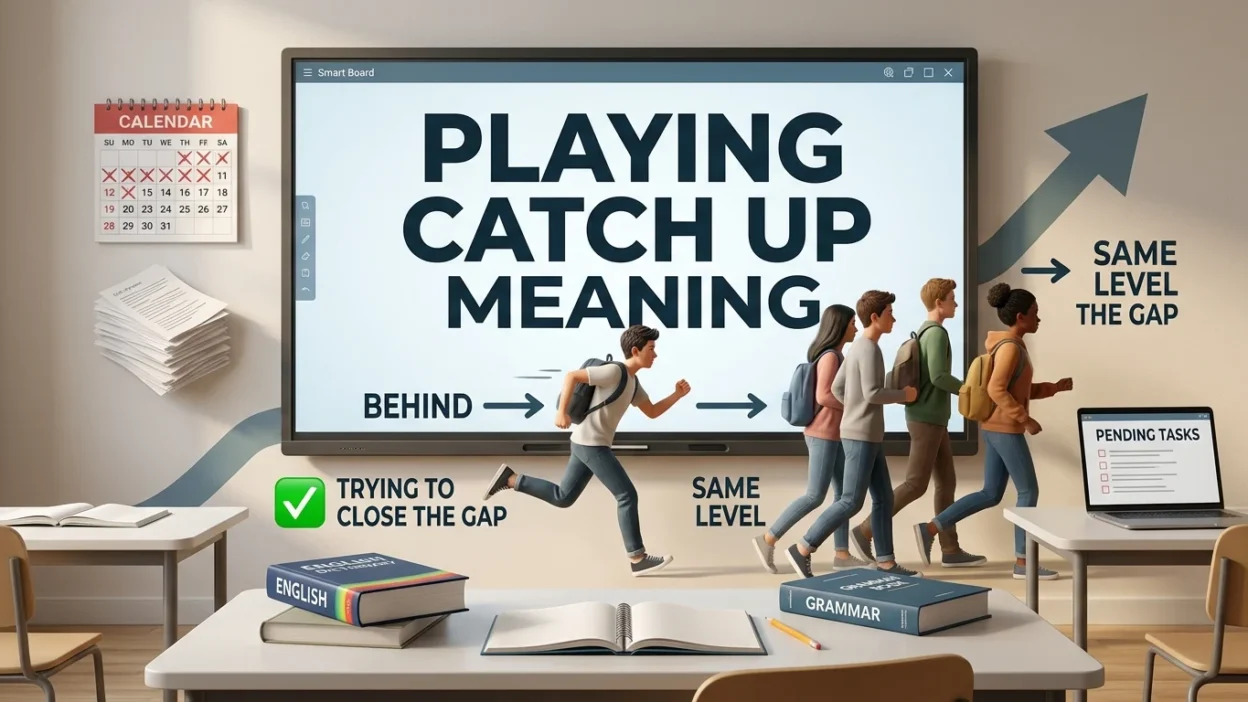
Have you ever fallen behind at work, in school, or in your personal life and then had to work hard to reach the same level as everyone else? In English, the phrase playing catch up describes exactly this situation. It is a common expression used when someone is trying to overcome a disadvantage or make up for lost time.
The phrase can be used in many everyday situations. You might be playing catch up with emails after a vacation, trying to catch up on missed lessons after being absent from school, or working harder to catch up with competitors. Understanding this expression will help you sound more natural and confident in conversational English.
Quick Answer
Playing catch up means trying to reach the same level, position, or progress as someone or something that is ahead of you.
It often happens because you started late, fell behind, missed something, or had a disadvantage.
Example:
After being sick for a week, I spent the weekend playing catch up with my schoolwork.
In simple words:
Playing catch up = trying to make up for being behind.
Playing Catch Up Meaning
The phrase playing catch up describes the process of trying to reduce a gap between yourself and someone or something that is already ahead.
The gap can involve:
- Time
- Work
- Knowledge
- Progress
- Money
- Skills
- Competition
- Schoolwork
For example:
I was away from work for three days, so I’m playing catch up with my emails.
This means the person has accumulated emails while they were away and is now working through them to get back to their normal position.
The expression is usually figurative. It does not normally mean that someone is literally playing a game of catch.
What Does Catch Up Mean?
To understand playing catch up, it helps to understand the verb phrase catch up.
Catch up can mean reaching someone who is ahead of you or becoming equally up to date with something.
For example:
Walk slowly so I can catch up with you.
Here, catch up means physically reaching someone.
But in:
I need to catch up on my homework.
it means completing work that you have missed or fallen behind on.
Playing catch up comes from this broader idea of closing a gap.
Playing Catch Up vs Catching Up
These expressions are closely related, but their grammar and emphasis can differ.
Catching up is the -ing form of catch up and is extremely common.
Playing catch up is an idiomatic expression that emphasizes the situation of being behind and trying to close the gap.
Compare:
I’m catching up on my emails.
This simply means you are dealing with emails you have not yet handled.
I’m playing catch up with my emails after being away for a week.
This emphasizes that you fell behind and are now trying to return to your normal workload.
Both can be natural, but playing catch up often highlights the effort involved in overcoming a disadvantage.
Playing Catch Up Examples
Here are some natural examples of the phrase:
- I missed two classes, so I’m playing catch up with my studies.
- After the holiday, I’m playing catch up on my emails.
- The company is playing catch up with its competitors.
- We lost valuable time because of the delay and are now playing catch up.
- She took a break from training and is playing catch up with the rest of the team.
- I’m still playing catch up after being sick last month.
- The team is playing catch up after a slow start to the season.
- He spent the weekend playing catch up on unfinished work.
- We have a lot of paperwork to finish, so we’re playing catch up today.
- The new technology helped the company stop playing catch up and become more competitive.
These examples show that the expression works in professional, educational, competitive, and everyday contexts.
Playing Catch Up at Work
The expression is especially common in workplace English.
Imagine an employee returning from vacation and discovering hundreds of unread emails and unfinished tasks.
They might say:
I’m spending today playing catch up after my vacation.
This means they are working through everything that accumulated while they were away.
Other workplace examples include:
- I’m playing catch up with my reports.
- We are playing catch up after the system outage.
- The team has been playing catch up all week.
- I need a quiet afternoon to play catch up on my workload.
The phrase can also describe businesses that are behind competitors.
The company is playing catch up with larger competitors in the technology market.
Here, the company is trying to close a competitive gap.
Playing Catch Up in School
Students can also use the phrase naturally.
For example:
I missed several classes because I was ill, so now I’m playing catch up.
This means the student is working to learn the material and complete assignments they missed.
Other examples:
- I’m playing catch up on my assignments.
- She spent the weekend playing catch up with her reading.
- We are playing catch up before the exams.
- He is playing catch up after missing two weeks of school.
This usage is especially common in informal spoken English.
Playing Catch Up in Competition
The expression can describe sports, business, technology, or any situation involving competition.
For example:
The team fell behind early in the game and spent the rest of the match playing catch up.
This means the team was behind in the score and was trying to close the difference.
In business:
The company invested heavily in research because it was playing catch up with its competitors.
Here, the company is behind its competitors in a particular area and is trying to reach their level.
Playing Catch Up With vs Playing Catch Up On
Both with and on can appear with catch up, but they serve different purposes.
Catch Up With
Use catch up with when you mean reaching a person, group, or level.
The company is playing catch up with its competitors.
I’m trying to catch up with the rest of the class.
Catch Up On
Use catch up on when you mean completing or reviewing something you missed.
I’m catching up on my emails.
She is catching up on her homework.
A useful way to remember this is:
with = person, group, or level
on = work, information, or activities
Playing Catch Up vs Falling Behind
These expressions describe related but different stages.
Falling behind means becoming less advanced or less up to date than others.
Playing catch up means actively trying to close that gap.
For example:
I fell behind because I was sick.
Then:
Now I’m playing catch up with my classmates.
So, falling behind describes the problem, while playing catch up describes the effort to solve it.
Playing Catch Up vs Keeping Up
These expressions are also easy to confuse.
Keeping up means staying at the same level or pace as someone else.
Playing catch up means you are already behind and are trying to reach that level.
Compare:
I’m keeping up with the rest of the class.
You are at roughly the same level.
I’m playing catch up with the rest of the class.
You are behind and trying to close the gap.
This distinction is useful in conversations about work, education, fitness, technology, and competition.
Comparison Table
| Expression | Meaning | Example |
|---|---|---|
| Playing catch up | Trying to close a gap after falling behind | I’m playing catch up after my vacation. |
| Catching up | Becoming up to date or reaching someone | I’m catching up on my emails. |
| Falling behind | Becoming less advanced or less up to date | I fell behind in my studies. |
| Keeping up | Staying at the same pace or level | I’m keeping up with the class. |
| Getting ahead | Moving into a better or more advanced position | She is getting ahead at work. |
Common Mistakes
Mistake 1: Thinking It Always Refers to a Game
Playing catch up is usually figurative.
It commonly describes work, school, business, sports, and personal responsibilities.
Mistake 2: Confusing Catch Up With Catch Up On
Use catch up with for people, groups, or levels.
Use catch up on for tasks, information, and missed activities.
Mistake 3: Assuming It Means Starting From Zero
Playing catch up does not necessarily mean starting from the beginning. It means trying to close a gap between your current position and where you need or want to be.
Mistake 4: Using It When You Are Already Ahead
If you are ahead of everyone else, you are not playing catch up. The phrase implies that you are behind in some way.
Mistake 5: Confusing Catch Up With Keep Up
Keep up means maintaining the same pace.
Catch up means reaching a level or position you have not yet reached.
American vs British English
Playing catch up is understood and used in both American and British English.
There is no major difference in meaning or grammar between the two varieties.
You may hear it in workplace conversations, sports commentary, education, business discussions, and everyday speech on both sides of the Atlantic.
The expression is generally informal and conversational, although it can also appear in news reports, business writing, and other semi-formal contexts.
Is Playing Catch Up Formal or Informal?
Playing catch up is primarily conversational and informal, but it is widely understood and can appear in professional contexts.
For example:
I’m playing catch up with my workload after the conference.
This sounds perfectly natural in a workplace conversation.
In highly formal writing, alternatives such as addressing the backlog, closing the gap, making up for lost time, or becoming up to date may be more appropriate.
Synonyms and Related Expressions
Depending on the context, you can replace playing catch up with:
- catching up
- closing the gap
- making up for lost time
- getting back on track
- getting up to date
- overcoming a delay
- reducing the gap
- reaching the same level
- recovering lost ground
- working through a backlog
These expressions are related but not always interchangeable.
For example, making up for lost time emphasizes recovering time, while playing catch up emphasizes reducing a gap between your current position and another position.
How to Use Playing Catch Up Naturally
A simple sentence pattern is:
Subject + be + playing catch up + with/on + something
Examples:
- I’m playing catch up with my classmates.
- We’re playing catch up with our competitors.
- She’s playing catch up on her assignments.
- They’re playing catch up after the delay.
You can also use the expression with play in other tenses: - I had to play catch up after missing work.
- We will have to play catch up tomorrow.
- The team has been playing catch up all season.
This makes the phrase flexible in everyday English.
FAQs
1. What does playing catch up mean?
Playing catch up means trying to reach the same level, position, or progress as someone or something that is ahead of you.
2. Is playing catch up grammatically correct?
Yes. Playing catch up is a natural English expression. It is commonly used when someone is behind and trying to close a gap.
3. What is an example of playing catch up?
I missed a week of school, so I’m playing catch up with my classmates. This means the student is trying to recover the progress they missed.
4. What is the difference between catching up and playing catch up?
Catching up simply means becoming up to date or reaching someone. Playing catch up emphasizes that you are behind and are working to close the gap.
5. What is the difference between playing catch up and falling behind?
Falling behind describes becoming less advanced or less up to date. Playing catch up describes the effort to recover from that disadvantage.
6. Is playing catch up American or British English?
It is used in both American and British English, with no significant difference in meaning.
7. Is playing catch up formal?
It is mainly conversational and informal, but it is also commonly used in workplace and business contexts. More formal alternatives include closing the gap and making up for lost time.
8. What is another way to say playing catch up?
Depending on the context, you can say catching up, closing the gap, making up for lost time, getting back on track, or recovering lost ground.
Summary
Playing catch up means trying to close a gap after falling behind. It can refer to schoolwork, professional responsibilities, business competition, sports, technology, or everyday tasks. The phrase emphasizes the effort to reach the same level, position, or progress as someone or something that is already ahead.
The expression is natural in both American and British English and is common in conversational and professional settings. Remember the key distinction: falling behind describes the situation, while playing catch up describes the effort to recover. If you are already at the same pace, you are keeping up, not playing catch up.