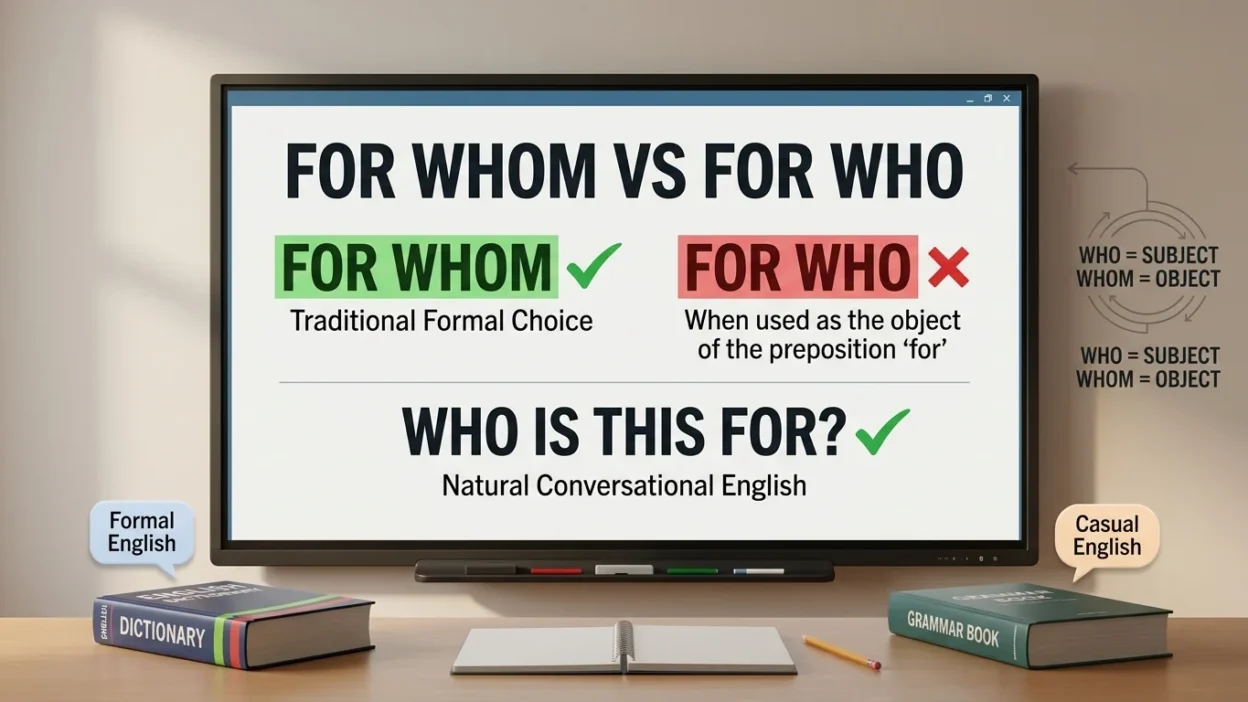
If you have ever paused before writing for whom vs for who, you are dealing with a common English grammar question. Both expressions can be heard in conversation, but traditional grammar rules distinguish them based on the grammatical role of the pronoun.
The good news is that the basic rule is simple: after the preposition for, traditional formal grammar uses whom because it is the objective form of who. However, everyday English is more flexible, and for who can sometimes occur, especially in informal speech or in structures where who is functioning differently.
Quick Answer
For whom is the traditional and formally correct choice when whom is the object of the preposition for.
For who is common in informal speech in some contexts, but it is generally avoided in formal writing when whom is clearly required.
- For whom ✓ = traditional formal grammar
- For who = common in informal or conversational English, depending on the sentence
Example
For whom is this gift? — traditional/formal
Who is this gift for? — natural and very common
If you want to avoid sounding overly formal, the second structure is often the most natural option in everyday English.
Why Is For Whom Grammatically Correct?
The traditional distinction between who and whom is based on grammatical function.
Who is traditionally used as a subject pronoun.
Whom is traditionally used as an object pronoun.
Consider:
Who called you?
Here, who is the subject of the verb called.
Now consider:
For whom did you buy the gift?
Here, whom is the object of the preposition for.
The structure can be simplified as:
You bought the gift for him.
Because him is an object form, the traditional question form is:
For whom did you buy the gift?
For Whom Meaning
For whom means for which person or for which people.
It asks about the person who is intended to receive something, benefit from something, or be the target of an action.
Examples:
- For whom is this letter intended?
- For whom did you buy the flowers?
- For whom are you preparing the report?
- For whom was the announcement written?
In each sentence, whom refers to the person affected by or associated with the preposition for.
For Who Meaning
For who is heard in everyday speech, particularly in informal English. However, under traditional grammar rules, who is not the expected object form after for.
For example:
For who did you buy this?
Traditional grammar would prefer:
For whom did you buy this?
But there is an important point: modern English increasingly favors natural sentence structures over strict traditional rules. Instead of using either form, speakers often move the preposition to the end:
Who did you buy this for?
This construction is extremely natural in ordinary conversation.
For Whom vs For Who Comparison Table
| Expression | Traditional Grammar | Common in Conversation | Best Formal Choice |
|---|---|---|---|
| For whom | Correct | Less common | Yes |
| For who | Generally nonstandard when who is the object of for | Sometimes heard | Usually no |
| Who … for? | Grammatically accepted | Very common | Yes, depending on style |
| The choice therefore depends not only on grammar but also on formality and sentence structure. |
Who vs Whom: The Basic Rule
A simple traditional rule is:
Who = subject
Whom = object
Compare:
Who invited Sarah?
Here, who performs the action.
Whom did Sarah invite?
Here, whom receives the action.
Another useful test is to replace the word with he/him or she/her.
If he/she fits, use who.
If him/her fits, use whom.
For example:
Who called?
→ He called.
So who is correct.
For whom did you buy the present?
→ I bought it for him.
So whom is correct.
Examples of For Whom
Here are several natural examples:
- For whom did you purchase this gift?
- For whom is this message intended?
- For whom are these documents?
- For whom was the award created?
- For whom are you writing this letter?
- For whom did she reserve the table?
- For whom is the package?
- For whom should I leave the documents?
These examples are grammatically formal and are especially suitable for careful writing.
Examples of Who … For
In everyday English, speakers often avoid placing whom after a preposition by moving the preposition to the end.
Instead of:
For whom are you waiting?
you can say:
Who are you waiting for?
Instead of:
For whom did you buy the gift?
you can say:
Who did you buy the gift for?
Instead of:
For whom is this letter?
you can say:
Who is this letter for?
These forms are natural and widely used in modern English.
Is For Who Always Wrong?
No, it is too simplistic to say that for who is always wrong in every possible sentence.
The traditional rule applies when who is being used as the object of the preposition for.
However, sentence structure can change the grammatical role of who.
For example:
For who you are is more important than your job title.
This is a different grammatical construction. Here, who you are functions as a clause, so simply applying the rule for + whom would not accurately describe the entire sentence.
This is why grammar should be understood in context rather than reduced to a rule that applies mechanically to every occurrence of the words.
Formal vs Informal English
One of the biggest practical differences between for whom and for who is register.
For whom sounds formal, traditional, and sometimes slightly old-fashioned.
Who … for? sounds natural, conversational, and modern.
For example:
Formal:
For whom was the invitation intended?
Everyday:
Who was the invitation for?
Both communicate essentially the same idea.
If you are writing a formal letter, academic paper, official document, or professional communication, for whom may be appropriate when the construction calls for it.
In casual conversation, who … for? is usually more natural.
American vs British English
The distinction is broadly similar in American and British English.
Traditional grammar in both varieties recognizes whom as the object form of who and therefore supports constructions such as for whom.
However, everyday usage in both varieties increasingly favors who in many situations, especially in conversation.
For example:
Who are you waiting for?
is natural in both American and British English.
The main difference is therefore one of formality and usage, rather than a simple American-versus-British spelling or grammar difference.
Common Mistakes
Mistake 1: Using For Who in Formal Writing
A common mistake is writing:
For who is this letter intended?
Traditional formal grammar prefers:
For whom is this letter intended?
An even more natural alternative is:
Who is this letter intended for?
Mistake 2: Thinking Whom Is Always Better
Using whom everywhere does not automatically make writing better.
For example:
Whom did you see?
is grammatically traditional, but:
Who did you see?
is extremely common in modern English.
The best choice depends on context, audience, and level of formality.
Mistake 3: Forgetting the Object Test
If you are unsure, replace the pronoun with him/her or he/she.
I bought it for him.
Therefore:
For whom did you buy it?
Mistake 4: Making Conversation Too Formal
In casual conversation, For whom are you waiting? may sound unusually formal.
Who are you waiting for? is much more natural.
For Whom vs Whom
It is also useful to understand that for whom is simply a prepositional phrase.
Compare:
Whom did you invite?
and:
For whom did you buy the gift?
In the first sentence, whom is the direct object of invite.
In the second, whom is the object of the preposition for.
The grammatical principle is the same: whom traditionally marks the object role.
For Whom vs To Whom
These expressions are sometimes confused because both use whom after a preposition.
For whom asks about the intended recipient, beneficiary, or person something is meant for.
To whom asks about the person toward whom an action is directed or to whom something is given or addressed.
Examples:
For whom did you buy the gift?
To whom did you give the gift?
The preposition changes the relationship and therefore changes the meaning.
How to Choose the Natural Expression
When deciding between these forms, ask yourself three questions:
- Is this formal writing?
- Is whom clearly the object of for?
- Would moving for to the end make the sentence sound more natural?
For example:
Formal:
For whom was the report prepared?
Natural everyday English:
Who was the report prepared for?
This gives you a useful choice without changing the basic meaning.
Related Grammar Terms
Understanding a few related terms can make this topic easier:
- Subject pronoun: performs the action, such as who.
- Object pronoun: receives the action or follows a preposition, traditionally whom.
- Preposition: a word such as for, to, with, by, or from.
- Formal English: language commonly used in academic, official, or professional contexts.
- Informal English: conversational language used in everyday situations.
The who vs whom distinction is mainly about grammatical case and sentence function.
FAQs
1. Is it for whom or for who?
In traditional formal grammar, for whom is correct when whom is the object of the preposition for. In everyday English, who … for? is also very common.
2. Is for who grammatically correct?
When who is functioning as the object of for, traditional grammar prefers for whom. However, modern informal English often uses who in such constructions.
3. Should I use for whom in formal writing?
Yes. For whom is the traditional formal choice when the pronoun is the object of for.
4. Is who are you waiting for correct?
Yes. Who are you waiting for? is a very common and natural construction in modern English.
5. Is for whom old-fashioned?
It can sound formal or somewhat traditional, especially in everyday conversation, but it remains grammatically standard and useful in formal writing.
6. What is the difference between who and whom?
Traditionally, who is used for subjects and whom for objects. For example, Who called? but Whom did you call?
7. Is whom still used in American English?
Yes. Whom is still used, particularly in formal writing and after certain prepositions, although who is increasingly common in everyday American English.
8. What is the easiest way to know whether to use who or whom?
Try replacing the word with he/him or she/her. If he/she works, use who. If him/her works, use whom.
Summary
The traditional grammatical distinction is straightforward: use whom when it functions as the object of the preposition for, giving us for whom. This form is especially appropriate in formal, academic, official, or carefully edited writing. For who is commonly heard in informal English, but it is generally not the traditional choice when who is directly functioning as the object of for.
In everyday conversation, however, English speakers frequently avoid the issue by moving the preposition to the end: Who is this for? or Who are you waiting for? These constructions are natural and widely accepted. So the best choice depends on both grammatical structure and the level of formality you want.
Actionable Takeaway
Remember: for + object → traditionally whom. In formal writing, choose for whom when the grammar calls for it. In everyday conversation, who … for? is often the most natural alternative.

Liam James is a language enthusiast and content writer at Verseslay, specializing in word comparisons, grammar debates, and vocabulary insights. He helps readers understand language nuances through clear, engaging, and practical explanations.