If you have ever wondered whether the correct spelling is dying or dieing, you are not alone. These two forms look very similar, but only one is normally correct when you mean the present participle or gerund of the verb die.
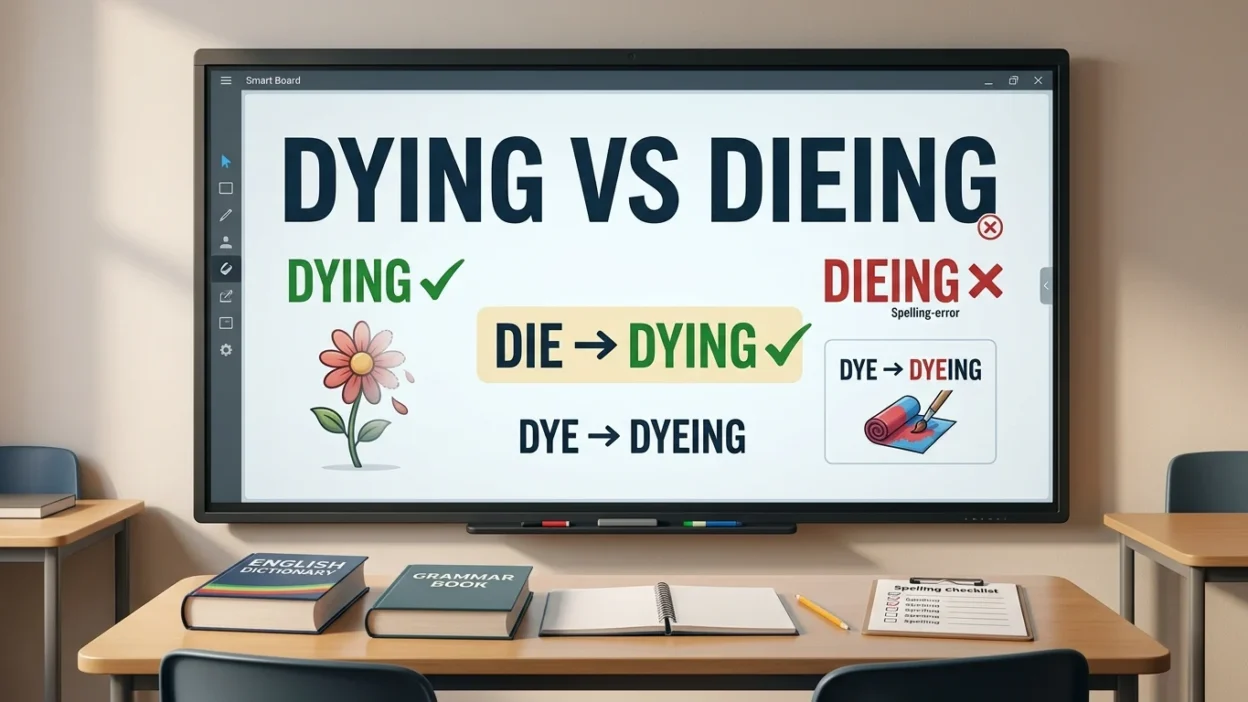
The correct spelling is dying. The form dieing is generally considered a spelling mistake in modern English. The confusion happens because many English verbs keep the final e before adding -ing, while die follows a different spelling pattern.
Quick Answer
Dying is the correct spelling when you mean the -ing form of die.
Dieing is generally incorrect in modern standard English.
- Die → dying ✓
- Die → dieing ✗
Example
The plant is dying because it has not received enough water.
Not:
The plant is dieing because it has not received enough water.
Dying Meaning
Dying is the present participle and gerund form of the verb die. It can refer to the process of losing life, or it can be used figuratively to describe something that is disappearing, ending, or becoming less active.
For example:
- The old tree is dying.
- The patient is dying.
- The flowers are dying without water.
- The tradition is slowly dying.
The word can also be used informally to express a very strong feeling: - I am dying to see the new movie.
- She is dying to know what happened.
In these expressions, dying does not literally mean losing one’s life. It emphasizes a very strong desire.
Why Is Dying Correct?
The spelling of dying may seem unusual because the base verb is die.
Normally, many verbs ending in a silent e drop the e before adding -ing:
- make → making
- write → writing
- hope → hoping
- dance → dancing
However, die is different. When die takes -ing, the spelling changes from ie to y:
die → dying
This spelling change helps avoid the awkward form dieing and follows a traditional English spelling pattern.
The same pattern can be seen in: - lie → lying
- tie → tying
- vie → vying
So the correct form is:
die + ing → dying
Dieing Meaning
In modern standard English, dieing is generally not used as the normal -ing form of die.
If you want to describe someone or something that is in the process of dying, write dying.
For example:
The leaves are dying. ✓
Not:
The leaves are dieing. ✗
The spelling dieing may occasionally appear as an error or in unusual historical contexts, but it should not be used in ordinary modern English writing.
Dying vs Dieing Comparison Table
| Word | Status | Meaning | Example |
|---|---|---|---|
| Dying | Correct | Present participle/gerund of die | The flowers are dying. |
| Dieing | Generally incorrect | Not the standard modern form of die | Avoid this spelling. |
| The easiest rule is: | |||
| Die → dying |
Dying Examples in Sentences
Here are some natural examples of dying:
- The flowers are dying because they need water.
- The tree is dying after years of disease.
- The animal was dying when it was found.
- Many old traditions are slowly dying out.
- The fire is dying down.
- The company is dying because it failed to adapt.
- He was dying of laughter after hearing the joke.
- I am dying to know the answer.
- She is dying to visit Paris.
- The sound of the music was slowly dying away.
These examples show that dying can have both literal and figurative meanings.
Dying as a Literal Meaning
In its most direct sense, dying means being in the process of death.
For example:
The injured animal was dying.
Here, the word describes an actual physical process.
Other examples include:
- The patient is dying.
- The plant is dying from lack of water.
- The fish were dying because of polluted water.
This is the most straightforward use of the word.
Dying as a Figurative Meaning
Dying can also be used figuratively to describe something that is gradually disappearing or becoming less common.
For example:
The old tradition is dying out.
This does not necessarily mean that something is literally dying. It means the tradition is becoming less common and may eventually disappear.
Other examples:
- The custom is dying out.
- Traditional crafts are slowly dying.
- The old industry is dying.
- Interest in the sport is dying down.
This figurative use is common in everyday English and formal writing.
Dying to Do Something
One particularly common expression is dying to + verb.
It means being extremely eager or excited to do something.
For example:
I am dying to hear the news.
This does not mean that the speaker is literally dying. It means the speaker is very eager to hear the news.
More examples:
- I’m dying to try that restaurant.
- She is dying to meet her favorite author.
- We are dying to know what happened.
- He was dying to tell everyone the good news.
This is an informal and expressive use of dying.
Dying vs Dead
Dying and dead are not interchangeable.
Dying describes the process of approaching death.
Dead describes a state after life has ended.
Compare:
The plant is dying.
The plant is still alive but is in poor condition.
The plant is dead.
The plant is no longer alive.
This distinction is important when choosing the correct word.
Dying vs Death
These words are also related but have different grammatical functions.
Dying is related to the process of dying.
Death refers to the end of life or the condition of being dead.
Examples:
- The patient is dying.
- His death was unexpected.
You would not normally replace one with the other because they perform different roles in a sentence.
Common Mistakes
1. Writing Dieing Instead of Dying
Incorrect:
The flowers are dieing.
Correct:
The flowers are dying.
This is the most common spelling mistake involving these words.
2. Applying the Normal Silent-E Rule
Learners often think:
die + ing = dieing
But die is an exception to the simple rule they may have learned for verbs ending in silent e.
Remember:
die → dying
3. Confusing Dying With Dyeing
Another important spelling distinction is dyeing.
Dying comes from die.
Dyeing comes from dye, meaning to change the color of something.
Compare:
The plant is dying.
She is dyeing the fabric blue.
These words sound similar but have completely different meanings.
4. Confusing Dying With Lying
The spelling pattern also appears in:
- die → dying
- lie → lying
- tie → tying
Remembering these related forms can make the spelling easier.
Dying vs Dyeing vs Dieing
| Word | Meaning | Example |
|---|---|---|
| Dying | Becoming dead or figuratively disappearing | The plant is dying. |
| Dyeing | Coloring something with dye | She is dyeing the cloth. |
| Dieing | Generally an incorrect spelling of dying | Avoid this form. |
| This three-way comparison is especially useful because dying and dyeing are both legitimate words, while dieing is generally not the standard form. |
American vs British English
There is no meaningful difference between American and British English in the spelling of this word.
Both varieties use:
die → dying
The spelling dieing is not the standard modern spelling in either American or British English.
Similarly, the distinction between dying and dyeing remains the same in both varieties.
Synonyms and Related Words
Depending on the context, alternatives to dying may include:
- passing away
- nearing death
- losing life
- fading
- disappearing
- declining
- weakening
- dying out
- dying down
The appropriate synonym depends on whether you are talking about literal death or a figurative decline.
For example, dying out can mean gradually disappearing:
The language is slowly dying out.
Meanwhile, dying down means becoming less intense:
The noise is dying down.
How to Remember Dying
A simple memory trick is to remember:
Die → Dying
The ie changes to y before -ing.
You can also remember the related forms:
- die → dying
- lie → lying
- tie → tying
This makes it easier to recognize the spelling pattern.
If you see dieing, stop and check whether you actually mean dying. In ordinary modern English, dying will almost always be the form you need.
FAQs
1. Is it dying or dieing?
Dying is the correct modern spelling when it is the -ing form of die. Dieing is generally considered incorrect.
2. Why is dying spelled without the e?
The spelling changes from ie to y when die takes the -ing ending: die → dying.
3. Is dieing ever correct?
For ordinary modern English, dieing is not the standard spelling of the -ing form of die. Use dying instead.
4. What is the difference between dying and dyeing?
Dying means losing life or, figuratively, disappearing or declining. Dyeing means coloring something with dye.
5. Is dying American or British English?
Dying is the standard spelling in both American and British English.
6. What does dying to do something mean?
Dying to do something means being extremely eager or excited to do it.
For example: I’m dying to see the results.
7. What is the past tense of die?
The past tense of die is died.
For example: The plant died last winter.
8. What is the noun form of die?
The noun is death.
For example: His death shocked everyone.
Summary
The correct spelling is dying, not dieing, when you need the -ing form of the verb die. Although many English verbs ending in a silent e simply drop the e before adding -ing, the verb die follows a different spelling pattern: die → dying.
It is also important not to confuse dying with dyeing. Dying relates to death or figurative decline, while dyeing means coloring something. The spelling dieing is generally a mistake in modern English, so when writing about someone or something that is dying, choose dying.
Actionable Takeaway
Remember this simple rule: die → dying. If you mean becoming dead, declining, or being extremely eager in the expression dying to, use dying. Use dyeing only when you mean coloring something.