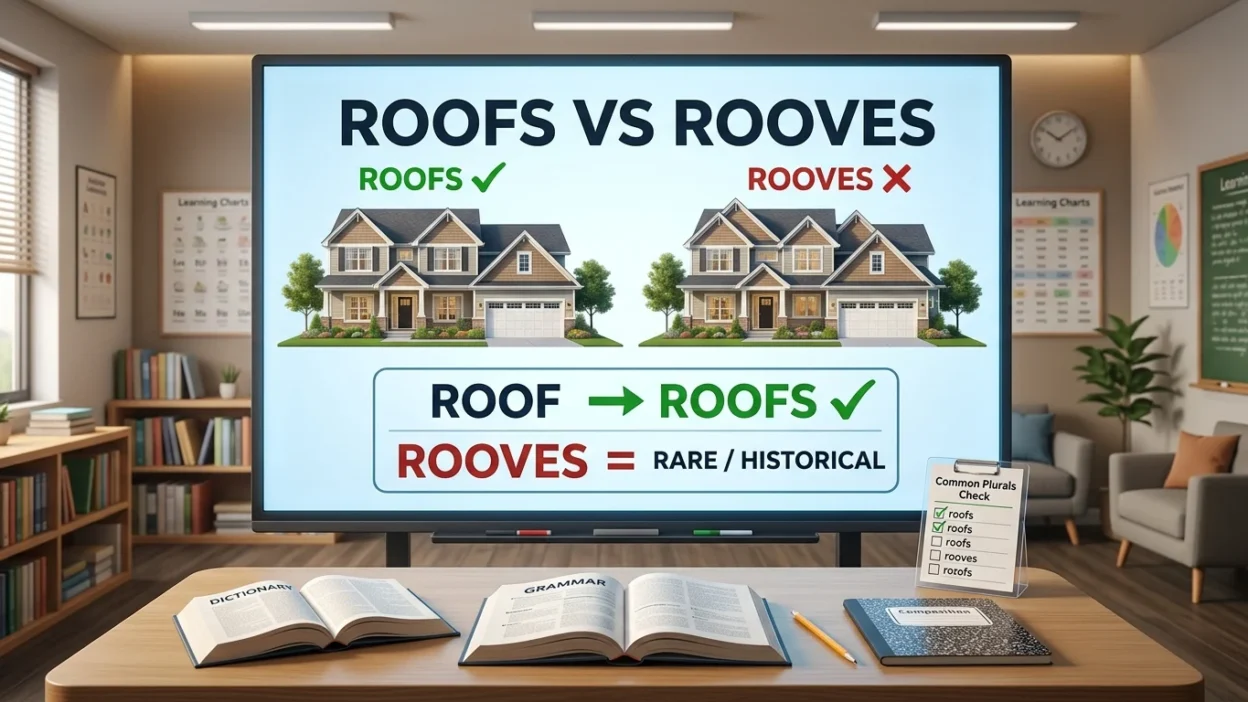
If you are unsure whether the plural of roof is roofs or rooves, you are not alone. Both forms have appeared in English, and the unusual spelling rooves can sometimes be found in older texts or regional usage. However, modern standard English has a clear preference.
The good news is that the correct plural form for most everyday writing is roofs. Whether you are writing an email, school assignment, article, report, or professional document, roofs is the form you should normally choose.
Quick Answer
Roofs is the standard and widely accepted plural of roof in modern English.
Rooves is an older or less common plural form that is now generally considered nonstandard or archaic in most contexts.
- Roof → singular
- Roofs → standard plural
- Rooves → historical/rare alternative
Example
The houses have red roofs. ✓
The houses have red rooves. → uncommon and generally best avoided in modern standard English
Roof Meaning
A roof is the covering or upper structure of a building. It protects the interior from rain, snow, wind, sunlight, and other weather conditions.
For example:
- The roof of the house needs repair.
- Snow covered the roof.
- We need to replace the damaged roof.
When you want to talk about more than one roof, the standard plural is roofs.
For example: - The roofs of the houses were covered with snow.
- Several roofs were damaged by the storm.
- The new buildings have flat roofs.
Roofs Meaning
Roofs is simply the plural form of roof. It refers to two or more roofs.
Examples:
- The roofs of the houses are made of metal.
- Birds were sitting on the roofs.
- The storm damaged hundreds of roofs.
- Solar panels were installed on several roofs.
There is no special change in meaning between roofs and the singular roof. The difference is simply number.
Is Roofs or Rooves Correct?
In modern standard English, roofs is the preferred plural.
Although rooves has historical support and can still be encountered, it is uncommon in contemporary English and may look unusual to many readers.
For modern writing, use:
roof → roofs
This follows the common English pattern in which many nouns ending in f or fe simply take -s in the plural.
For example:
- roof → roofs
- belief → beliefs
- chief → chiefs
- chef → chefs
English does have exceptions, such as leaf → leaves and knife → knives, which is one reason learners sometimes assume that roof should become rooves. But English plural forms cannot always be predicted simply from spelling.
Why Do People Write Rooves?
The spelling rooves exists because English has historically had different plural patterns for words ending in f.
Some nouns change f to v before adding a plural ending:
- wolf → wolves
- loaf → loaves
- leaf → leaves
- knife → knives
This pattern may lead people to assume:
roof → rooves
However, modern standard English normally uses roofs instead.
The spelling rooves has appeared in historical English and can still be found occasionally, but it is not the normal choice in contemporary standard writing.
Roofs vs Rooves Comparison Table
| Form | Status | Meaning | Recommended Today? |
|---|---|---|---|
| roof | Singular | One roof | Yes |
| roofs | Standard plural | More than one roof | Yes |
| rooves | Rare/historical alternative | More than one roof | Generally no |
| The easiest rule is: | |||
| One roof → two roofs. |
Roofs Examples in Sentences
Here are some natural examples using roofs:
- The roofs of the houses were damaged by heavy rain.
- Many roofs in the area need repairs.
- The workers are painting the roofs.
- Solar panels cover several roofs.
- The roofs were designed to withstand strong winds.
- Water was leaking through the roofs.
- The new roofs look modern and attractive.
- Birds were resting on the roofs of the buildings.
- The roofs of the old houses were made of clay tiles.
- Several roofs collapsed under the weight of the snow.
These examples demonstrate the standard modern usage.
Is Rooves Ever Correct?
Rooves is not simply an invented spelling. It has been used historically as a plural of roof, and dictionaries may mention it as an old, dialectal, or less common form.
However, that does not mean it is the best choice for contemporary standard English.
If your goal is clear, modern, broadly accepted English, use roofs.
For example, in a school assignment:
The roofs of the houses were damaged by the storm. ✓
This is much more natural than:
The rooves of the houses were damaged by the storm.
Common Mistakes
1. Assuming Every F Becomes V
One of the most common mistakes is applying the f → v plural pattern to every noun ending in f.
That does not work in English.
For example:
- roof → roofs
- chief → chiefs
- belief → beliefs
But: - leaf → leaves
- wolf → wolves
- knife → knives
Plural formation depends on the individual word.
2. Using Rooves in Modern Formal Writing
Although rooves has historical usage, it can look unusual or outdated in contemporary writing.
If you are writing a report, article, assignment, or professional document, roofs is the safer and more natural choice.
3. Thinking Rooves Is Always Wrong
It is useful to understand that rooves has existed as a plural form. Calling it completely invented would be inaccurate.
The issue is that it is rare and nonstandard for most modern contexts, rather than being the normal plural used today.
4. Confusing Roofs With Roof’s
Remember that roofs and roof’s are different.
Roofs = plural
Roof’s = possessive singular or contraction
Examples:
- The roofs are damaged.
- The roof’s condition is poor.
5. Confusing Roofs With Roofers
A roofer is a person who installs or repairs roofs.
For example:
- The roofer repaired the roof.
- Several roofers worked on the roofs.
The words are related but have different meanings.
American vs British English
There is no major difference between American and British English regarding the standard plural of roof.
In both varieties, roofs is the normal modern plural.
For example:
The roofs of the buildings were damaged.
This sentence is natural in both American and British English.
The form rooves may occasionally appear in older British texts or regional usage, but it is not the normal modern plural in standard British English either.
Therefore, whether your audience is American or British, roofs is the safest choice.
Why Roof Is Different From Leaf
A common question is why English uses:
leaf → leaves
but:
roof → roofs
The answer is that English pluralization is influenced by historical development and word-specific patterns rather than one universal spelling rule.
Although roof ends in f, it belongs to the group that normally forms the plural with -s.
This is why:
roof + s = roofs
is the standard modern form.
The same idea applies to other words that do not follow the expected f → v pattern:
- chef → chefs
- chief → chiefs
- belief → beliefs
- proof → proofs
- safe → safes
Learning these common forms individually is often more reliable than trying to apply one spelling rule to every noun.
Roofs in Different Contexts
The word roofs can appear in many contexts.
Houses and Buildings
- The roofs of the houses need repair.
Architecture
- The buildings have unusual roofs.
Weather
- Strong winds damaged several roofs.
Solar Energy
- Solar panels were installed on residential roofs.
Construction
- Workers are replacing old roofs.
Urban Areas
- The city’s rooftops and roofs look different from above.
In each case, roofs is the standard plural.
Roofs vs Rooftops
Although the words are related, they are not always interchangeable.
A roof is the structure that covers a building.
A rooftop generally refers to the upper surface or top area of a building, especially when people use it as a space.
For example:
- The roof was damaged by the storm.
- We had dinner on the rooftop.
The plural forms are: - roofs
- rooftops
This distinction can be useful when writing about buildings, architecture, construction, or real estate.
Synonyms and Related Words
Depending on the context, related words include:
- rooftop
- covering
- shelter
- canopy
- ceiling
- roofing
- roof structure
- roof covering
- tiled roof
- flat roof
- pitched roof
Note that these words are not exact synonyms in every context. A ceiling, for example, is the interior surface beneath a roof, while a roof is the exterior covering of a building.
How to Remember the Correct Plural
A simple memory trick is:
Roof → roofs
Think of the sentence:
Many roofs protect many homes.
Do not automatically change every final f to v when forming a plural.
If you are unsure, remember the most important rule:
The standard modern plural of roof is roofs.
FAQs
Is roofs the correct plural of roof?
Yes. Roofs is the standard and most widely accepted plural form of roof in modern English.
Is rooves a real word?
Yes. Rooves has historical and dialectal usage as a plural of roof, but it is rare and generally not preferred in modern standard English.
Which is more common, roofs or rooves?
Roofs is overwhelmingly the normal modern form and is the one you should generally use.
Why isn’t the plural of roof rooves?
English does not apply the f → v pattern to every noun ending in f. Roof normally forms its plural simply by adding -s.
Is rooves correct in British English?
It can be found as an older or regional form, but roofs is the standard modern plural in British English.
Is roofs correct in American English?
Yes. Roofs is the standard plural in American English.
Should I use rooves in formal writing?
Generally, no. Roofs is the clearer and more widely accepted choice for modern formal writing.
What is the singular of roofs?
The singular is roof.
For example:
- One roof
- Two roofs
Summary
The standard modern plural of roof is roofs. Although rooves has appeared in historical English and may still be found occasionally, it is rare and is generally not the preferred form in contemporary standard English. For everyday communication, schoolwork, professional writing, and online content, roofs is the form to choose.
The confusion mainly comes from other English words such as leaf → leaves and knife → knives, which change f to v in the plural. However, English has many word-specific plural patterns, so it is better to learn roof → roofs as its standard form rather than applying the same rule to every word ending in f.
Actionable Takeaway
Remember the simple rule: one roof, two roofs. Use roofs in modern English, and treat rooves as a rare historical or regional form rather than the normal plural.

Liam James is a language enthusiast and content writer at Verseslay, specializing in word comparisons, grammar debates, and vocabulary insights. He helps readers understand language nuances through clear, engaging, and practical explanations.