
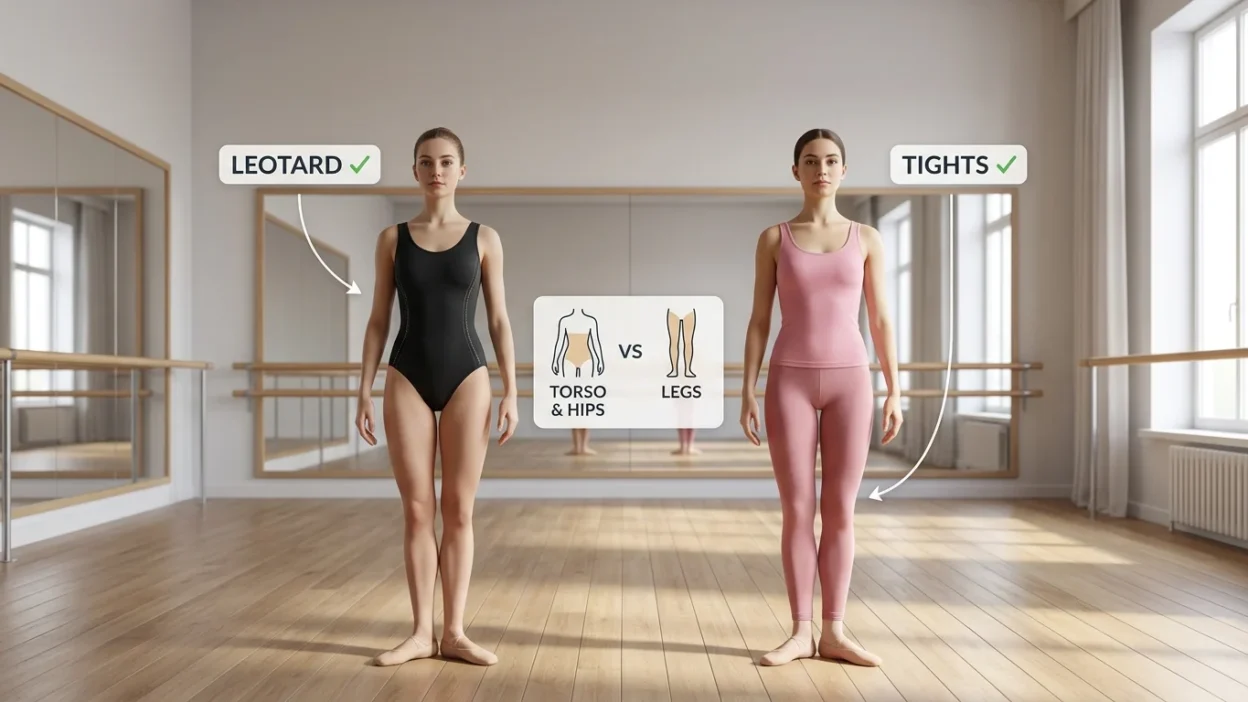
If you are confused about leotard vs tights, you are not alone. Both are closely associated with ballet, gymnastics, dance, figure skating, theater, and other performance activities, but they are actually different types of clothing. Knowing the difference makes it much easier to choose the right outfit or describe what someone is wearing.
The simplest distinction is that a leotard is a one-piece garment covering the torso and usually the hips, while tights are close-fitting garments worn on the legs and sometimes extending up to the waist. They can be worn together, which is one reason the two terms are sometimes confused. Let’s look at their meanings, differences, examples, common mistakes, and usage in American and British English.
Quick Answer
A leotard is a one-piece, close-fitting garment that covers the torso and usually extends over the hips. It is commonly worn by dancers, gymnasts, and performers.
Tights are close-fitting garments that cover the legs and may extend from the feet or ankles up to the waist.
In simple terms:
Leotard = covers the torso and hips
Tights = cover the legs
They can also be worn together.
For example:
The gymnast wore a blue leotard.
The dancer wore a black leotard with matching tights.
What Is a Leotard?
A leotard is a tight-fitting, one-piece garment designed to cover the torso and hips while leaving the legs mostly exposed.
Leotards are especially common in activities where freedom of movement is important.
You may see them in:
- Ballet
- Gymnastics
- Dance
- Acrobatics
- Theater
- Circus performances
- Figure skating
- Fitness activities
A typical leotard fits closely against the body and may have short sleeves, long sleeves, or no sleeves.
What Are Tights?
Tights are close-fitting garments that cover the legs. Depending on the style, they may extend from the feet all the way up to the waist.
Tights are commonly worn for:
- Ballet
- Dance
- Gymnastics
- Theater
- Costumes
- Fashion
- Warmth
- Exercise
Some tights cover the feet completely, while others leave the feet exposed.
Common varieties include:
- Footed tights
- Footless tights
- Stirrup tights
- Convertible tights
- Dance tights
- Ballet tights
- Opaque tights
- Sheer tights
Leotard vs Tights: Main Difference
The biggest difference is which part of the body the garment covers.
| Feature | Leotard | Tights |
|---|---|---|
| Main coverage | Torso and hips | Legs |
| Basic design | One-piece garment | Leg-covering garment |
| Covers arms? | Sometimes | No |
| Covers legs? | Usually not | Yes |
| Common in ballet | Yes | Yes |
| Common in gymnastics | Yes | Sometimes |
| Can be worn together? | Yes | Yes |
| Main purpose | Movement and performance | Leg coverage, warmth, or performance |
The two garments are not alternatives in every situation. In dance, for example, a person may wear both a leotard and tights.
Leotard and Tights Together
One of the most common dance outfits consists of a leotard paired with tights.
For example:
The ballet students wore pink tights and black leotards.
Here, the leotard covers the upper body, while the tights cover the legs.
This combination allows dancers to move freely while providing coverage and creating a traditional dance appearance.
Types of Leotards
Leotards come in many styles.
Sleeveless Leotard
A sleeveless leotard leaves the shoulders and arms uncovered.
It is common in ballet and gymnastics.
Short-Sleeved Leotard
This style provides some coverage around the upper arms.
Long-Sleeved Leotard
Long-sleeved leotards provide greater arm coverage and may be useful in colder environments or certain performances.
High-Neck Leotard
A high-neck style provides additional coverage around the neckline.
Ballet Leotard
A ballet leotard is typically designed specifically for dance training and performances.
Different ballet schools may have particular requirements regarding color and style.
Types of Tights
Tights also come in several varieties.
Footed Tights
Footed tights cover the entire foot.
They are particularly common in ballet and dance.
Footless Tights
Footless tights stop around the ankle and leave the feet uncovered.
They can be useful for activities where dancers need direct contact between their feet and the floor.
Convertible Tights
Convertible tights have an opening around the bottom of the foot, allowing them to be worn either over or under the foot.
Stirrup Tights
Stirrup tights cover most of the foot but leave the heel and front of the foot exposed.
Leotard vs Bodysuit
A leotard and bodysuit can look similar, but they are not always used in exactly the same context.
A leotard is strongly associated with activities such as dance and gymnastics.
A bodysuit is often used as a fashion garment and may be worn as part of an everyday outfit.
For example:
The gymnast wore a leotard.
She wore a black bodysuit with jeans.
The designs may overlap, but the purpose and context often distinguish them.
Leotard vs Swimsuit
A leotard can also resemble a one-piece swimsuit.
However, they are designed for different purposes.
A swimsuit is specifically designed for swimming or water activities and is made from materials suitable for getting wet.
A leotard is designed primarily for movement, performance, dance, gymnastics, or similar activities.
Although they may look similar, they are not necessarily interchangeable.
Tights vs Leggings
Another common source of confusion is tights vs leggings.
Tights are generally thinner, more form-fitting, and often made from stretchy hosiery materials. Many styles cover the feet or are specifically designed for dance or fashion.
Leggings are usually thicker and are generally worn as a separate lower-body garment.
For example:
She wore a leotard and tights for ballet class.
She wore leggings and a T-shirt for exercise.
There can be overlap between the two categories, especially in modern fashion.
Common Mistakes With Leotard and Tights
Mistake 1: Thinking a Leotard Covers the Legs
A standard leotard does not cover the legs like tights do.
It primarily covers the torso and hips.
Mistake 2: Calling Tights a Leotard
Tights cover the legs, while a leotard is a one-piece torso garment.
They can be worn together, but they are different items.
Mistake 3: Assuming All Tights Cover the Feet
Not all tights cover the feet.
Footless, stirrup, and other styles leave some part of the foot exposed.
Mistake 4: Using Leotard and Bodysuit as Exact Synonyms
The garments can look similar, but their typical uses differ.
A leotard is especially associated with performance and athletic activities, while a bodysuit is often associated with fashion.
Mistake 5: Thinking Tights Always Mean Dancewear
Tights are also widely used in fashion and for warmth.
Their meaning depends on the context.
Examples of Leotard in Sentences
Here are some natural examples:
- The gymnast wore a red leotard.
- She bought a new leotard for ballet class.
- The dancers wore matching leotards.
- Her performance costume included a long-sleeved leotard.
- The coach asked the students to wear black leotards.
- The child practiced gymnastics in a comfortable leotard.
Examples of Tights in Sentences
- She wore pink tights for ballet.
- The dancer bought a new pair of tights.
- The costume included black tights.
- These tights are comfortable enough for long rehearsals.
- The gymnast wore tights during the performance.
- She chose footless tights for dance practice.
American vs British English
There is no major difference between American and British English in the basic meanings of leotard and tights.
Both varieties commonly use leotard for the close-fitting one-piece garment associated with dance, gymnastics, and performance.
The word tights is also widely understood in both varieties.
However, there can be differences in related clothing vocabulary.
In British English, tights commonly refers to close-fitting legwear that may be worn for warmth or fashion.
In American English, tights is also common, especially for dance, performance, and fashion.
The exact terminology may vary slightly depending on the type of garment and context, but leotard and tights are standard terms in both varieties.
How to Remember the Difference
Use this simple memory trick:
Leotard = upper body
Tights = legs
Imagine a dancer wearing both.
The leotard forms the one-piece upper-body garment.
The tights cover the legs.
This makes the distinction easy to remember.
Related Dancewear Vocabulary
If you are learning vocabulary related to ballet and dancewear, you may also encounter:
- Leotard
- Tights
- Ballet shoes
- Pointe shoes
- Dance skirt
- Unitard
- Bodysuit
- Leggings
- Warm-up clothing
- Dance costume
A unitard, for example, is similar to a leotard but extends down the legs.
This is another useful distinction:
Leotard = torso and hips
Unitard = torso and legs
FAQs
1. What is the difference between a leotard and tights?
A leotard is a one-piece garment covering the torso and hips, while tights are close-fitting garments that cover the legs.
2. Can you wear a leotard with tights?
Yes. Wearing a leotard with tights is very common in ballet, dance, gymnastics, and other performance activities.
3. Are tights considered pants?
Generally, tights are classified as hosiery or close-fitting legwear rather than traditional pants. However, fashion terminology can vary.
4. Do leotards cover the legs?
Standard leotards generally do not cover the legs. They stop around the hips or upper thighs.
5. Are leggings and tights the same thing?
Not exactly. Tights are generally thinner and more form-fitting, while leggings are usually thicker and worn as a separate lower-body garment.
6. Is a leotard the same as a bodysuit?
They can look similar, but they are usually associated with different contexts. Leotards are strongly associated with dance and gymnastics, while bodysuits are commonly worn as fashion garments.
7. Are leotards only used for ballet?
No. Leotards are also used for gymnastics, dance, theater, figure skating, acrobatics, and other performance activities.
8. Are leotard and tights the same in American and British English?
Yes, the basic meanings are essentially the same in both American and British English.
Summary
The difference between leotard vs tights is easy once you focus on body coverage. A leotard is a close-fitting one-piece garment that covers the torso and hips, while tights cover the legs and may extend from the feet to the waist. They are especially common in ballet, dance, gymnastics, and performance settings.
These garments are often worn together rather than being alternatives. A dancer might wear a leotard with footed or footless tights, depending on the activity and dress requirements. Understanding this distinction also helps you differentiate related clothing terms such as bodysuit, leggings, swimsuit, and unitard.