
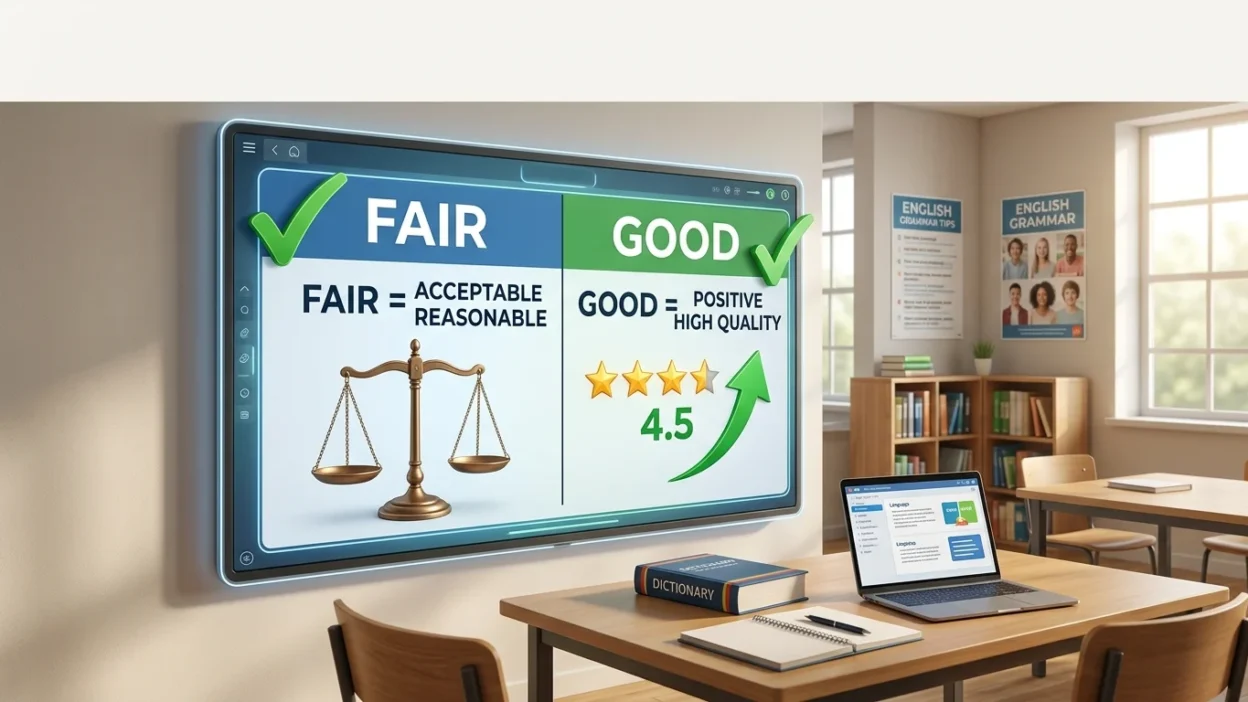
The words fair and good are both common English adjectives, but they do not always mean the same thing. Learners often use them interchangeably because both can describe something positively, especially when talking about quality, performance, or situations.
However, fair usually suggests that something is acceptable, reasonable, or average, while good generally suggests that something is positive, satisfactory, or above average. The right choice depends heavily on context. In this guide, we will explain fair vs good with simple meanings, examples, comparisons, common mistakes, synonyms, and American vs British English usage.
Quick Answer
Fair usually means acceptable, reasonable, just, or average.
Good usually means positive, satisfactory, suitable, or of a high enough quality.
For example:
The food was fair.
The food was acceptable, but not especially impressive.
The food was good.
The food was enjoyable or of satisfactory quality.
Simple difference
Fair = acceptable or average
Good = positive or better than merely acceptable
However, fair has several other meanings, including just, reasonable, light in color, and beautiful, so context is very important.
What Does Fair Mean?
The word fair has several meanings in English.
When describing quality or performance, fair can mean reasonably good but not excellent.
For example:
His performance was fair.
This suggests that his performance was acceptable but probably not outstanding.
Fair can also mean reasonable or just.
For example:
The teacher gave everyone a fair chance.
Here, fair means equal and reasonable.
Another meaning relates to appearance or color:
She has fair hair.
In this context, fair means light in color.
Fair can also refer to an event:
We visited the county fair.
Therefore, fair has a much wider range of meanings than simply acceptable quality.
What Does Good Mean?
Good is one of the most frequently used adjectives in English.
It can describe something that is positive, satisfactory, useful, enjoyable, successful, or high in quality.
Examples:
- This is a good book.
- She is a good teacher.
- He did a good job.
- The food was good.
- We had a good time.
- That is a good idea.
The exact meaning depends on context, but good generally communicates a positive judgment.
Fair vs Good: Main Difference
The easiest way to understand the difference is to think about a scale.
| Word | General Meaning | Approximate Level |
|---|---|---|
| Poor | Not good | Low |
| Fair | Acceptable or average | Moderate |
| Good | Positive or satisfactory | Above fair |
| Very good | Clearly high quality | High |
| Excellent | Extremely good | Very high |
This is only a general guide because fair can mean something completely different when it refers to justice or equality.
For example:
The movie was fair.
This may mean the movie was acceptable but not particularly impressive.
The movie was good.
This gives a more clearly positive evaluation.
Fair vs Good for Performance
Both words are frequently used to describe someone’s performance.
Fair Performance
She gave a fair performance.
This usually means her performance was acceptable or average.
It does not necessarily mean she performed badly, but it does not strongly praise her either.
Good Performance
She gave a good performance.
This is more clearly positive.
It suggests that she performed successfully and met or exceeded expectations.
Compare:
His performance was fair.
Acceptable or average.
His performance was good.
Clearly satisfactory or positive.
Fair vs Good for Quality
The same distinction applies when describing products or services.
The quality is fair.
This suggests the quality is acceptable but not especially impressive.
The quality is good.
This indicates that the quality is satisfactory or better than average.
For example:
The phone has fair battery life.
This means the battery life is acceptable but could be better.
The phone has good battery life.
This suggests that the battery performs well.
Fair vs Good in Reviews
These words can have an important difference in reviews.
If someone says:
The restaurant was fair.
They probably mean the restaurant was acceptable but not particularly impressive.
If someone says:
The restaurant was good.
They are giving a more positive recommendation.
This is why businesses and reviewers often pay attention to these words.
A simple rating idea
You might interpret them roughly as:
Fair → 5 or 6 out of 10
Good → 7 or 8 out of 10
This is not a strict rule, but it helps explain the difference in everyday evaluation.
Fair Does Not Always Mean Average
This is important because fair has several meanings.
Consider:
That is a fair price.
Here, fair does not mean average.
It means the price is reasonable.
Another example:
The judge made a fair decision.
Here, fair means just and impartial.
So you should always look at the context before deciding what fair means.
Fair Meaning Just or Reasonable
One of the most important meanings of fair is just, reasonable, or impartial.
Examples:
- Everyone deserves a fair chance.
- That seems like a fair price.
- The referee made a fair decision.
- We need a fair agreement.
- The rules should be fair to everyone.
In these examples, replacing fair with good would change or destroy the meaning.
For example:
That is a good price.
This means the price is favorable or inexpensive.
That is a fair price.
This means the price is reasonable or appropriate.
The two sentences are similar but not identical.
Fair vs Good for People
When describing a person’s character, good is much more common.
For example:
She is a good person.
This suggests that she has positive moral qualities.
You can use fair to describe someone’s behavior or treatment of others:
She is fair to her employees.
This means she treats them justly and reasonably.
Therefore:
good person → positive moral character
fair person → treats people equally and reasonably
Fair vs Good for Health
Both words can describe someone’s health or condition, but the meaning can differ.
How are you feeling?
Fair.
This can mean the person feels reasonably well but not particularly good.
How are you feeling?
Good.
This generally indicates a more positive condition.
In everyday conversation, people may also say:
- I feel okay.
- I feel fine.
- I feel pretty good.
- I feel better.
The exact choice depends on the intended tone.
Fair vs Good in American English
In American English, fair can sometimes be used to mean average or moderate, particularly when evaluating quality or performance.
For example:
The movie was fair.
This suggests the movie was acceptable but not outstanding.
Good is clearly more positive.
American English also commonly uses fair to mean reasonable or just:
That sounds fair.
This is a very common expression meaning that something seems reasonable or acceptable.
Fair vs Good in British English
British English uses fair and good in largely the same ways.
The phrase fair enough is especially common in British English and means something like:
- That is reasonable.
- I understand your point.
- That seems acceptable.
For example:
You do not want to go tonight? Fair enough.
American English speakers also understand and use fair enough, so it is not exclusively British.
There is no major grammar difference between American and British English for these adjectives.
Common Mistakes With Fair and Good
Mistake 1: Assuming Fair Always Means Good
Fair can mean acceptable, reasonable, or just.
It is not always a direct synonym for good.
Mistake 2: Thinking Fair Is Always Negative
Calling something fair is not necessarily criticism.
For example:
That is a fair price.
This is positive because it means the price is reasonable.
Mistake 3: Using Good When You Mean Just
Incorrect for the intended meaning:
The referee made a good decision to everyone.
Better:
The referee made a fair decision.
Here, fair means impartial or just.
Mistake 4: Assuming Fair and Good Are Exact Synonyms
They overlap when evaluating quality, but they communicate different levels of approval.
Fair often sounds neutral or moderate.
Good usually sounds more positive.
Fair vs Good vs Fine
Another useful comparison is fair vs good vs fine.
Fair can mean acceptable or average.
Fine can mean satisfactory or okay.
Good generally expresses stronger approval.
For example:
How was the movie?
Fair. → It was acceptable but not impressive.
Fine. → It was okay.
Good. → I liked it or thought it was satisfactory.
The exact emotional strength can change depending on tone and context.
Fair vs Good Synonyms
Synonyms for Fair
Depending on the meaning:
- Reasonable
- Just
- Impartial
- Acceptable
- Average
- Moderate
- Decent
- Equitable
Synonyms for Good
Depending on context:
- Excellent
- Positive
- Fine
- Nice
- Satisfactory
- Effective
- Suitable
- Quality
- Beneficial
- Enjoyable
Not every synonym can replace the original word in every sentence.
How to Remember Fair vs Good
Use this simple rule:
Fair = acceptable, reasonable, or just
Good = positive, satisfactory, or high quality
If you are evaluating quality, fair is often weaker than good.
If you are talking about equality or justice, fair is usually the correct choice.
For example:
The service was fair. → Acceptable.
The service was good. → Positive evaluation.
The price was fair. → Reasonable.
The teacher was fair. → Impartial and just.
FAQs
1. Is fair better than good?
Usually, no. When describing quality or performance, good generally indicates a more positive evaluation than fair. However, fair can have completely different meanings, such as just or reasonable.
2. Does fair mean average?
It can. When evaluating quality or performance, fair can mean acceptable or average. But fair can also mean reasonable, just, or light in color.
3. What is the difference between fair and good?
Fair often means acceptable, moderate, reasonable, or just. Good generally means positive, satisfactory, or high enough in quality to be praised.
4. Can fair and good be synonyms?
Sometimes, particularly when describing something as acceptable or satisfactory. However, they are not exact synonyms because fair has several additional meanings.
5. Is fair enough the same as good enough?
Not exactly. Fair enough usually means something is reasonable or acceptable. Good enough means something meets the required standard.
6. Can I say a person is fair?
Yes. Fair can describe someone who treats people equally and reasonably.
Example:
Our manager is fair to everyone.
7. Is fair used differently in American and British English?
The basic meanings are the same. Both varieties use fair for reasonable, just, and acceptable meanings.
8. What is the opposite of fair?
Depending on the meaning, opposites include unfair, unjust, unreasonable, or poor.
Summary
The difference between fair vs good depends heavily on context. When evaluating quality or performance, fair often means acceptable, average, or moderate, while good usually communicates stronger approval. For example, a fair performance is acceptable, whereas a good performance is clearly satisfactory or positive.
However, fair has meanings that good cannot replace. It can mean just, impartial, reasonable, or equitable. Saying a fair price means a reasonable price, while a good price usually means a favorable or attractive price. Both American and British English use these words in essentially the same ways.

Liam James is a language enthusiast and content writer at Verseslay, specializing in word comparisons, grammar debates, and vocabulary insights. He helps readers understand language nuances through clear, engaging, and practical explanations.