If you’ve come across the words emasculate and demasculate, you may have wondered whether they mean the same thing—or whether demasculate is even a real word. Because both terms seem similar, many English learners and native speakers occasionally confuse them. However, only one of these words is considered standard English.
Understanding emasculate vs demasculate is important if you want to write accurately and confidently. Whether you’re reading literature, studying vocabulary, or improving your English grammar, this guide explains the meanings, usage, examples, common mistakes, and key differences in a simple, easy-to-follow way.
Quick Answer
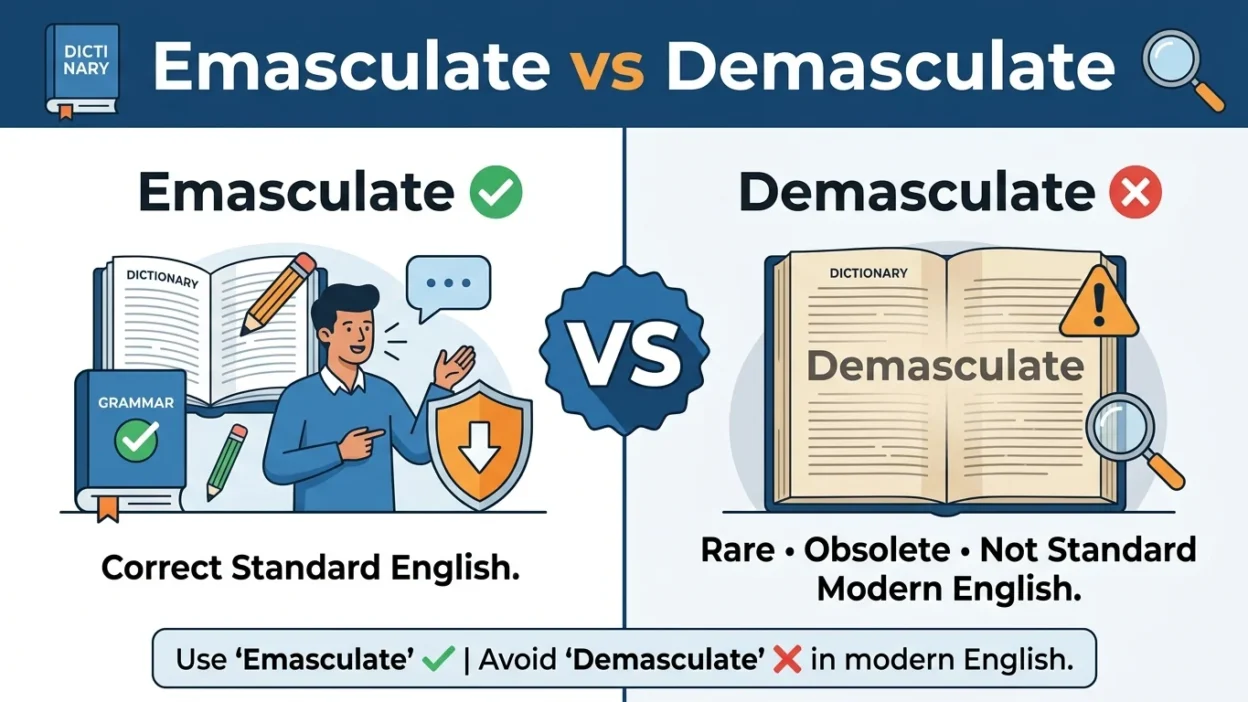
Emasculate is the correct and widely accepted English word.
Demasculate is considered nonstandard, obsolete, or extremely rare and is generally not recommended in modern English.
Examples
- The harsh criticism seemed to emasculate his confidence. ✅
- The policy was criticized for attempting to emasculate local authority. ✅
- The proposal aimed to demasculate the system. ❌ (Avoid in standard English.)
If you’re writing for school, work, or publication, always choose emasculate.
What Does “Emasculate” Mean?
Emasculate is a verb with both literal and figurative meanings.
Historically, it referred to castrating a male. Today, however, it is much more commonly used figuratively to mean weakening, depriving someone or something of strength, confidence, effectiveness, or authority.
Simple Definition
Emasculate means:
Because of its history, the word can carry strong emotional connotations. It should be used thoughtfully, especially when referring to people.
What Does “Demasculate” Mean?
Demasculate occasionally appears in older texts or online discussions, but it is not recognized as the standard modern English word.
Most major dictionaries either:
- do not list it,
- label it obsolete,
- or treat it as a nonstandard variation of emasculate.
In modern writing, emasculate already expresses the intended meaning, making demasculate unnecessary.
Emasculate vs Demasculate: Key Difference
The distinction is straightforward.
| Feature | Emasculate | Demasculate |
|---|---|---|
| Standard English | ✅ Yes | ❌ No |
| Modern dictionaries | Yes | Rare or obsolete |
| Professional writing | Recommended | Avoid |
| Everyday usage | Common | Extremely rare |
| Meaning | Weaken or deprive of strength | Nonstandard variant |
If you’re unsure, always choose emasculate.
Why Is “Emasculate” the Preferred Word?
English often preserves one standard form even when similar-looking alternatives exist.
The word emasculate comes from the Latin emasculare, meaning to deprive of masculine qualities.
Because this historical form has been used for centuries, it became the accepted spelling in modern English.
Adding the prefix de- creates demasculate, but that form never gained widespread acceptance.
As a result, dictionaries, style guides, and professional writers overwhelmingly prefer emasculate.
How to Use “Emasculate”
Today, emasculate is usually used figuratively rather than literally.
1. Weakening Confidence
- Constant criticism can emasculate someone’s confidence.
- Public humiliation may emasculate a person’s self-esteem.
2. Reducing Authority
- The new law could emasculate local governments.
- Critics argued the reforms would emasculate the committee’s powers.
3. Weakening Effectiveness
- Budget cuts may emasculate the program.
- Removing key features could emasculate the software.
In these examples, the word refers to reducing effectiveness or influence rather than physical meaning.
Examples of “Emasculate” in Sentences
Here are natural examples from different contexts.
Workplace
- Poor leadership can emasculate employee motivation.
- Constant micromanagement may emasculate creativity.
Politics
- Opponents claimed the legislation would emasculate the judiciary.
- The amendments could emasculate the original proposal.
Education
- Excessive restrictions may emasculate innovation in schools.
- The revised curriculum should not emasculate critical thinking.
Everyday Conversation
- Negative comments shouldn’t emasculate your confidence.
- Supportive feedback builds people up rather than emasculating them.
Is “Demasculate” Ever Correct?
In modern English, it is best to avoid demasculate.
Although you may occasionally encounter it in:
- historical texts,
- archived publications,
- informal internet discussions,
it is not considered standard.
Replacing it with emasculate will almost always improve clarity and correctness.
Common Mistakes to Avoid
Many learners make similar vocabulary mistakes.
1. Using “Demasculate”
Incorrect:
- The decision will demasculate the organization.
Correct:
- The decision will emasculate the organization.
2. Assuming the Prefix “De-” Makes It Correct
English doesn’t always allow prefixes to be added freely.
Although words like:
- deactivate
- decentralize
- devalue
exist, demasculate never became standard English.
3. Using “Emasculate” Too Casually
Because the word has historical and emotional associations, it can sound stronger than words like:
- weaken
- reduce
- diminish
Choose it only when its meaning truly fits the context.
Emasculate vs Similar Words
Sometimes another word may communicate your idea more clearly.
| Word | Meaning |
|---|---|
| Emasculate | Weaken or deprive of strength or authority |
| Weaken | Make less strong |
| Undermine | Gradually reduce confidence or effectiveness |
| Diminish | Make smaller or less important |
| Reduce | Make less |
| Impair | Damage effectiveness |
| Undercut | Lessen strength or success |
In many professional contexts, these alternatives sound more neutral.
American vs British English
There is no significant difference between American and British English regarding these words.
Both varieties:
- recognize emasculate as the standard word,
- generally avoid demasculate.
Spelling, grammar, and usage remain the same in both forms of English.
Related Words and LSI Keywords
To better understand this topic, it’s useful to know related vocabulary.
Examples include:
- weaken
- diminish
- undermine
- reduce authority
- lessen effectiveness
- strip of power
- loss of confidence
- authority
- influence
- vocabulary differences
- English word comparison
- correct English usage
These related terms naturally support the topic without overusing the primary keyword.
Tips to Remember the Difference
Here’s an easy memory trick.
Think about dictionaries.
If you search a dictionary, you’ll consistently find:
- emasculate
You generally won’t find:
- demasculate as a standard entry.
Another helpful reminder:
If you’re tempted to add de-, don’t.
The original word already carries the complete meaning.
FAQs
Which is correct: emasculate or demasculate?
Emasculate is the correct and accepted English word.
Is demasculate a real word?
It has appeared in some historical or rare contexts, but it is not considered standard modern English.
Why do people say demasculate?
Many assume adding the prefix de- creates a valid word, but English does not recognize it as the standard form.
What does emasculate mean today?
It most commonly means to weaken someone’s confidence, authority, effectiveness, or influence.
Is emasculate offensive?
It can be sensitive depending on the context because of its historical meaning. In professional writing, consider whether a more neutral word like weaken or undermine better expresses your point.
Do British and American English use different spellings?
No. Both use emasculate and generally avoid demasculate.
What words can I use instead of emasculate?
Depending on the context, alternatives include:
- weaken
- diminish
- reduce
- undermine
- impair
- lessen
- undercut
Summary
Understanding emasculate vs demasculate is relatively simple once you know that emasculate is the accepted standard English word. It is commonly used to describe weakening someone’s confidence, reducing authority, or diminishing effectiveness. While demasculate may occasionally appear in older or informal sources, it is considered nonstandard and should generally be avoided in modern writing.
If you’re writing an essay, business report, or article, choosing emasculate will ensure your language is accurate and widely understood. Since both American and British English follow the same convention, you can confidently use emasculate in almost any formal or professional context.