The words eaten vs ate often confuse English learners because both are forms of the verb eat, but they are used in different grammatical situations. Choosing the correct one depends mainly on the tense and whether you are using an auxiliary verb such as have, has, or had.
The good news is that the difference is easy to understand once you know one simple rule: ate is the simple past tense of eat, while eaten is the past participle. In this guide, we’ll explain exactly how to use ate and eaten, provide plenty of examples, highlight common mistakes, and show you an easy way to remember the difference.
Quick Answer: Eaten vs Ate
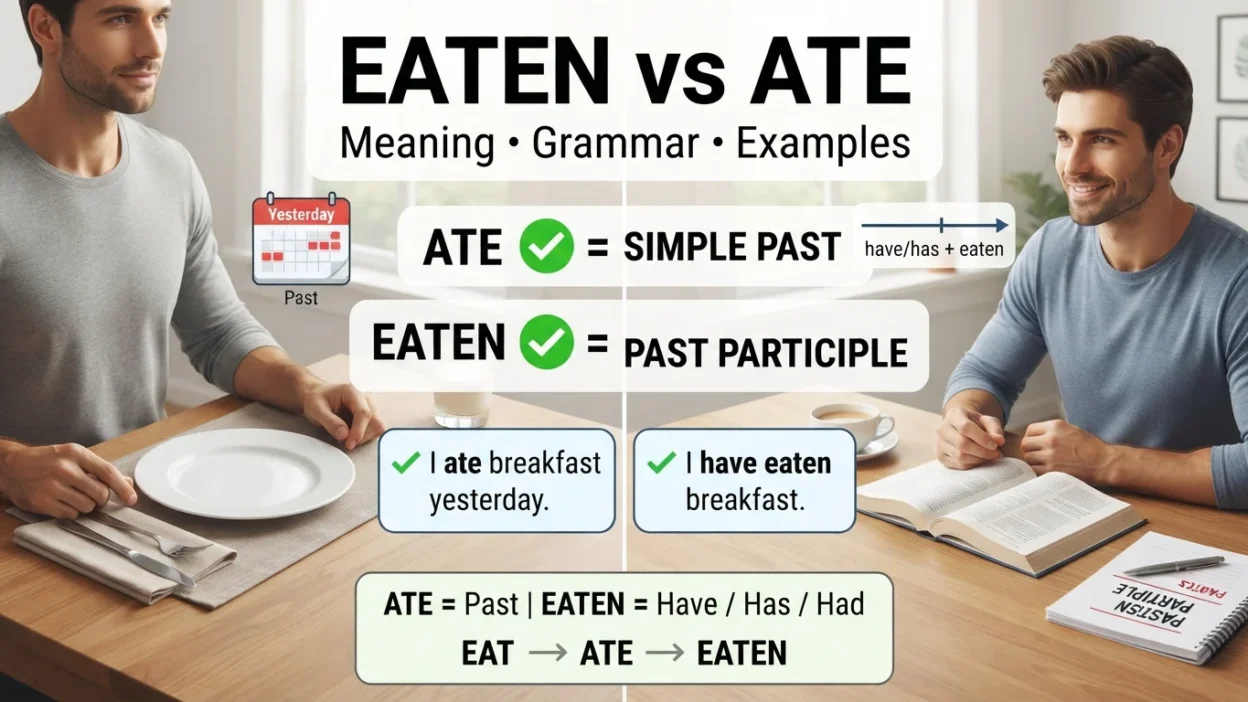
Ate is the simple past tense of eat.
Eaten is the past participle of eat and normally appears with have, has, or had, or in the passive voice.
Simple Rule
- Eat → Ate → Eaten
- Present: I eat
- Past: I ate
- Past participle: I have eaten
Examples
- I ate breakfast at 8 a.m.
- I have eaten breakfast already.
- She ate the sandwich yesterday.
- She has eaten the sandwich.
The key is to look at the words around the verb.
What Does “Ate” Mean?
Ate is the simple past form of eat.
You use ate when talking about something that happened and finished in the past.
Examples:
- I ate lunch at noon.
- She ate an apple yesterday.
- We ate dinner together.
- They ate all the cake.
- He ate breakfast before school.
Notice that ate can stand alone as the main verb.
For example:
I ate pizza last night.
You don’t need have, has, or had before ate.
What Does “Eaten” Mean?
Eaten is the past participle form of eat.
It usually needs a helping verb such as have, has, or had when used in perfect tenses.
Examples:
- I have eaten breakfast.
- She has eaten already.
- They had eaten before we arrived.
- We have eaten at that restaurant before.
You can also see eaten in passive constructions.
Example:
The cake was eaten by the children.
Here, eaten is part of the passive construction.
Eaten vs Ate Comparison Table
| Word | Verb Form | Main Use | Example |
|---|---|---|---|
| Eat | Present/base form | Present or infinitive | I eat breakfast early. |
| Ate | Simple past | Completed past action | I ate breakfast earlier. |
| Eaten | Past participle | Perfect tenses/passive voice | I have eaten breakfast. |
The most important distinction is:
Ate = simple past
Eaten = past participle
When to Use “Ate”
Use ate when describing a completed action in the past.
Common time expressions include:
- Yesterday
- Last night
- Last week
- This morning
- Two hours ago
- When I was younger
- Earlier today
Examples:
I ate breakfast at 7 a.m.
She ate dinner with her family last night.
We ate at a restaurant yesterday.
Because the action is presented as a completed past event, ate is the appropriate form.
When to Use “Eaten”
Use eaten when it follows a helping verb in a perfect tense.
Present Perfect
Use:
have/has + eaten
Examples:
- I have eaten.
- You have eaten.
- She has eaten.
- He has eaten.
- They have eaten.
Example:
She has eaten lunch already.
Past Perfect
Use:
had + eaten
Example:
They had eaten before the movie started.
This shows that eating happened before another past event.
Future Perfect
Use:
will have + eaten
Example:
By 8 p.m., we will have eaten dinner.
Common Mistakes
Mistake 1: “I Have Ate”
This is one of the most common errors.
Incorrect:
I have ate breakfast.
Correct:
I have eaten breakfast.
Why?
Because have requires the past participle, and the past participle of eat is eaten.
Mistake 2: “I Eaten Breakfast”
Incorrect:
I eaten breakfast.
Correct:
I ate breakfast.
Or:
I have eaten breakfast.
Eaten normally needs a helping verb in this type of sentence.
Mistake 3: “She Has Ate”
Incorrect:
She has ate the food.
Correct:
She has eaten the food.
Remember:
has + eaten
not:
has + ate
Mistake 4: Using “Ate” After “Had”
Incorrect:
He had ate before we arrived.
Correct:
He had eaten before we arrived.
The past perfect always uses:
had + past participle
Therefore:
had eaten
is correct.
Ate vs Eaten in Questions
Questions can also cause confusion.
Simple Past
Use did + eat, not did + ate.
Correct:
Did you eat breakfast?
Incorrect:
Did you ate breakfast?
When did is already carrying the past tense, the main verb returns to its base form.
Present Perfect
Use:
Have/Has + eaten
Examples:
- Have you eaten?
- Has she eaten?
- Have they eaten lunch?
This distinction is extremely important.
Ate vs Eaten in Negative Sentences
The same rules apply to negative sentences.
Simple Past
Use:
did not + eat
Example:
I did not eat breakfast.
Not:
I did not ate breakfast.
Present Perfect
Use:
have/has not + eaten
Example:
I have not eaten breakfast yet.
Both forms are correct, but they communicate different grammatical structures.
American vs British English
The words ate and eaten are standard in both American and British English.
There is no meaningful difference in their basic grammar.
However, you may notice differences in how people use certain perfect constructions, especially with words such as just, already, and yet.
For example, British English commonly uses the present perfect in situations where American English may sometimes use the simple past in informal speech.
British English:
I’ve just eaten.
American English:
I just ate.
Both are widely understood, although the first is particularly common in British English.
The forms ate and eaten themselves do not change.
Eaten vs Ate: Easy Memory Trick
Here’s a simple way to remember the difference:
ATE = PAST
Think:
Yesterday → Ate
Example:
I ate pizza yesterday.
EATEN = HAVE/HAS/HAD
Think:
Have → Eaten
Example:
I have eaten pizza.
You can memorize the three principal forms:
Eat → Ate → Eaten
This pattern is similar to other irregular verbs where the past and past participle are different.
More Examples
Simple Past
- I ate an orange.
- He ate the whole sandwich.
- We ate dinner at home.
- She ate too quickly.
- They ate breakfast together.
Present Perfect
- I have eaten an orange.
- He has eaten the whole sandwich.
- We have eaten dinner.
- She has already eaten.
- They have eaten breakfast.
Past Perfect
- I had eaten before leaving.
- She had eaten when I called.
- They had eaten dinner before the guests arrived.
Seeing the patterns repeatedly makes the difference much easier to remember.
FAQs
1. Is “ate” the past tense of eat?
Yes. Ate is the simple past tense of eat.
Example:
I ate breakfast this morning.
2. Is “eaten” the past tense of eat?
No. Eaten is the past participle of eat.
It is commonly used with have, has, or had.
Example:
I have eaten breakfast.
3. Which is correct: “I ate” or “I eaten”?
Both can be correct depending on the sentence.
I ate is simple past.
I have eaten uses the past participle.
You cannot normally say I eaten by itself.
4. Is “I have ate” correct?
No. The correct form is:
I have eaten.
5. Is “Did you ate?” correct?
No. The correct sentence is:
Did you eat?
After did, use the base form eat.
6. Is “I had eaten” correct?
Yes. Had eaten is the past perfect form.
Example:
I had eaten before they arrived.
7. What is the third form of eat?
The three main forms are:
Eat – Ate – Eaten
Therefore, eaten is the past participle.
8. Do American and British English use ate and eaten differently?
The basic grammar is the same. Both varieties use ate as the simple past and eaten as the past participle.
Final Summary
The difference between eaten vs ate is mainly grammatical. Ate is the simple past form of eat, so it is used for completed actions in the past: “I ate breakfast.” Eaten, on the other hand, is the past participle and is normally used with helping verbs such as have, has, or had: “I have eaten breakfast.”
The easiest way to avoid mistakes is to remember the complete verb pattern: eat → ate → eaten. Use ate for simple past statements, but use eaten after have, has, or had. Also remember that after did, you return to the base form: “Did you eat?”, not “Did you ate?”