The for example comma rule can be confusing because the phrase for example can appear at the beginning, middle, or end of a sentence. Depending on its position and grammatical function, the punctuation can change. Learning these simple patterns can make your writing clearer and more professional.
If you are writing a school assignment, blog post, email, report, or academic paper, knowing how to punctuate for example correctly is useful. The good news is that the main rules are easy to remember once you understand how the phrase works in a sentence.
Quick Answer: For Example Comma Rule
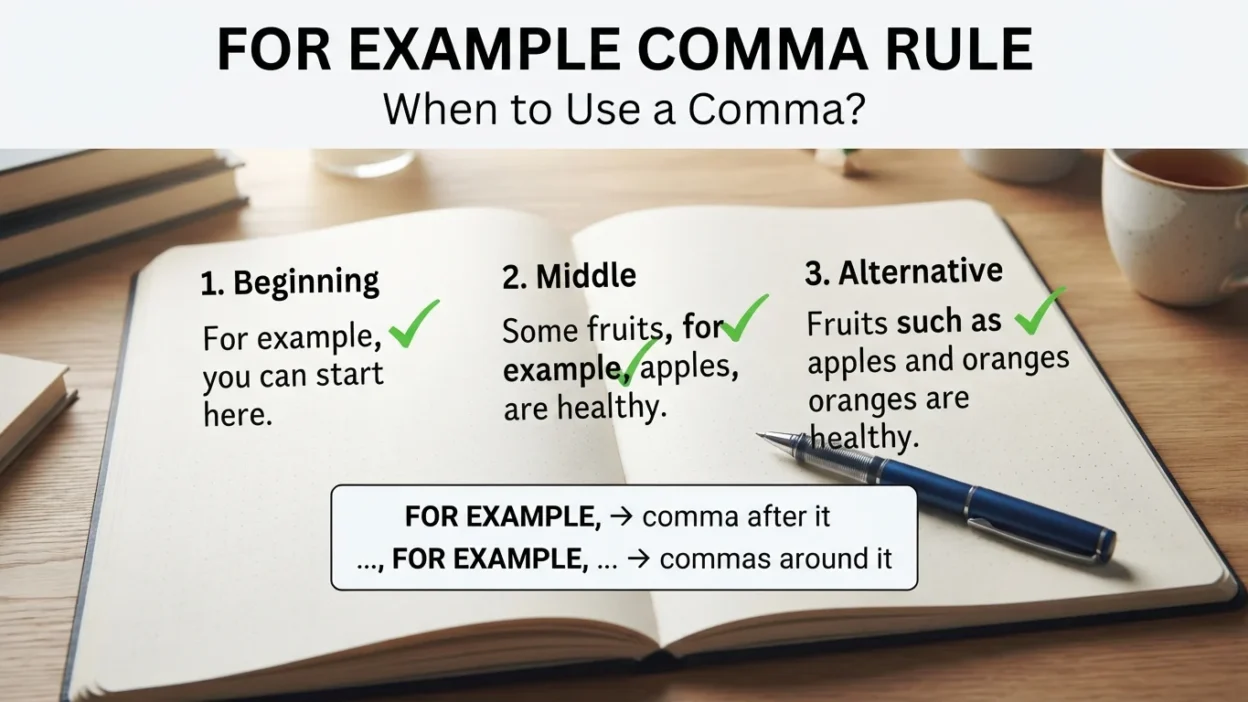
When for example begins a sentence, it is normally followed by a comma.
For example, you can improve your writing by reading regularly.
When for example interrupts a sentence as additional information, commas are usually placed around it.
Many fruits, for example, apples and oranges, contain important nutrients.
When for example is closely connected to the surrounding sentence, the punctuation depends on the exact sentence structure.
The easiest patterns to remember are:
- For example, + complete sentence
- Main idea, for example, + additional example
- Such as + example or examples
What Does For Example Mean?
For example is a phrase used to introduce a specific example that explains or supports a general statement.
It is similar to:
- For instance
- As an example
- To illustrate
- Such as
- Including
For example, a writer might say:
There are many ways to stay healthy. For example, regular walking can improve fitness.
The first sentence gives a general idea, while the second sentence provides a specific example.
When Do You Put a Comma After For Example?
When for example appears at the beginning of a sentence, a comma normally follows it.
Examples:
For example, you can start with a short introduction.
For example, apples contain fiber.
For example, this method can save time.
For example, students can improve their vocabulary through reading.
The basic pattern is:
For example, + sentence
This is one of the simplest parts of the for example comma rule.
When For Example Appears in the Middle of a Sentence
When for example interrupts a sentence and adds extra information, it is commonly separated by commas.
Examples:
Some fruits, for example, apples and oranges, are rich in nutrients.
Many countries, for example, Canada and Australia, use English extensively.
Several sports, for example, football and tennis, require regular practice.
The phrase for example is not essential to the basic grammatical structure in these examples. The commas help separate it from the main sentence.
When For Example Comes at the End
For example can sometimes appear at the end of a sentence, although this construction may sound less natural in some situations.
Example:
You can choose several types of fruit, for example.
However, it is often clearer to rewrite the sentence and place the example more naturally.
For example, you can choose apples, oranges, or bananas.
Or:
You can choose several types of fruit, such as apples and oranges.
The best punctuation is not only about following a rule. Good writing should also sound natural and be easy to understand.
For Example vs Such As
For example and such as are closely related, but they are normally used in different sentence structures.
For example commonly introduces an example as a separate phrase or sentence.
There are many healthy foods. For example, vegetables provide important nutrients.
Such as usually appears directly before an example within a sentence.
Healthy foods such as vegetables and fruit provide important nutrients.
Compare the structures:
For example, apples contain fiber.
Fruits such as apples contain fiber.
Both are correct, but the punctuation is different.
For Example vs For Instance
For example and for instance generally have the same meaning.
For example, you could take the train.
For instance, you could take the train.
Both are grammatically correct.
The comma rules are also very similar. When either phrase begins a sentence, a comma commonly follows it.
When You Do Not Need Commas Around For Example
You should not automatically place commas around every use of for example.
The punctuation depends on the role of the phrase within the sentence.
Consider this sentence:
You can use a fruit such as an apple.
Here, such as is directly connected to the noun fruit, so commas are not needed.
A different structure would be:
You can choose a fruit, for example, an apple.
Here, for example introduces an example and is separated with commas.
The key is to understand the grammatical structure rather than adding commas automatically.
Common Mistakes With For Example
Mistake 1: Missing the Comma at the Beginning
Incorrect:
For example you can start with a simple sentence.
Correct:
For example, you can start with a simple sentence.
When for example introduces a sentence, the comma normally separates the introductory phrase from the main clause.
Mistake 2: Missing the Second Comma
Incorrect:
Many fruits, for example apples and oranges, are healthy.
Correct:
Many fruits, for example, apples and oranges, are healthy.
When for example is used as an interrupting phrase, it is commonly separated by commas on both sides.
Mistake 3: Adding Too Many Commas
Some writers place commas around phrases that do not need them.
For example:
Fruits, such as apples and oranges, are healthy.
This sentence can be grammatically acceptable depending on whether the information is intended as parenthetical, but a more direct version is often:
Fruits such as apples and oranges are healthy.
The punctuation should match the intended meaning.
Mistake 4: Confusing For Example With Such As
These phrases are related but should not always be treated as interchangeable.
For example:
Several sports, for example, tennis and football, require practice.
Another natural construction is:
Several sports such as tennis and football require practice.
The sentence structure determines the punctuation.
For Example at the Beginning of a Sentence
This is a very common construction in essays, articles, and educational writing.
Examples:
For example, you can improve your grammar through regular practice.
For example, this rule applies to introductory phrases.
For example, students can use comparison tables to understand difficult words.
For example, reading can help expand your vocabulary.
The general pattern is:
For example, + complete sentence
The comma after example is normally the correct choice.
For Example in the Middle of a Sentence
When for example appears in the middle as an interruption, commas are commonly used.
Examples:
Some writing tools, for example, grammar checkers, can identify punctuation problems.
Many languages, for example, Spanish and French, have words derived from Latin.
Several activities, for example, reading and writing, can improve language skills.
The commas make it clear that for example is providing additional information.
For Example in Academic Writing
For example is particularly useful in academic and professional writing because examples make explanations clearer.
Consider:
There are several ways to improve communication. For example, active listening can help people understand others more effectively.
It can also appear inside a sentence:
Communication skills, for example, listening and clear writing, are valuable in many professions.
Examples help readers understand abstract ideas and can make an explanation more convincing.
American vs British English
The basic comma rules for for example are very similar in American and British English.
Both varieties commonly use a comma after for example when it begins a sentence.
For example, you could try this approach.
Both varieties can also use commas around a parenthetical use.
Some animals, for example, dolphins, are highly intelligent.
There are broader punctuation differences between American and British English, but the fundamental rules for punctuating for example remain largely the same.
For Example in Formal and Informal Writing
For example works well in both formal and informal English.
Formal example:
Several factors can affect productivity. For example, a well-organized workspace can reduce distractions.
Informal example:
There are lots of things you can do. For example, you could start by making a simple list.
The phrase is neutral and natural, making it suitable for many types of writing.
FAQs
1. Should there be a comma after for example?
Usually, yes, when for example begins a sentence and introduces an example.
For example, you can start with this rule.
2. Do you put commas around for example?
Usually, when for example functions as an interrupting or parenthetical phrase.
Some fruits, for example, apples, contain fiber.
3. Is a comma required before for example?
Not in every sentence. It depends on how the phrase is being used.
When it interrupts a sentence, a comma often appears before and after it.
4. Can for example come at the end of a sentence?
Yes, but this construction can sometimes sound less natural. Rewriting the sentence may produce clearer writing.
5. Is for example the same as for instance?
Yes. They generally have the same meaning and can often be used interchangeably.
6. What is the difference between for example and such as?
For example commonly introduces an example or examples as a phrase or separate sentence. Such as usually appears directly before examples within a sentence.
7. Do American and British English use different comma rules for for example?
The basic rules are very similar. Both varieties commonly use a comma after introductory for example and commas around parenthetical uses.
8. Can I use for example in academic writing?
Yes. For example is widely used in essays, reports, research writing, educational articles, and professional documents.
Final Summary
The for example comma rule becomes much easier when you look at the position and function of the phrase. When for example starts a sentence, a comma normally follows it. When it interrupts a sentence and provides additional information, commas are commonly placed around it.
For example and for instance generally follow the same punctuation pattern, while such as usually works differently because it connects directly to the noun or phrase that follows it. The most important goal is to make the sentence clear, natural, and easy for the reader to understand.