
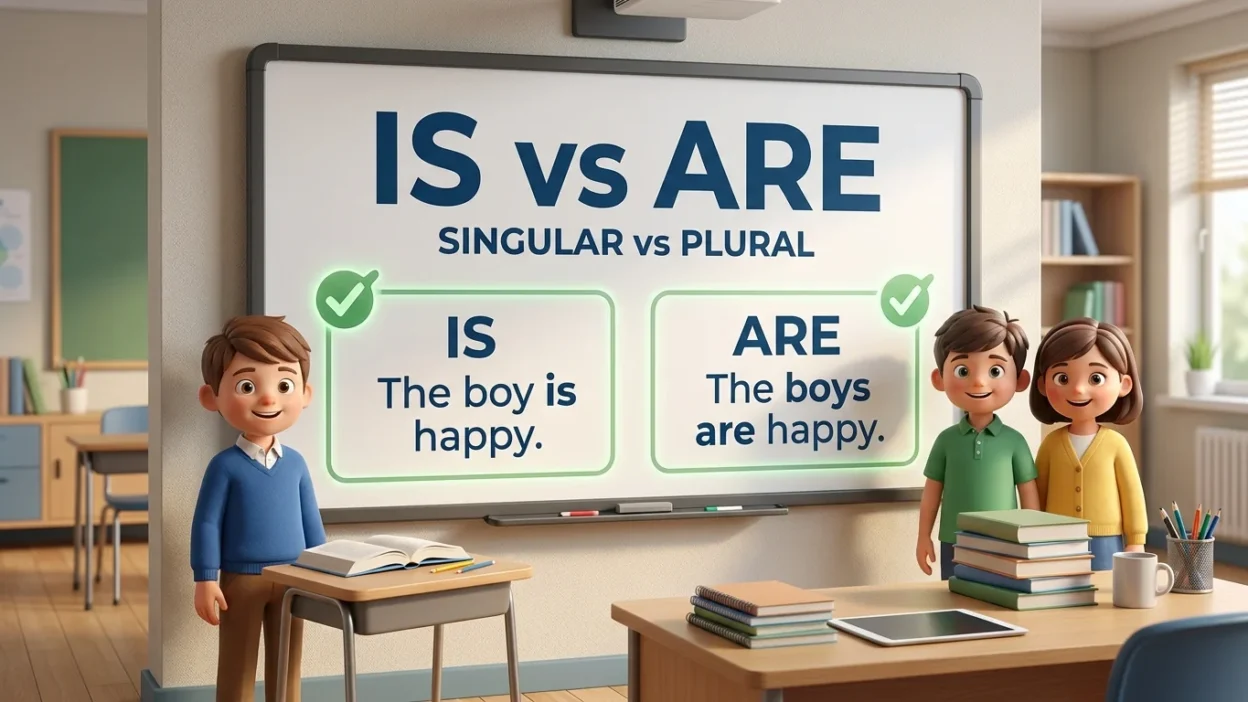
Have you ever stopped while writing a sentence and wondered whether to use is or are? You are not alone. These two small words appear in everyday English, school assignments, emails, conversations, and professional writing. Although they seem simple, choosing the correct one can sometimes be confusing, especially when a sentence contains more than one noun or a subject that is difficult to identify.
The good news is that understanding is vs are usage does not require complicated grammar rules. Once you learn how these words agree with singular and plural subjects, you can use them confidently in almost any sentence. In this guide, you will discover the meanings of is and are, learn the rules with easy examples, and understand how to avoid common subject-verb agreement mistakes.
Quick Answer: Is vs Are
Is is used with singular subjects, such as he, she, it, and a singular noun. Are is used with plural subjects and with you and they.
Examples:
- She is happy.
- The boy is playing.
- They are happy.
- The boys are playing.
- You are my friend.
Easy rule to remember: Use is for most singular subjects and are for plural subjects. However, the pronoun you always takes are, whether you are speaking to one person or several people.
What Does Is Mean?
Is is a form of the verb be. It is used in the present tense to describe a person, place, thing, condition, or action in progress. It commonly appears with singular subjects.
Examples of Is in Sentences
- He is a teacher.
- She is very kind.
- The cat is sleeping.
- My brother is at home.
- The weather is pleasant today.
- This book is interesting.
- The baby is crying.
In these examples, the subjects he, she, the cat, my brother, the weather, and this book are singular. Therefore, is is the correct verb.
When Is Is Used
Use is in these common situations:
- With he, she, and it: He is ready. She is busy. It is cold.
- With a singular noun: The student is present.
- To describe a condition: The room is clean.
- To identify someone or something: My father is a doctor.
- With the present continuous tense: She is reading a book.
Remember that is does not always describe a permanent condition. It can describe something happening now, such as “The child is laughing.”
What Does Are Mean?
Are is another form of the verb be. It is used with plural subjects and with the pronouns you and they. Like is, it can describe a condition, identity, location, or action in progress.
Examples of Are in Sentences
- They are students.
- We are ready.
- You are very helpful.
- The children are playing outside.
- My friends are at school.
- These flowers are beautiful.
- The books are on the table.
The subjects they, we, you, the children, my friends, these flowers, and the books take are.
When Are Is Used
Use are in the following situations:
- With we, you, and they: We are happy. You are welcome. They are ready.
- With plural nouns: The girls are singing.
- To describe people or things: The rooms are clean.
- To describe location: The keys are on the desk.
- With the present continuous tense: They are studying English.
One important point: you are is correct even when you are speaking to only one person. English uses are with you in both singular and plural situations.
Is vs Are: Key Differences
The main difference between is and are is subject-verb agreement. The verb must match the subject in number and person.
| Grammar point | Is | Are |
|---|---|---|
| Typical subject | Singular | Plural |
| Common pronouns | He, she, it | We, you, they |
| Singular noun | The teacher is here. | Not usually correct |
| Plural noun | Not usually correct | The teachers are here. |
| Present continuous | She is writing. | They are writing. |
| Description | The apple is red. | The apples are red. |
The phrase not usually correct matters because some nouns look plural but are treated as singular, while some subjects have special grammatical rules. The key is to identify the actual subject rather than simply looking at the nearest noun.
Important Rules for Using Is and Are
1. Use Is With a Singular Subject
When the subject refers to one person, place, thing, or idea, use is in the present tense.
Examples:
- The teacher is explaining the lesson.
- My phone is new.
- This idea is useful.
- The house is beautiful.
Incorrect: The teacher are explaining the lesson.
Correct: The teacher is explaining the lesson.
2. Use Are With a Plural Subject
When the subject refers to more than one person or thing, use are.
Examples:
- The teachers are in the classroom.
- My shoes are dirty.
- The students are preparing for the test.
- These ideas are useful.
Incorrect: The students is ready.
Correct: The students are ready.
3. Use Are With You
This rule often confuses English learners because you can refer to one person or several people.
Examples:
- You are my best friend.
- You are all invited.
- Are you ready for the exam?
Do not write “You is ready” in standard English. The correct form is “You are ready.”
4. Use Is or Are With This, That, These, and Those
Demonstrative words can help you identify whether a subject is singular or plural.
- This is my pen.
- That is your bag.
- These are my books.
- Those are beautiful flowers.
Use this and that with singular nouns, and these and those with plural nouns.
5. Pay Attention to Compound Subjects
When two singular subjects are joined by and, they usually form a plural subject and take are.
Examples:
- Ali and Ahmed are friends.
- My mother and father are at home.
- The teacher and the student are talking.
However, when two words refer to one person, one item, or one combined idea, a singular verb may be appropriate.
Example: Bread and butter is my usual breakfast.
Here, bread and butter is treated as one combined meal or idea. In other contexts, the intended meaning can affect the choice.
6. Do Not Be Misled by Words Between the Subject and Verb
Sometimes a sentence contains extra information between its subject and verb. The verb must still agree with the main subject.
Incorrect: The box of pencils are on the desk.
Correct: The box of pencils is on the desk.
The subject is box, not pencils. Because box is singular, use is.
More examples:
- The group of students is waiting.
- The pages of this book are missing.
- The color of these flowers is beautiful.
A useful trick is to temporarily remove the phrase beginning with of. You can then see the main subject more clearly.
Is vs Are in Questions and Negative Sentences
The same subject-verb agreement rules apply when you form questions and negative sentences.
Questions With Is and Are
Place is or are before the subject to form a question.
- Is she your sister?
- Is the shop open?
- Are they coming today?
- Are the children asleep?
- Are you ready?
Negative Sentences With Is and Are
Add not after the verb to make a negative sentence.
- He is not busy.
- The room is not clean.
- They are not at home.
- We are not late.
- You are not alone.
In everyday conversation, contractions are also common:
- Is not → isn’t
- Are not → aren’t
For example, “She isn’t ready” and “They aren’t ready” are both correct.
Common Mistakes in Is vs Are Usage
Mistake 1: Using Is With a Plural Noun
Incorrect: The dogs is hungry.
Correct: The dogs are hungry.
Dogs refers to more than one dog, so use are.
Mistake 2: Using Are With a Singular Noun
Incorrect: My brother are sleeping.
Correct: My brother is sleeping.
Brother is singular, so use is.
Mistake 3: Forgetting the Rule for You
Incorrect: You is very kind.
Correct: You are very kind.
Always use are with you in standard English.
Mistake 4: Matching the Verb to the Nearest Noun
Incorrect: The list of names are ready.
Correct: The list of names is ready.
The main subject is list, which is singular. The noun names does not determine the verb.
Mistake 5: Confusing There Is and There Are
Use there is for a singular noun and there are for plural nouns.
- There is a book on the table.
- There are three books on the table.
- There is a problem with the computer.
- There are several problems with the computer.
In informal speech, you may hear “there’s” before plural nouns, but in careful standard writing, there are is preferred for plural subjects.
Is vs Are in American and British English
There is no significant difference between American and British English in the basic rules for is and are. Both varieties generally use is with singular subjects and are with plural subjects.
Examples:
- American English: The student is ready.
- British English: The student is ready.
- American English: The students are ready.
- British English: The students are ready.
A few collective nouns can be treated differently depending on the variety of English and the intended meaning. For example, British English more readily allows a plural verb when a collective noun refers to its individual members: “The team are playing well.” American English more commonly uses the singular: “The team is playing well.”
This variation concerns collective nouns, not the basic rules for ordinary singular and plural subjects.
Frequently Asked Questions (FAQs)
1. What is the basic rule for is vs are usage?
Use is with most singular subjects, such as he, she, it, and singular nouns. Use are with plural subjects and with you and they.
2. Is “you is” ever correct?
In standard modern English, “you is” is not grammatically correct. The correct expression is “you are,” whether you are talking to one person or several people.
3. Is it “there is” or “there are”?
Use “there is” before a singular noun and “there are” before a plural noun. For example, “There is a chair” and “There are two chairs.”
4. Should I write “the team is” or “the team are”?
Both can be correct depending on the variety of English and the intended meaning. American English generally favors “the team is,” while British English may use “the team are” when emphasizing individual team members.
5. Is “everyone is” or “everyone are” correct?
“Everyone is” is correct because everyone is grammatically singular, even though it refers to many people. For example, “Everyone is welcome.”
6. Is “the books on the table is” correct?
No. The correct sentence is “The books on the table are.” The main subject, books, is plural.
7. What is the difference between is and are in questions?
The same agreement rule applies. Use “Is he ready?” for a singular subject and “Are they ready?” for a plural subject. Use “Are you ready?” with you.
8. How can I remember when to use is or are?
First, identify the main subject. If it is singular, use is in most present-tense statements. If it is plural, use are. Remember the special rule that you always takes are.
Summary
Understanding is vs are usage becomes much easier when you focus on the subject of a sentence. Use is with singular nouns and pronouns such as he, she, and it. Use are with plural nouns and pronouns such as we, you, and they. These verbs can describe identities, conditions, locations, and actions in progress, so learning the rules will help you write clearer sentences and speak more confidently.
The most common mistakes happen when writers overlook the main subject, forget the special rule for you, or confuse singular and plural nouns. Remember that American and British English follow the same basic rules, although collective nouns may sometimes take different verb forms. With regular practice, choosing between is and are will soon feel natural.