Have you ever wondered whether to write with regard to or with regards to in an email, school assignment, or professional message? Both expressions are widely used in English, and their similar spelling makes it difficult to know which one is correct. If you have ever paused before sending a message because you were unsure about this small grammar detail, you are certainly not alone.
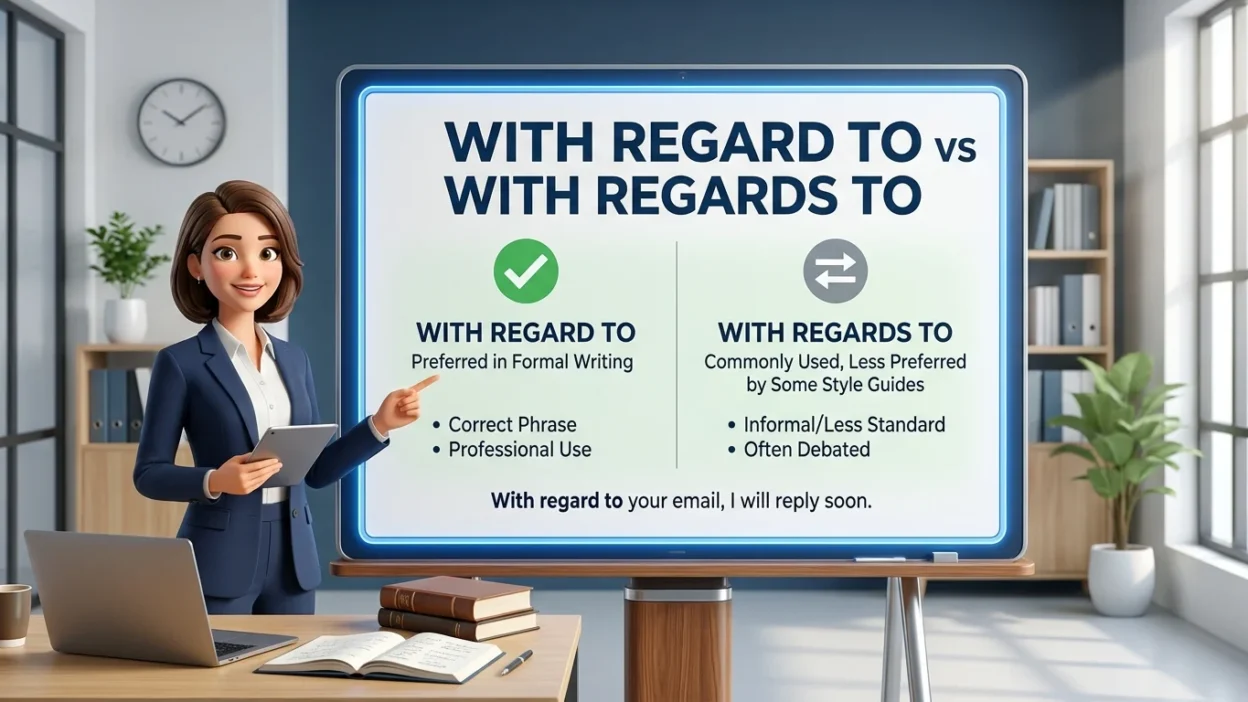
The good news is that both expressions can be correct, but they are not always used in exactly the same way. With regard to is a standard expression meaning “concerning” or “in relation to,” while with regards to is also commonly used with the same meaning, although some style guides prefer the singular form. In this guide, you will learn their meanings, differences, examples, common mistakes, and the best option for formal and everyday writing.
Quick Answer: With Regard to vs With Regards to
With regard to means “concerning,” “about,” or “in relation to” something. It is the conventional choice in formal and professional writing.
With regards to is also commonly used to mean “concerning” or “about.” However, some editors and style guides consider it less preferred in this particular expression.
Examples:
- With regard to your application, we will contact you soon.
- With regards to your application, we will contact you soon.
Both versions are widely understood. If you want the safest choice for formal writing, use with regard to.
Remember that regards has another common meaning when used to express good wishes, as in “Please give my regards to your family.” That is a different use of the word.
What Does With Regard To Mean?
The phrase with regard to means concerning, regarding, about, or in relation to a particular subject. It introduces the topic that a sentence or statement is discussing.
It is especially common in formal emails, business correspondence, academic writing, reports, and official communication.
Examples of With Regard To
- With regard to your request, we will provide an update tomorrow.
- I am writing with regard to the meeting scheduled for Monday.
- With regard to your performance, the manager has shared positive feedback.
- We have received your complaint with regard to the delivery delay.
- With regard to the school timetable, a few changes are necessary.
In each sentence, the phrase identifies the subject being discussed. You could often replace it with “about” or “concerning” without changing the main meaning.
For example: - With regard to your application, we need additional documents.
- Regarding your application, we need additional documents.
- About your application, we need additional documents.
The first two sound natural in formal writing. The third may sound less polished in some professional contexts.
What Does With Regards To Mean?
With regards to is commonly used as an alternative to with regard to, meaning “concerning” or “in relation to.” You will encounter it in emails, online writing, workplace messages, and everyday communication.
Examples:
- With regards to your email, I will reply shortly.
- With regards to the new policy, the team will meet tomorrow.
- With regards to your order, the package is on its way.
- With regards to the school event, further details will be shared soon.
These sentences are understandable and common in actual usage. Nevertheless, some formal editors prefer with regard to because it is the established conventional expression for introducing a topic.
Is With Regards To Grammatically Wrong?
It is too strong to say that with regards to is always grammatically wrong. It is widely used with the meaning “concerning,” and many readers will understand it without difficulty. However, in carefully edited formal writing, with regard to is generally the more conventional choice.
A useful approach is to use with regard to in reports, academic work, official letters, and professional emails, particularly when you want to avoid editorial objections.
With Regard to vs With Regards to: Key Differences
The difference is mainly about conventional usage and editorial preference rather than a major change in meaning.
| Feature | With regard to | With regards to |
|---|---|---|
| Meaning | Concerning or about | Commonly used to mean concerning or about |
| Formal writing | Conventional and widely preferred | Often considered less preferred by some editors |
| Professional emails | Recommended choice | Commonly seen, but may be edited |
| Everyday communication | Correct and natural | Commonly used and understood |
| Best choice for formal work | Yes | Usually avoid if following strict style guidance |
Important: The singular expression is the safest option when you are unsure which form your reader or editor expects.
When Should You Use With Regard To?
Use with regard to when you want to introduce a subject in a formal, neutral, or professional way. It is particularly useful when replying to an earlier message or referring to a specific matter.
1. In Professional Emails
- With regard to your previous email, please find the requested information below.
- I am contacting you with regard to the upcoming meeting.
- With regard to your question, I have attached the relevant document.
2. In Academic Writing
- With regard to the research findings, further investigation is needed.
- The study identified several limitations with regard to sample size.
- With regard to student performance, regular feedback can be helpful.
In academic writing, the phrase should not be repeated unnecessarily. Alternatives such as regarding, concerning, and in relation to can help your writing feel more varied.
3. In Official Letters and Reports
- With regard to your application, the decision will be communicated shortly.
- With regard to the complaint received on 10 October, an investigation has begun.
- The department has issued new instructions with regard to safety procedures.
In these contexts, the expression helps establish the subject clearly and professionally.
When Is With Regards To Used?
You may see with regards to in casual writing, online discussions, business messages, and informal correspondence. Many writers use it to mean “concerning,” even though traditional style advice often recommends the singular form.
Examples:
- With regards to your message, everything is clear.
- With regards to the arrangements, I will update you later.
- With regards to the payment, please contact the accounts department.
These examples illustrate common usage, but if you are writing a formal document, it is better to choose with regard to or simply regarding.
With Regard To vs In Regard To vs Regarding
English has several expressions that introduce a topic. Although they are similar, their style and structure differ slightly.
| Expression | Meaning | Example |
|---|---|---|
| With regard to | Concerning a topic | With regard to your request, we need more information. |
| In regard to | Concerning a topic | I am writing in regard to your application. |
| Regarding | About or concerning | Regarding your application, we need more information. |
| In relation to | Connected with or concerning | We have questions in relation to the report. |
| As for | Introducing a topic, often conversationally | As for the meeting, we can discuss it tomorrow. |
Regarding is often the shortest and most direct alternative. For example, “Regarding your application, we need more information” is clear and professional without sounding unnecessarily wordy.
With Regard To vs Regards: An Important Difference
The word regard can be used in several expressions, and not all of them have the same meaning.
With Regard To
This expression introduces a topic.
Example: With regard to your request, we will respond tomorrow.
Meaning: Concerning your request.
Give My Regards To
This expression means to send greetings or good wishes to someone.
Example: Please give my regards to your parents.
Meaning: Please pass my greetings to your parents.
Best Regards
This is a common closing for emails and letters.
Example: Best regards, Ahmed.
Meaning: A polite closing that conveys goodwill.
Do not confuse with regard to with give my regards to. One introduces a topic, while the other expresses greetings or good wishes.
Common Mistakes to Avoid
Mistake 1: Assuming With Regards To Is Always Incorrect
Some style guides prefer the singular expression, but with regards to is commonly used with the meaning “concerning.” It is better to describe it as less preferred in formal edited writing rather than universally wrong.
Mistake 2: Using Regard Instead of Regards in an Email Closing
Incorrect: Best regard, Ahmed.
Correct: Best regards, Ahmed.
The conventional email closing uses the plural form regards.
Mistake 3: Confusing Regard With Regarding
Incorrect: With regarding to your application, we need more details.
Correct: With regard to your application, we need more details.
You can also write: “Regarding your application, we need more details.”
Mistake 4: Repeating the Phrase Too Often
Using with regard to in every paragraph can make writing feel stiff.
Instead of:
- With regard to the budget, we need a meeting. With regard to staffing, we need a decision.
Try:
- Regarding the budget, we need a meeting. As for staffing, we need a decision.
A mixture of clear alternatives makes professional writing easier to read.
Mistake 5: Using an Overly Formal Phrase in a Casual Message
In everyday conversation, you may not need this expression at all.
Formal: With regard to your question, I will respond shortly.
Casual: About your question, I will get back to you soon.
Choose language that suits the situation and the person receiving your message.
American vs British English: Is There a Difference?
There is no major difference in the basic meaning of with regard to and with regards to between American and British English. Both expressions appear in writing in the United States and the United Kingdom.
However, preferences can vary among individual writers, publications, and style guides. Formal editors in either variety may prefer with regard to as the conventional expression for introducing a topic.
Examples in American English:
- With regard to your request, we will respond soon.
- Regarding the report, please send your comments.
Examples in British English: - With regard to your request, we will respond soon.
- Regarding the report, please send your comments.
For either variety, with regard to and regarding are dependable choices for formal communication.
FAQs
1. Is with regard to or with regards to correct?
Both expressions are commonly used to mean “concerning” or “about.” However, with regard to is the conventional form and is generally preferred in formal writing.
2. What does with regard to mean?
It means “concerning,” “about,” or “in relation to” a particular topic. For example, “With regard to your email, I will respond tomorrow.”
3. Is with regards to grammatically wrong?
Not necessarily. It is widely used with the meaning “concerning,” but some editors consider it less preferable than with regard to. Use the singular form for formal documents if you want to follow conventional style advice.
4. Should I use with regard to in a professional email?
Yes. With regard to is a suitable expression for professional emails, reports, and official communication because it clearly introduces the topic being discussed.
5. What is a simpler alternative to with regard to?
Regarding, about, and concerning are useful alternatives. “Regarding your request, we need more information” is concise and professional.
6. What is the difference between with regard to and in regard to?
Both mean “concerning” or “in relation to.” With regard to is a conventional choice, while in regard to is also standard and widely understood.
7. Is there a difference between American and British English?
There is no major difference in meaning. Preferences may vary between style guides, but with regard to is a reliable choice in formal writing in both varieties.
8. Is it correct to write best regards?
Yes. Best regards is a standard and polite way to close an email or letter. It is different from with regard to, which introduces the subject of a sentence.
Summary
The expressions with regard to vs with regards to are often used to introduce a topic and mean “concerning,” “about,” or “in relation to.” Although both forms are widely encountered, with regard to is the conventional expression and the safer choice for formal emails, academic assignments, business communication, and official documents. The singular form is generally preferred by editors who follow traditional style guidance.
You can also use regarding, concerning, or in relation to to make your writing clearer and less repetitive. Remember that best regards and give my regards to someone have a different function: they express greetings or goodwill rather than introduce a topic. Choosing the right expression depends on your audience, tone, and purpose.

Liam James is a language enthusiast and content writer at Verseslay, specializing in word comparisons, grammar debates, and vocabulary insights. He helps readers understand language nuances through clear, engaging, and practical explanations.