Have you ever wondered whether you should write “compared to” or “as compared to”? Both phrases are correct in English, but their use can depend on the sentence, writing style, and emphasis you want to create. Understanding the difference can help you write clearer sentences and avoid unnecessary words.
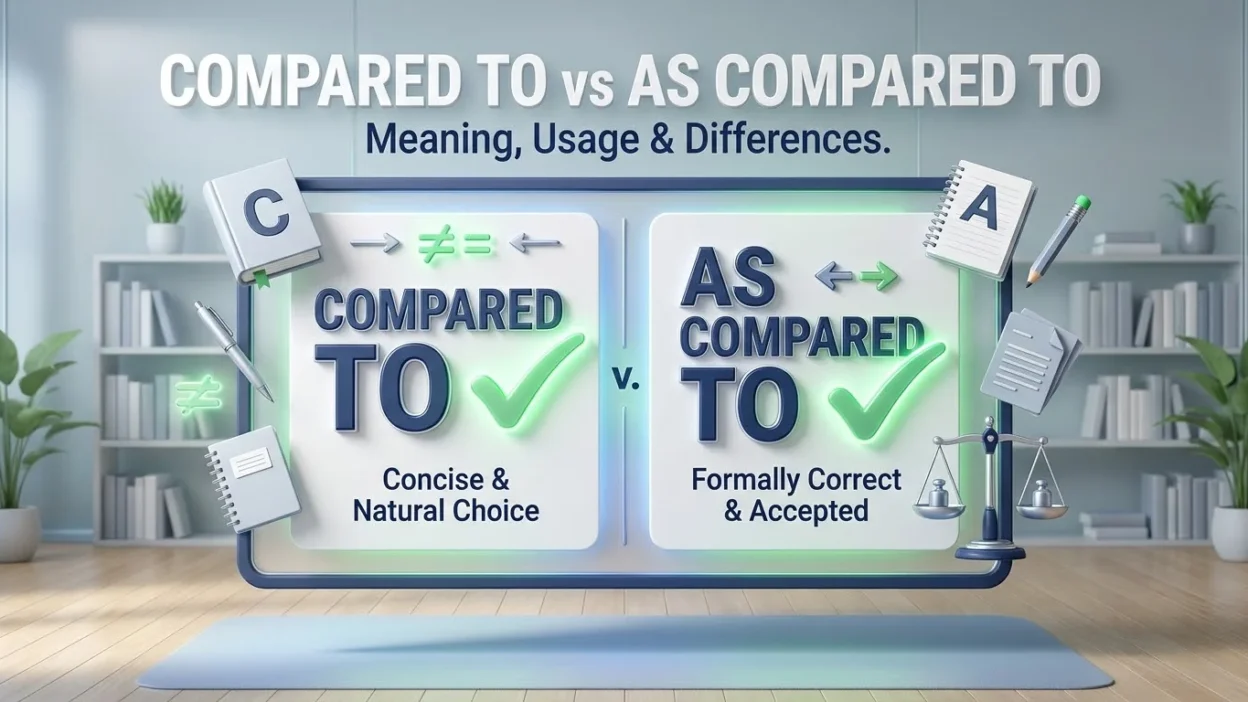
The phrase “compared to” is the shorter, more common choice for everyday conversations, academic writing, and general comparisons. The phrase “as compared to” can also introduce a comparison, often with a slightly more formal or emphatic tone. In many sentences, the two expressions can be used interchangeably without changing the main meaning. However, neither phrase is automatically better in every situation. The most important thing is to make a fair, logical comparison between two people, things, ideas, or situations. This guide explains both expressions with simple definitions, practical examples, common mistakes, and easy tips to help you choose the right phrase.
Quick Answer
Both “compared to” and “as compared to” are correct English expressions used to show similarities or differences between two or more things. “Compared to” is generally shorter and more natural in everyday writing. “As compared to” is also acceptable, especially when a slightly more formal tone is appropriate. Choose the phrase that makes your sentence clear and natural.
Why Do People Confuse Compared To and As Compared To?
People often confuse these expressions because they communicate a similar idea. Both can introduce a comparison between people, objects, results, conditions, or situations.
The main difference is the extra word “as.” It does not usually create a major change in meaning when the phrases are used in comparable sentence structures.
For example:
- The new phone is cheaper compared to the old model.
- The new phone is cheaper as compared to the old model.
Both sentences communicate that the new phone costs less than the old model. However, many writers would prefer “than the old model” in this particular sentence because it expresses a direct difference in price more naturally.
Understanding the sentence structure is just as important as choosing between the two phrases.
What Does Compared To Mean?
“Compared to” is a phrase used to examine two or more things and show how they are similar or different.
It is concise, natural, and widely used in everyday English, professional communication, and academic writing.
Examples of Compared To
- This year’s sales are higher compared to last year’s.
- My new laptop is lighter compared to my old one.
- Compared to other cities, this town is relatively quiet.
- The second book is shorter compared to the first.
The phrase can appear at the beginning or within a sentence, depending on how the comparison is structured.
For instance:
“Compared to last year, our school has improved its results.”
Here, the phrase introduces the point of comparison before presenting the main statement.
Is Compared To Always Correct?
The phrase is grammatically acceptable in many contexts, but the best wording depends on the sentence.
When you are describing a direct difference, “than” may be more natural.
Less natural: This bag is cheaper compared to that bag.
More natural: This bag is cheaper than that bag.
When you are discussing similarities, differences, or a broader comparison, “compared to” often works well.
Example: Compared to the previous version, the new application is easier to use.
What Does As Compared To Mean?
“As compared to” is another phrase used to introduce a comparison. It often sounds more formal or emphatic, although it is not inherently more correct than “compared to.”
The phrase appears frequently in reports, presentations, discussions of statistics, and formal explanations.
Examples of As Compared To
- The company earned more profit this year as compared to last year.
- The new building uses less energy as compared to the old building.
- Student attendance has improved as compared to the previous term.
- The rural population is smaller as compared to the urban population in this particular area.
These examples show how the phrase can introduce comparisons involving quantities, performance, or conditions.
Is As Compared To Grammatically Correct?
Yes. “As compared to” is grammatically acceptable when it fits the sentence structure and intended meaning.
However, the additional word “as” is often unnecessary. In many cases, removing it makes a sentence shorter and easier to read.
Wordier: The results were better as compared to the previous assessment.
More concise: The results were better compared to the previous assessment.
Even more direct: The results were better than those of the previous assessment.
The best choice depends on what you want to communicate and how the sentence is constructed.
Compared To vs As Compared To: Comparison Table
| Feature | Compared to | As compared to |
|---|---|---|
| Correct English | Yes | Yes |
| Main purpose | Introduces a comparison | Introduces a comparison |
| Length | Shorter | Longer |
| Tone | Neutral and natural | Sometimes more formal or emphatic |
| Everyday conversation | Very suitable | Suitable, but can sound wordier |
| Academic writing | Suitable | Also suitable |
| Business reports | Suitable | Suitable |
| Usually interchangeable? | Often | Often |
| Always the best choice? | No | No |
Key takeaway: Both expressions are correct, but “compared to” is often the simpler choice when the extra word “as” adds no useful meaning.
When Should You Use Each Phrase?
Choosing the right expression depends on the purpose of your sentence, the audience, and the comparison you are making.
1. When to Use Compared To
Use “compared to” when you want a concise, natural expression.
It works well in:
- Everyday conversations
- School assignments
- Emails and messages
- Academic explanations
- General descriptions
- Articles and reports
Examples:
“Compared to last month, the weather is cooler.”
“Compared to the old design, the new design looks cleaner.”
This phrase is particularly useful when you want to introduce a comparison without making the sentence unnecessarily long.
2. When to Use As Compared To
Use “as compared to” when it fits the tone and structure of a formal explanation or report.
For example:
“Revenue increased by 12% this quarter as compared to the same quarter last year.”
This sentence is understandable, although “compared with” or “than in the same quarter last year” may be more concise, depending on the intended meaning.
The phrase can also work when a writer wants to emphasize the comparison. However, you should not add “as” simply to make your writing sound more professional.
3. When Neither Phrase Is the Best Choice
Sometimes, the word “than” is the clearest option for a direct comparison involving words such as better, faster, taller, cheaper, or more expensive.
Examples:
- Correct and direct: Ali is taller than Ahmed.
- Less natural: Ali is taller compared to Ahmed.
- Correct and direct: This phone is cheaper than that one.
- Wordier: This phone is cheaper as compared to that one.
Use the structure that expresses your intended comparison most clearly.
12 Examples of Compared To and As Compared To
The following examples demonstrate how both expressions can be used.
- Compared to last year, our school has achieved better results.
- The new road is wider compared to the old road.
- As compared to the previous model, this device uses less electricity.
- Our classroom is brighter compared to the classroom upstairs.
- The company recorded higher sales as compared to the previous month.
- Compared to city life, village life can be quieter.
- This exercise is easier compared to the last one.
- The new policy has reduced costs as compared to the earlier policy.
- Compared to Monday, attendance was higher on Tuesday.
- The updated website loads faster compared to the previous version.
- The project required less time as compared to our original estimate.
- Compared to the first chapter, the second chapter contains more examples.
These sentences show that both phrases can introduce a comparison. In some examples, a direct construction using “than” would be more concise.
For example, “This exercise is easier than the last one” is a particularly natural way to express a direct difference in difficulty.
Common Mistakes with Compared To and As Compared To
Even though both expressions are correct, writers can make mistakes when using them.
Mistake 1: Assuming One Phrase Is Always Correct
Incorrect assumption: “Compared to” is correct, but “as compared to” is always wrong.
Correct understanding: Both phrases are acceptable in appropriate contexts.
Why? They can perform the same general function, although one may be more concise or natural in a particular sentence.
Mistake 2: Adding Unnecessary Words
Wordy: The new system is more efficient as compared to the previous system.
More concise: The new system is more efficient than the previous system.
Why? The comparative word “more efficient” naturally works with “than” when expressing a direct difference.
Mistake 3: Making an Unclear Comparison
Unclear: Compared to the teacher, the student’s explanation was excellent.
This sentence may be confusing because it is not clear whether the writer is comparing teaching ability, the quality of two explanations, or something else.
Clearer: Compared with the teacher’s explanation, the student’s explanation was excellent.
Why? The reader can identify exactly what is being compared.
Mistake 4: Comparing Different Things Unfairly
Incorrect: Compared to last year, the population is larger.
This sentence may be unclear because a population is being compared with a year rather than with the population in that year.
Clearer: Compared with last year’s population, this year’s population is larger.
Why? The two items being compared should be logically equivalent.
Mistake 5: Using the Phrase in Every Sentence
Repetitive: Compared to last year, sales increased. As compared to last year, costs decreased. Compared to last year, customer numbers grew.
Better: Sales increased, costs decreased, and customer numbers grew compared with last year.
Why? Varying sentence structures improves readability and avoids unnecessary repetition.
What Is an Easy Memory Trick?
Use this simple rule:
“Compared to” is short; “as compared to” is longer, but both can be correct.
Remember these three points:
- Use “compared to” for a concise comparison.
- Use “as compared to” when it fits your sentence and tone.
- Use “than” for many direct comparisons involving better, faster, taller, or cheaper.
For example:
- Compared to last week, it is colder today.
- As compared to last week, it is colder today.
- It is colder today than it was last week.
All three communicate a similar comparison, but the third is often the most direct.
Is There a Difference in American and British English?
There is no major spelling difference between American and British English for these phrases. Both varieties use “compared to” and “as compared to.”
However, “compared with” is another common expression in both varieties.
Some traditional style guidance distinguishes “compare to,” which can emphasize similarities, from “compare with,” which can emphasize examining differences. In modern usage, however, the expressions overlap considerably, and writers do not always follow that distinction.
Examples:
- American English: Compared to last year, sales increased.
- British English: Compared with last year, sales increased.
Both examples are understandable in either variety of English. The choice may depend on house style, personal preference, and the context.
What Are Some Similar Expressions?
Several phrases can help you express comparisons more clearly.
| Expression | Meaning or use | Example |
|---|---|---|
| Compared with | Examines similarities or differences | Compared with last year, sales improved. |
| In comparison with | Introduces a comparison | In comparison with the old model, this one is lighter. |
| In contrast to | Highlights a difference | In contrast to his brother, Ali is quiet. |
| Unlike | Shows that things are different | Unlike the old phone, this one has a larger screen. |
| Than | Expresses a direct comparison | This road is wider than that road. |
| Relative to | Describes something in relation to another thing | Costs are low relative to income. |
| When compared with | Introduces a comparison | When compared with the original, the copy is clearer. |
These alternatives are useful because they allow you to choose the most precise expression for your sentence.
Final Verdict: Compared To or As Compared To?
Both “compared to” and “as compared to” are correct English expressions. They can introduce comparisons and often communicate the same basic meaning.
Choose “compared to” when you want concise, natural wording. Choose “as compared to” when it fits your sentence, but avoid adding unnecessary words just to sound formal.
For direct comparisons involving words such as better, faster, and cheaper, “than” is often the clearest choice. Above all, make sure your sentence compares the right things and communicates your meaning clearly.
FAQs
1. Is compared to or as compared to correct?
Both are correct. “Compared to” is shorter, while “as compared to” is a longer expression that can introduce the same kind of comparison.
2. What is the difference between compared to and as compared to?
The main difference is the additional word “as.” In many contexts, it does not substantially change the meaning. “Compared to” is often more concise.
3. Is as compared to grammatically correct?
Yes. “As compared to” is grammatically acceptable when used in a suitable sentence. However, the shorter “compared to” may be preferable when the extra word is unnecessary.
4. Should I use compared to or compared with?
Both expressions are widely used. Some traditional guidance associates “compared to” with similarities and “compared with” with examining differences, but modern usage often overlaps. Follow the requirements of your writing context if a style guide specifies a preference.
5. Is compared to formal or informal?
“Compared to” works in both formal and informal writing. It is suitable for conversations, schoolwork, reports, and academic explanations.
6. Can I use as compared to in academic writing?
Yes. You can use “as compared to” in academic writing, but make sure it improves the sentence. A shorter expression may be clearer and more direct.
7. Is than better than compared to?
For many direct comparisons, especially those using taller, faster, cheaper, or more effective, “than” is more natural. For example, “This car is faster than that car” is clearer than “This car is faster compared to that car.”
Remember This
- Compared to: Correct, concise, and widely used.
- As compared to: Also correct, but sometimes wordier.
- Compared with: Another common way to introduce a comparison.
- Than: Often best for direct comparisons such as “better than” or “faster than.”
The goal is not to choose the longest or most formal expression. It is to make your comparison clear, logical, and natural.
Conclusion
“Compared to” and “as compared to” are both correct expressions in English. They are often interchangeable when introducing a comparison, although “compared to” is generally more concise. The best choice depends on the sentence, the intended meaning, and the style of writing.
If you are unsure which phrase to use, begin with “compared to” for a simple comparison. If you are describing a direct difference in size, quality, speed, or price, consider using “than.” By choosing clear sentence structures and avoiding unnecessary words, you can make your English more natural and effective.

Liam James is a language enthusiast and content writer at Verseslay, specializing in word comparisons, grammar debates, and vocabulary insights. He helps readers understand language nuances through clear, engaging, and practical explanations.