Have you ever had so many tasks, plans, or opportunities going on at the same time that you could hardly keep track of them all? If someone says you have too many irons in the fire, they are describing exactly that kind of situation. This colorful English idiom is often used when a person is involved in several activities or possibilities at once.
The phrase can sound strange if you take it literally. After all, most people are not actually putting pieces of iron into a fire. Instead, too many irons in the fire is a figurative expression about having too many things in progress at the same time. Understanding this idiom can help you recognize it in conversations, books, articles, workplace discussions, and everyday English.
Quick Answer
Too many irons in the fire means having too many activities, plans, projects, opportunities, or commitments happening at the same time.
It often suggests that someone has taken on more than they can comfortably manage.
Example:
I need to turn down this project because I already have too many irons in the fire.
This means the speaker already has too many things to deal with and does not want to take on another responsibility.
The expression can sometimes have a positive sense, especially when someone is keeping several opportunities open. However, too many irons in the fire often suggests that there are so many things happening that managing them all may become difficult.
Too Many Irons in the Fire Meaning
The idiom too many irons in the fire means being involved in too many activities, projects, plans, or opportunities at the same time.
It is often used when someone has multiple commitments or possibilities competing for their attention.
For example:
Sarah has too many irons in the fire right now, so she cannot accept another assignment.
Sarah is not literally handling pieces of iron. The sentence means she already has many things going on.
The phrase can apply to almost any area of life, including:
- Work projects
- Business opportunities
- Job applications
- Personal plans
- Investments
- Creative projects
- School assignments
- Social commitments
- Career opportunities
What Does Iron Mean in This Idiom?
To understand the expression, it helps to look at its traditional imagery.
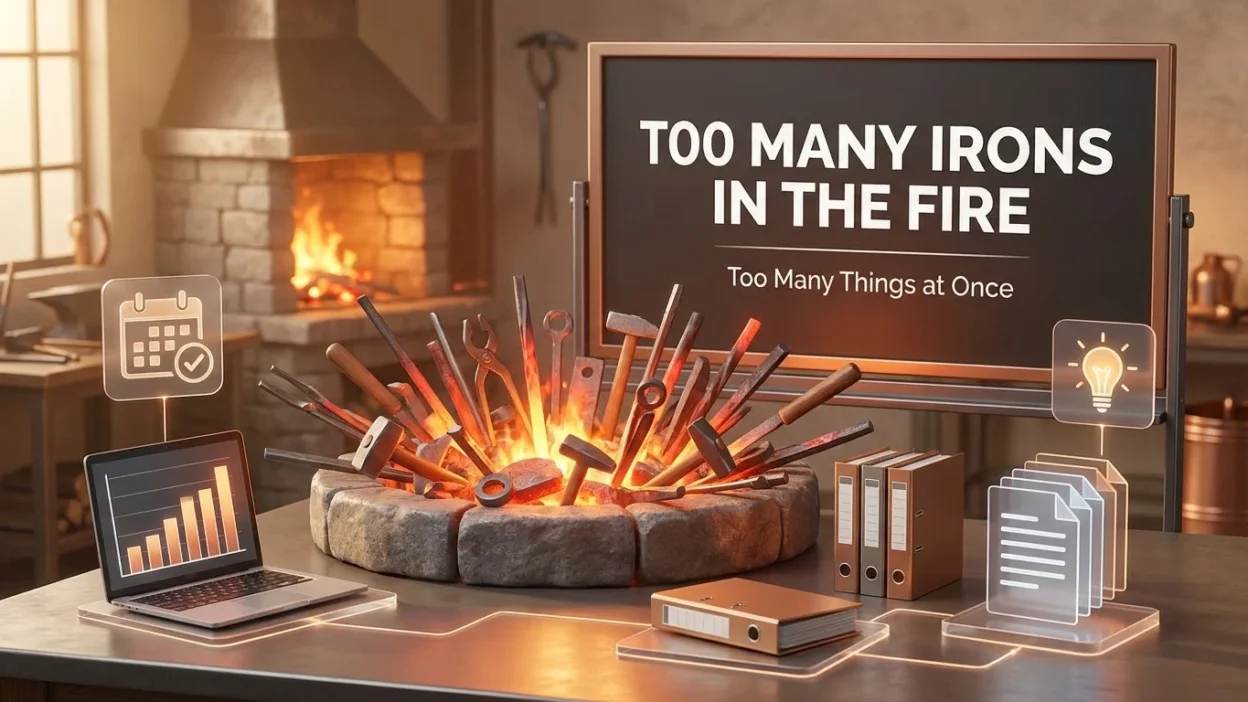
Imagine a blacksmith working with several pieces of iron. The iron needs to be heated in a fire before it can be shaped. If a blacksmith has several irons in the fire, they are all being prepared for work.
Having several possibilities can be useful, but having too many can make it difficult to give enough attention to each one.
That idea eventually developed into the figurative meaning we use today: having many things in progress at the same time.
The expression is therefore closely connected with the ideas of opportunity, preparation, workload, attention, and competing priorities.
Too Many Irons in the Fire Examples
Here are some natural examples of the idiom:
- I have too many irons in the fire to start another project.
- She has too many irons in the fire at work this month.
- He always seems to have several irons in the fire.
- We should not take on another client; we already have too many irons in the fire.
- I’m trying to reduce my workload because I have too many irons in the fire.
- The company has several irons in the fire and may launch a new product soon.
- He has too many irons in the fire to focus properly on one business.
- I would love to help, but I already have too many irons in the fire.
These examples show that the expression is particularly useful when discussing multiple commitments or possibilities.
Is Too Many Irons in the Fire Always Negative?
Not necessarily.
The phrase can have either a negative or mildly positive implication depending on context.
Negative Meaning
Often, the idiom suggests that someone is taking on too much.
I have too many irons in the fire, and I’m starting to feel overwhelmed.
Here, the speaker has more responsibilities than they can comfortably manage.
Positive Meaning
In some contexts, having several irons in the fire can mean having several opportunities available.
The company has several irons in the fire, so we are optimistic about the future.
Here, the phrase suggests that the company has multiple possibilities or projects that could succeed.
The addition of too many usually strengthens the idea of having more commitments than is practical.
Too Many Irons in the Fire vs Several Irons in the Fire
There is a subtle difference between these expressions.
| Expression | Meaning | Typical implication |
|---|---|---|
| several irons in the fire | Several plans or opportunities are in progress | Often neutral or positive |
| too many irons in the fire | Too many plans or activities are in progress | Usually suggests overload |
| have an iron in the fire | Have one opportunity or possibility in progress | Usually neutral |
| keep an iron in the fire | Maintain an opportunity or possibility | Often positive |
For example:
I have several irons in the fire.
This simply means the person has several things underway.
I have too many irons in the fire.
This suggests the person has more things underway than they can comfortably handle.
Have an Iron in the Fire Meaning
The singular expression have an iron in the fire means to have an opportunity, plan, or possibility in progress.
For example:
I have an iron in the fire with another company.
This could mean the speaker has another job opportunity or business possibility being considered.
Unlike too many irons in the fire, the singular form does not necessarily suggest that the person is overwhelmed.
It can actually imply that someone is keeping a useful option available.
Too Many Irons in the Fire in the Workplace
This idiom is especially useful in professional English.
For example:
Our marketing team has too many irons in the fire this quarter.
This means the team is working on too many projects simultaneously.
A manager might say:
Let’s finish our current projects before adding another one. We already have too many irons in the fire.
The expression can make workplace communication sound more natural and conversational.
However, in highly formal writing, simpler alternatives such as multiple competing priorities or an excessive number of ongoing projects may be more appropriate.
Common Synonyms and Similar Expressions
Several words and phrases can express a similar idea.
Synonyms
- Too many commitments
- Too many responsibilities
- Too many projects
- Too many priorities
- Overcommitted
- Overloaded
- Overstretched
- Extremely busy
Similar idiomatic expressions
- Have a lot on one’s plate
- Spread oneself too thin
- Juggle too many things
- Have too much going on
- Bite off more than one can chew
These expressions are related, but they are not always interchangeable.
For example, have a lot on your plate generally means you have many responsibilities, while too many irons in the fire emphasizes several projects, plans, or opportunities that are actively in progress.
Too Many Irons in the Fire vs Too Much on Your Plate
These two expressions are often confused because they can describe similar situations.
Too many irons in the fire focuses on multiple projects, possibilities, or activities that are underway.
Too much on your plate focuses more generally on having too many responsibilities or tasks to handle.
Compare:
I have too many irons in the fire because I’m working on three business ideas.
This emphasizes several active projects.
I have too much on my plate because of work, family responsibilities, and exams.
This emphasizes an overall heavy workload.
Common Mistakes
1. Taking the Idiom Literally
A common mistake is assuming that the expression is actually about putting iron into a fire.
In modern English, it is usually figurative.
I have too many irons in the fire.
This normally means the person has too many things going on.
2. Thinking It Only Refers to Work
The idiom can describe professional activities, but it is not limited to the workplace.
You can have too many irons in the fire in your:
- Career
- Business
- Education
- Personal life
- Creative work
- Social life
3. Assuming It Always Means Failure
Having too many irons in the fire does not mean that everything will fail.
It simply suggests that someone has many things happening at once, often with the implication that managing them may become difficult.
4. Confusing It With Being Completely Idle
The phrase has almost the opposite meaning of doing nothing.
Someone with too many irons in the fire is generally very active and involved in multiple things.
5. Overusing the Idiom in Formal Writing
The expression is natural in conversation and informal or semi-formal writing.
In highly formal documents, a clearer phrase may be preferable.
Instead of:
The department has too many irons in the fire.
You might write:
The department is currently managing too many simultaneous projects.
American English vs British English
Too many irons in the fire is understood in both American and British English.
There is no major difference in its basic meaning or usage between the two varieties.
American English:
I’ve got too many irons in the fire right now.
British English:
I’ve got too many irons in the fire at the moment.
The idiom is familiar in both varieties, although individual speakers may naturally prefer simpler alternatives such as I have too much on my plate or I’m juggling too many things.
How to Use Too Many Irons in the Fire Naturally
The expression usually works best when talking about several things that are actively being pursued.
Natural:
I have too many irons in the fire, so I need to focus on my main project.
Natural:
She has several irons in the fire and is waiting to see which opportunity works out.
Natural:
The company has too many irons in the fire and needs to prioritize its projects.
It is less natural when you are simply describing a long list of ordinary daily tasks with no sense of separate plans or possibilities.
FAQs
What does too many irons in the fire mean?
Too many irons in the fire means having too many activities, projects, plans, responsibilities, or opportunities happening at the same time.
Is too many irons in the fire an idiom?
Yes. It is a common English idiom that uses the image of several pieces of iron being heated in a blacksmith’s fire.
Is too many irons in the fire positive or negative?
It can be either, depending on context. It often suggests being overcommitted, but having several opportunities can sometimes be viewed positively.
What does have an iron in the fire mean?
Have an iron in the fire means to have an opportunity, plan, or possibility in progress or available as an option.
What is another way to say too many irons in the fire?
You can say have too much on your plate, be overcommitted, spread yourself too thin, or juggle too many things.
Is too many irons in the fire used in American English?
Yes. The idiom is widely understood and used in American English.
Is too many irons in the fire used in British English?
Yes. British English speakers also understand and use the expression.
Can I use this idiom in professional writing?
Yes, especially in conversational, informal, or semi-formal professional communication. For highly formal writing, a more direct phrase such as multiple ongoing projects may be clearer.
Summary
The idiom too many irons in the fire means having too many plans, projects, activities, commitments, or opportunities happening at the same time. It comes from the traditional image of a blacksmith working with several pieces of iron in a fire. The phrase is usually used when someone has so many things in progress that it may become difficult to give each one enough attention.
The expression can sometimes have a positive meaning when it refers to having multiple opportunities available, but too many irons in the fire often carries a warning about being overcommitted or spread too thin. It is widely understood in both American and British English and can be a colorful alternative to simply saying that someone is very busy.
Actionable Takeaway
When you are talking about several active projects, opportunities, or plans, you can naturally say you have too many irons in the fire. If the situation is becoming overwhelming, phrases such as spread yourself too thin or have too much on your plate may express the idea even more clearly.
Easy rule to remember: One or several irons can represent opportunities; too many irons in the fire suggest too much going on at once.

Liam James is a language enthusiast and content writer at Verseslay, specializing in word comparisons, grammar debates, and vocabulary insights. He helps readers understand language nuances through clear, engaging, and practical explanations.