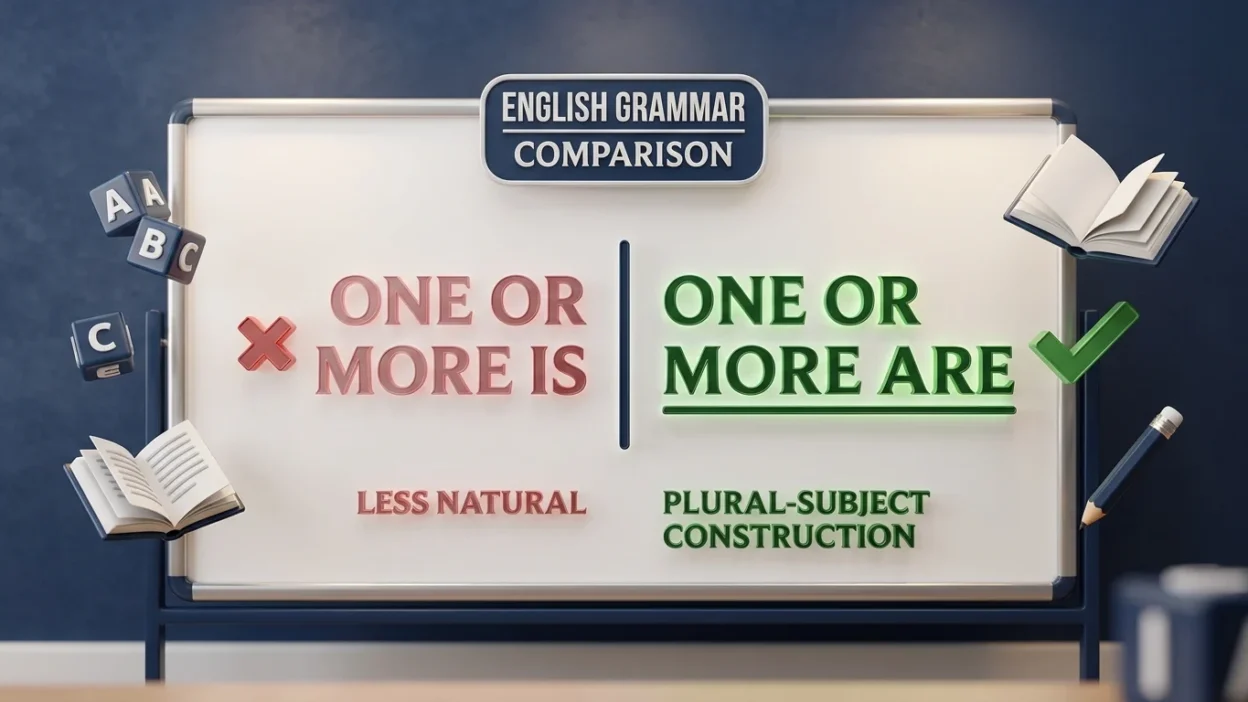
Have you ever wondered whether to write one or more is or one or more are? You are not alone. This grammar question can confuse even confident English writers because the phrase one or more refers to at least one item but can include several. Choosing the correct verb depends on the sentence’s structure and what the verb refers to.
The good news is that there is a simple way to understand this expression. Whether you are writing an email, preparing an assignment, creating website content, or improving your everyday English, learning when to use is and are will help you communicate more clearly. Let’s explore the grammar rule, practical examples, common mistakes, and situations where each form is appropriate.
Quick Answer: One or More Is vs One or More Are
Both one or more is and one or more are can occur in English, but they are not interchangeable in every sentence.
- One or more are is generally correct when one or more is the subject and the verb agrees with the plural meaning of the expression.
- One or more is can be correct when the sentence focuses on one item, when the grammatical subject is singular, or when one or more is part of a different construction.
- In formal writing, the clearest approach is often to rewrite the sentence to avoid uncertainty.
Example:
- Awkward: One or more of the students is absent.
- Clearer: One or more of the students are absent.
In standard usage, the plural verb are is generally preferred in the second sentence because the expression refers to an unspecified number of students, potentially including several.
What Does One or More Mean?
The expression one or more means at least one. It allows for the possibility of a single person or thing as well as multiple people or things.
For example:
- One or more students may participate.
- One or more documents are required.
- One or more errors have been identified.
- One or more employees will attend the meeting.
In each example, the expression leaves the exact number open. The number could be one, two, or several.
This flexibility is what makes subject-verb agreement tricky. English verbs must agree with their grammatical subjects, but the phrase one or more contains both a singular number word and an indication that the quantity may be plural.
When Should You Use One or More Are?
Use one or more are when the expression refers to one or several members of a plural group and the sentence treats the group of possible items as the subject.
Here are some natural examples:
- One or more of the students are missing from the classroom.
- One or more employees are responsible for checking the records.
- One or more documents are needed to complete the application.
- One or more applicants are eligible for the scholarship.
- One or more reasons are responsible for the delay.
- One or more errors are present in the report.
- One or more participants are required to register in advance.
- One or more books are available in the school library.
Notice that the nouns after one or more are usually plural: students, employees, documents, applicants, reasons, errors, participants, and books.
The plural verb are works naturally in these sentences because the expression allows for multiple members of the group.
Why Is Are Often Preferred?
The expression does not guarantee that there is only one item. Since it explicitly includes the possibility of several items, a plural verb is commonly used when the entire phrase functions as the subject.
This is particularly common in formal instructions, reports, technical documents, and general statements about a group.
For example:
One or more changes are necessary before the report can be approved.
This sentence is clear and natural because the changes may involve one or several modifications.
When Is One or More Is Correct
The phrase one or more is requires closer attention to sentence structure. It is not automatically wrong, but it is often less natural when the complete phrase is the subject of a sentence and the verb refers to multiple possible items.
A singular verb is correct when the actual grammatical subject is singular or when one is the specific focus of the statement.
Consider these examples:
- One or more than one student is needed to demonstrate the activity.Here, the construction one or more than one student can take a singular verb in standard usage, although the sentence may be clearer if rewritten.
- One or more is the minimum number of participants allowed.This sentence is possible when one or more is treated as a quoted expression or grammatical unit, although a clearer version is: The minimum number of participants allowed is one or more.
- One or more of these options is acceptable as a general description of the available choice.This construction may be encountered, but many readers will prefer One or more of these options are acceptable when the sentence refers to an unspecified number of options.
The key lesson is that one or more is not a universal rule for singular agreement. The entire sentence determines which verb is appropriate. When the subject genuinely refers to an unspecified number of plural items, are is usually the safer choice.
One or More Is vs One or More Are: Comparison Table
| Sentence | Preferred form | Explanation |
|---|---|---|
| One or more students ___ absent. | Are | The expression refers to an unspecified number of students. |
| One or more documents ___ required. | Are | The documents may number one or several. |
| One or more employees ___ available. | Are | The subject allows for multiple employees. |
| One or more errors ___ present. | Are | The sentence refers to possible errors. |
| One or more ___ the minimum number allowed. | Is, with restructuring preferred | A singular linking verb can agree with a singular subject after rewriting. |
| One or more than one student ___ needed. | Is | The construction more than one commonly takes a singular verb. |
| At least one student ___ absent. | Is | The grammatical subject is the singular phrase at least one student. |
| Several students ___ absent. | Are | The subject is explicitly plural. |
The table shows why it is important to look at the complete construction rather than selecting a verb based only on the word one.
The Grammar Rule Behind One or More
English subject-verb agreement generally requires a singular subject to take a singular verb and a plural subject to take a plural verb.
- Singular: One student is absent.
- Plural: Two students are absent.
- Plural: Several students are absent.
- Usually plural: One or more students are absent.
The last example differs from one student is absent because one or more does not limit the subject to exactly one person.
Do Not Confuse One or More With More Than One
These expressions look similar but often follow different agreement patterns.
One or more commonly takes a plural verb when used as the subject:
One or more students are waiting outside.
More than one commonly takes a singular verb when it directly modifies a singular countable noun:
More than one student is waiting outside.
Although the second sentence refers to multiple students, the construction more than one student traditionally takes singular agreement.
Remembering this distinction can help you avoid one of the most common subject-verb agreement mistakes in English.
Common Mistakes to Avoid
1. Assuming One Always Requires Is
A common mistake is choosing is simply because the expression begins with one.
Incorrect or less natural: One or more books is available.
Preferred: One or more books are available.
The phrase permits a plural quantity, so the plural verb is generally more natural here.
2. Assuming Are Is Always Correct
Although are is usually preferred when one or more refers to possible multiple items, it should not be selected blindly.
For example:
More than one student is absent.
This is standard because more than one usually takes a singular verb when followed by a singular countable noun.
3. Ignoring the Real Subject
Sometimes a sentence contains additional phrases between the subject and the verb. These phrases can distract writers from the actual grammatical structure.
Example:
One or more of the reports are missing.
The subject is one or more of the reports, not simply reports. Nevertheless, the expression’s potential plural meaning makes are the natural choice in this sentence.
4. Using an Unclear Sentence Structure
Sometimes both the intended meaning and the grammatical relationship are difficult to follow.
Instead of writing:
One or more is required for approval.
Try:
At least one document is required for approval.
Or:
One or more documents are required for approval.
The rewritten sentences make the intended meaning easier to understand.
5. Confusing Grammatical Number With Actual Quantity
The phrase one or more does not tell readers the exact number of items involved. It means that at least one item meets the condition.
For example:
One or more candidates are eligible.
This does not mean that several candidates definitely qualify. It means that one candidate or multiple candidates may qualify.
American English vs British English
There is no major American-versus-British English distinction that changes the basic guidance for one or more is and one or more are.
Both American and British English generally favor plural agreement when one or more refers to an unspecified number of plural items.
Examples used in both varieties include:
- One or more applicants are eligible.
- One or more documents are missing.
- One or more students are absent.
Differences in agreement sometimes occur with collective nouns such as team, family, and government. British English can more readily use plural agreement with a collective noun when its members are considered individually, while American English more often treats the collective noun as a singular unit.
However, this variation does not mean that one or more follows completely different rules in the two varieties. For clear, standard writing, use are for the usual plural interpretation and restructure sentences when the intended subject is singular.
How to Choose the Correct Verb
When you are unsure whether to use is or are, follow these simple steps.
- Find the subject. Identify the word or expression that the verb describes.
- Check the complete phrase. Do not make your decision based on the word one alone.
- Consider the meaning. Does the sentence refer to one specific item, or does it allow for one or several items?
- Apply subject-verb agreement. Use are when one or more naturally refers to an unspecified number of plural items.
- Rewrite if necessary. Use a clearer expression such as at least one document is required when you want to emphasize a minimum of one.
For example:
Unclear: One or more is needed for the task.
Clearer: One or more tools are needed for the task.
Also clear: At least one tool is needed for the task.
Both revised sentences communicate the intended meaning more directly.
FAQs
1. Is one or more is grammatically correct?
It can be correct in certain sentence structures, particularly when the actual subject is singular or the expression is treated as a unit. However, one or more are is generally preferred when the phrase refers to an unspecified number of plural items.
2. Should I write one or more is or one or more are?
In most ordinary sentences, choose one or more are when the phrase is the subject and refers to one or several members of a plural group.
Example: One or more students are absent.
3. Is one or more students is correct?
It is generally less natural in standard writing than one or more students are. The plural form is usually preferred because the sentence permits more than one student.
4. Why does more than one student take is?
The expression more than one traditionally takes a singular verb when it modifies a singular countable noun.
Example: More than one student is participating in the competition.
5. Does one or more always mean several?
No. It means at least one. The actual number could be one or any greater number.
6. Is one or more are correct in formal writing?
Yes. It is a natural and standard choice when the phrase refers to one or several possible items.
Example: One or more documents are required to process the application.
7. Do American and British English use different rules?
Not for this expression’s basic agreement pattern. Both generally use are when one or more refers to an unspecified number of plural items.
8. How can I avoid mistakes with one or more?
Identify the complete subject, consider whether it refers to one or several items, and check the verb accordingly. If the sentence sounds awkward, rewrite it using at least one or a clearer plural construction.
Summary:
The difference between one or more is and one or more are comes down to sentence structure and subject-verb agreement. In ordinary English, one or more are is generally the preferred construction when the phrase refers to an unspecified number of people, objects, or other plural items. For example, One or more students are absent is natural and clear.
However, do not assume that are is correct in every sentence containing these words. Expressions such as more than one student commonly take a singular verb, and some sentences containing one or more need to be rewritten to make the intended subject clearer. The best approach is to examine the complete sentence rather than relying on a single-word rule.

Liam James is a language enthusiast and content writer at Verseslay, specializing in word comparisons, grammar debates, and vocabulary insights. He helps readers understand language nuances through clear, engaging, and practical explanations.