
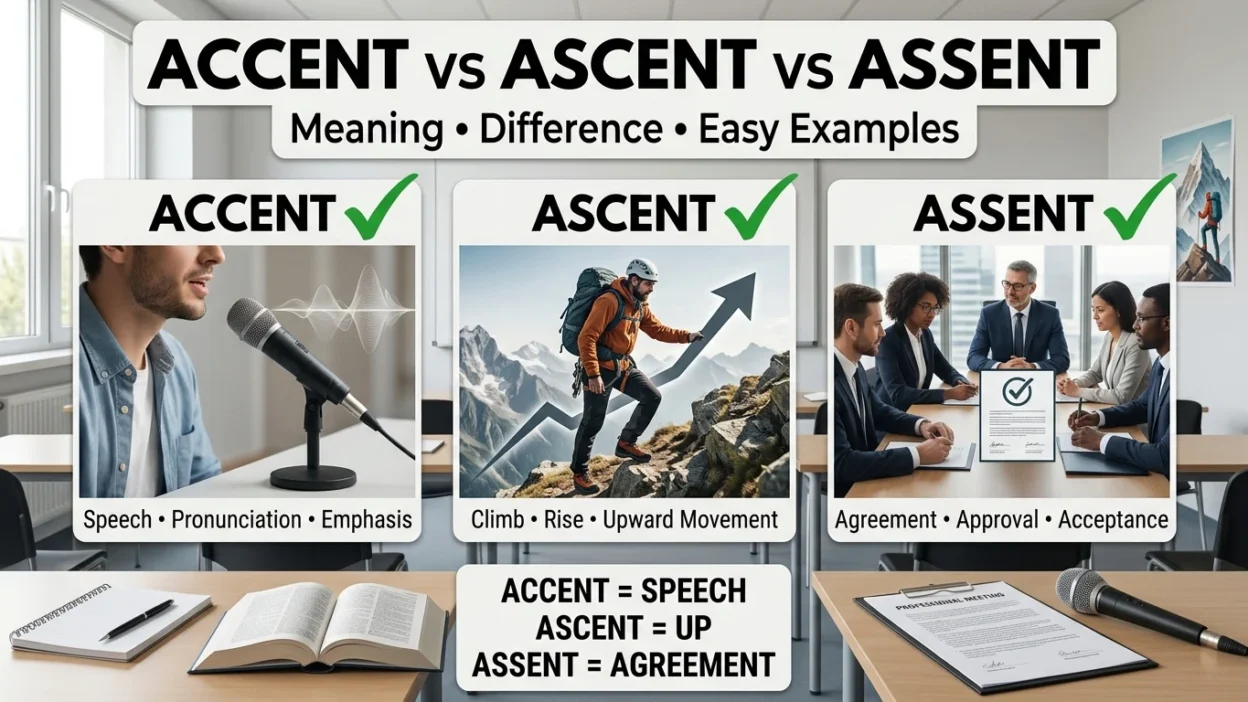
If you have ever confused accent vs ascent vs assent, you are definitely not alone. These three words sound very similar, but they have completely different meanings and are used in different situations. Learning the difference can help you avoid spelling mistakes and make your English more precise.
The confusion is especially common because all three words are pronounced similarly in many varieties of English. However, their meanings are easy to separate once you connect each word with a simple idea: accent relates to speech or emphasis, ascent relates to going upward, and assent means agreement or approval.
Quick Answer: Accent vs Ascent vs Assent
Here is the easiest way to remember the three words:
- Accent = a way of pronouncing words or special emphasis
- Ascent = movement upward or a climb
- Assent = agreement or approval
Examples:
She speaks English with a British accent.
The hikers began their ascent up the mountain.
The committee gave its assent to the proposal.
Although the words sound alike or nearly alike, they are not interchangeable.
What Does Accent Mean?
Accent is a noun that commonly refers to the particular way someone pronounces words. An accent can indicate a person’s regional, national, or social background.
For example:
He has a strong Scottish accent.
She speaks English with an American accent.
I could hear a different accent in his voice.
Accent can also refer to emphasis placed on a particular word, syllable, or idea.
For example:
The teacher put an accent on the importance of pronunciation.
In music, accent can describe extra emphasis given to a particular note.
Accent can also refer to a mark written above or below a letter in some languages.
What Does Ascent Mean?
Ascent means movement upward or the act of climbing to a higher position.
It is commonly used when talking about mountains, stairs, aircraft, or anything moving upward.
Examples:
The hikers began their ascent before sunrise.
The airplane started its ascent shortly after takeoff.
The steep ascent made the journey difficult.
The climber completed the ascent safely.
Ascent is closely related to the verb ascend, which means to move upward.
A simple connection to remember is:
Ascent → Ascend → Upward movement
This connection makes the spelling and meaning easier to remember.
What Does Assent Mean?
Assent means agreement, approval, or acceptance of a proposal, request, or idea.
It is often used in formal, legal, academic, or professional contexts.
Examples:
The board gave its assent to the new policy.
The proposal was accepted with the manager’s assent.
The parents gave their assent to the arrangement.
The committee gave its assent after reviewing the plan.
Assent can be used as both a noun and a verb.
As a noun:
The committee gave its assent.
As a verb:
The members assented to the proposal.
A useful connection is:
Assent → Agree → Approval
Accent vs Ascent vs Assent Comparison Table
| Word | Meaning | Common Use | Example |
|---|---|---|---|
| Accent | Pronunciation style or emphasis | Speech, language, music | She has a clear American accent. |
| Ascent | Movement upward or climbing | Mountains, aircraft, stairs | The ascent was difficult. |
| Assent | Agreement or approval | Formal decisions and proposals | The board gave its assent. |
The easiest memory trick is:
Accent = speech
Ascent = up
Assent = agreement
Accent vs Ascent
The main difference between accent and ascent is their meaning.
Accent is usually connected with pronunciation, speech, emphasis, or language.
Ascent is connected with moving upward.
Compare these sentences:
She has a noticeable accent.
The hikers began their ascent.
In the first sentence, accent describes pronunciation. In the second sentence, ascent describes upward movement.
A useful spelling clue is that ascent is related to ascend.
Accent vs Assent
Accent and assent are also completely different.
Accent relates to pronunciation or emphasis.
Assent relates to agreement or approval.
Examples:
He speaks English with a noticeable accent.
The committee gave its assent.
You can remember assent by connecting it with agreement.
If someone assents to an idea, they agree with it.
Ascent vs Assent
These two words are particularly easy to confuse because their spelling differs by only one letter.
Ascent means upward movement.
Assent means agreement.
Compare:
The climber began the ascent.
The manager gave his assent.
A simple memory trick is:
Ascent has C for climbing.
Assent has two Ss and means support or agreement.
This is not a formal spelling rule, but it can be a useful memory aid.
Common Meanings of Accent
Accent has several meanings beyond pronunciation.
Regional or National Pronunciation
People from different places may pronounce the same language differently.
Examples:
She has a strong Irish accent.
He speaks with a Canadian accent.
I noticed her Australian accent immediately.
Emphasis
Accent can also mean special emphasis.
Example:
The speaker placed an accent on the importance of education.
Music
In music, an accent can indicate that a particular note should receive extra emphasis.
Written Marks
Some languages use accent marks over letters to indicate pronunciation or distinguish words.
Common Uses of Ascent
Ascent is frequently used in situations involving upward movement.
Mountain Climbing
The climbers began their ascent early in the morning.
Air Travel
The aircraft began its ascent after leaving the runway.
Stairs or Elevation
The steep ascent made the stairs difficult to climb.
Figurative Progress
Ascent can also describe movement toward a higher position or status.
The young athlete’s ascent to the top of the sport was remarkable.
In this sense, ascent does not necessarily involve physical movement.
Common Uses of Assent
Assent is particularly common in formal contexts.
Approval
The committee gave its assent to the proposal.
Agreement
She gave her assent to the plan.
Formal Decisions
The members assented to the new rules.
Legal or Official Language
Assent can appear in formal documents when someone officially agrees to something.
Because of this, assent may sound more formal than ordinary words such as agree or approve.
Common Mistakes With Accent, Ascent, and Assent
Mistake 1: Using Ascent When You Mean Accent
Incorrect meaning:
He speaks with a British ascent.
Correct:
He speaks with a British accent.
Accent is the word connected with pronunciation.
Mistake 2: Using Accent for Upward Movement
Incorrect:
The hikers began their accent up the mountain.
Correct:
The hikers began their ascent up the mountain.
Ascent describes movement upward.
Mistake 3: Using Ascent When You Mean Agreement
Incorrect:
The manager gave his ascent to the proposal.
Correct:
The manager gave his assent to the proposal.
Assent means agreement or approval.
Mistake 4: Assuming They Are Pronounced Exactly the Same
The pronunciation can vary depending on accent and regional variety. In many forms of English, they are homophones or very close in pronunciation.
Because of this, spelling and context are especially important.
American vs British English Differences
There is no major difference in the basic meanings of accent, ascent, and assent between American and British English.
All three words are used in both varieties.
However, the word accent can sometimes be especially relevant when discussing differences in pronunciation between American and British English.
For example:
She speaks with an American accent.
He speaks with a British accent.
The pronunciation of the three words themselves can vary slightly depending on regional accent, but their meanings remain the same.
Therefore, the distinction between accent, ascent, and assent is primarily a vocabulary and spelling issue rather than an American-versus-British English difference.
Accent, Ascent, and Assent Pronunciation
Because these words sound similar, they are often confused when heard rather than read.
Accent is pronounced with emphasis on the first syllable.
Ascent begins with a weaker initial sound and has the main stress later in the word.
Assent is also commonly pronounced with the main stress on the second syllable.
The exact pronunciation can vary by region, so learners should pay attention to both pronunciation and context.
How to Remember the Difference
Try these three simple associations:
Accent → A = Accent in speech
Think about the way someone speaks.
Ascent → C = Climb
Think about going upward.
Assent → Agree
Think about giving approval.
You can also memorize these short definitions:
Accent = how you sound
Ascent = how you go up
Assent = how you agree
These associations make the three words much easier to remember.
FAQs
1. What is the difference between accent and ascent?
Accent usually refers to pronunciation, emphasis, or a speech pattern. Ascent means movement upward or the act of climbing.
2. What is the difference between ascent and assent?
Ascent means upward movement, while assent means agreement or approval.
3. What does accent mean?
Accent can refer to a person’s pronunciation style, emphasis in speech or music, or a written mark used with a letter.
4. What does ascent mean?
Ascent means movement upward, climbing, or progress toward a higher position.
5. What does assent mean?
Assent means agreement, approval, or acceptance. It can be used as both a noun and a verb.
6. Are accent, ascent, and assent homophones?
They can sound very similar, and in some varieties of English they may be pronounced as homophones or near-homophones. Their spelling and meanings are different.
7. Which word should I use for pronunciation?
Use accent.
Example:
She has a noticeable American accent.
8. Which word means agreement?
Use assent.
Example:
The committee gave its assent to the proposal.
Final Summary
The difference between accent vs ascent vs assent becomes simple once you connect each word with its meaning. Accent relates mainly to pronunciation, speech, emphasis, or a special mark. Ascent describes movement upward, such as climbing a mountain or an aircraft gaining altitude. Assent means agreement or approval, particularly in formal situations.
Although these words can sound very similar, their meanings are completely different. Context is therefore extremely important. When you see or hear one of these words, think about whether the sentence is talking about speech, upward movement, or agreement.