If you have ever been confused by forgo vs forego, you are not alone. These two words look almost identical, but they can have different meanings. The confusion becomes even greater because many writers use them interchangeably, especially when they mean to give something up or do without it.
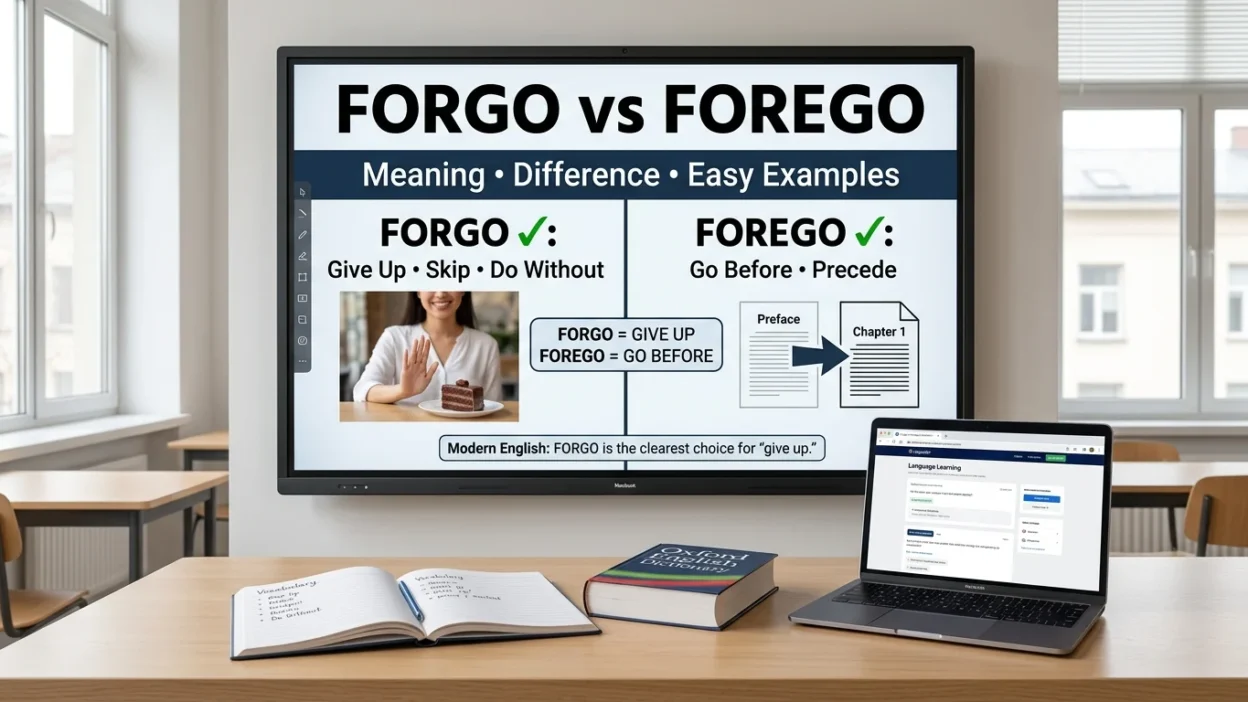
The good news is that the distinction is easy to understand. Forgo means to give up, skip, or do without something. Forego traditionally means to go before or precede, although it is also commonly used as a variant spelling of forgo in modern English. Knowing this difference can help you choose the clearest word for formal, academic, and everyday writing.
Quick Answer: Forgo vs Forego
The traditional distinction is simple:
- Forgo = to give up, skip, or do without something
- Forego = to go before or precede something
- Forego is also widely used as a spelling variant of forgo when meaning give up
Examples:
She decided to forgo dessert.
The introduction foregoes the main discussion.
However, when you mean give up or do without, forgo is the clearer and more traditional choice.
What Does Forgo Mean?
Forgo is a verb meaning to give up, skip, or decide not to have or do something.
It often describes voluntarily choosing to do without something.
For example:
I decided to forgo dessert.
She chose to forgo the opportunity.
He decided to forgo the trip this year.
The company may forgo the additional expense.
In each case, someone chooses not to have, do, or pursue something.
Common synonyms for forgo
Depending on the context, synonyms include:
- Give up
- Skip
- Do without
- Abandon
- Sacrifice
- Pass up
- Waive
- Decline
The exact synonym depends on the sentence, but the basic idea is choosing not to have or do something.
What Does Forego Mean?
Traditionally, forego means to go before or precede something.
The word contains the element fore, which can mean before or in front of.
For example:
The introductory remarks forego the main presentation.
In this traditional sense, forego describes something that comes before another thing.
However, there is an important complication: forego is also widely used as a variant spelling of forgo, especially when writers mean give up or do without.
This means that modern dictionaries and usage references may recognize both forms for the meaning of giving something up.
Forgo vs Forego Comparison Table
| Word | Traditional Meaning | Common Modern Meaning | Example |
|---|---|---|---|
| Forgo | Give up or do without | Give up or do without | She decided to forgo dessert. |
| Forego | Go before or precede | Sometimes used for give up | The introduction foregoes the main discussion. |
The safest practical rule is:
Use forgo when you mean give up or do without.
Use forego for the meaning of going before or preceding, especially when you want to preserve the traditional distinction.
Forgo Meaning: Give Up or Do Without
The most common modern use of forgo is to describe choosing not to have or do something.
Examples:
She decided to forgo the invitation.
He chose to forgo a vacation this year.
We may have to forgo some unnecessary expenses.
The athlete decided to forgo the competition.
The family chose to forgo the expensive option.
In each sentence, something is being voluntarily skipped, surrendered, or left aside.
Forego Meaning: Go Before
The traditional meaning of forego is connected to the idea of coming before.
For example:
A short introduction foregoes the main explanation.
The opening section foregoes the detailed discussion.
The preliminary remarks forego the final announcement.
This meaning is relatively uncommon in everyday English, so many readers may not encounter it frequently.
That is one reason the distinction can be confusing.
Why Are Forgo and Forego Confused?
There are several reasons these words are frequently mixed up.
First, they differ by only one letter.
Second, forego has been used in modern English as a variant spelling of forgo.
Third, many writers know that the prefix fore- means before, but they may not realize that forego has developed overlapping usage.
As a result, you may see forego used when the writer actually means give up.
For modern readers, context usually makes the intended meaning clear.
Common Mistakes With Forgo and Forego
Mistake 1: Assuming Forego Is Always Wrong
It is not always wrong.
Forego has a traditional meaning related to going before, and it is also used as a variant of forgo in some modern contexts.
However, if you mean give up, forgo is the clearest choice.
Mistake 2: Using Forgo to Mean Come Before
If you specifically mean that something comes before something else, forego can be appropriate.
For example:
The introductory section foregoes the main chapter.
Here, the idea is that the introductory section comes before the main chapter.
Mistake 3: Confusing Forgo With Forget
Forgo and forget are completely different words.
Forgo means to give up or do without.
Forget means to fail to remember something.
Compare:
I decided to forgo the opportunity.
I forgot about the opportunity.
The words may look somewhat similar, but their meanings are unrelated.
Mistake 4: Assuming the Words Are Interchangeable in Every Context
Because forego is sometimes used as a variant of forgo, the words can overlap.
However, in careful writing, choosing forgo for the meaning of giving something up makes your intended meaning immediately clear.
Forgo in Everyday English
Forgo is common in both everyday and formal writing.
Examples:
I will forgo coffee today.
She decided to forgo the dessert.
He chose to forgo the opportunity.
They decided to forgo the extra expense.
The team may forgo the traditional approach.
The word can sound slightly more formal than simply saying give up or skip, but it is perfectly natural in many contexts.
Forgo in Formal and Academic Writing
Forgo is especially useful in formal writing because it expresses the idea of intentionally giving something up in a concise way.
For example:
The researchers chose to forgo additional testing.
The organization decided to forgo unnecessary expenses.
The study participants were asked to forgo certain activities.
The author chose to forgo a detailed discussion of the topic.
These examples demonstrate why forgo appears frequently in professional and academic contexts.
American vs British English
There is no major difference between American and British English in the basic use of forgo.
Both varieties commonly use forgo to mean give up or do without.
The spelling forego can also appear in both American and British English, particularly because it has an established traditional meaning and is sometimes used as a variant of forgo.
Therefore, this is not a simple American-versus-British spelling difference.
If you are writing for either audience and mean give up, forgo is the safest and clearest choice.
Forgo vs Forego in the Past Tense
This is another area where writers can become confused.
The past tense of forgo is forwent.
Example:
She forwent the opportunity.
He forwent dessert.
The past participle is forgone.
Example:
They have forgone the traditional approach.
This is important because forgo is an irregular verb.
The forms are:
Forgo → forwent → forgone
Do not automatically add -ed.
Forgo vs Forego: Easy Memory Trick
Use this simple rule:
FORGO = GIVE UP
Think:
Forgo the extra expense.
FOREGO = GO BEFORE
Think:
Forego = go before.
The connection between fore and before can help you remember the traditional meaning of forego.
If your sentence means skip, sacrifice, surrender, or do without, choose forgo.
If your sentence means precede or come before, forego may be appropriate.
FAQs
1. What is the difference between forgo and forego?
Traditionally, forgo means give up or do without, while forego means go before or precede. Forego is also used as a variant spelling of forgo in some modern usage.
2. Is forgo the correct spelling for give up?
Yes. Forgo is the clearest and traditional spelling when you mean give up, skip, or do without something.
3. Is forego a real word?
Yes. Forego is a legitimate word. Traditionally, it means to go before or precede. It is also sometimes used as a variant spelling of forgo.
4. Should I use forgo or forego in formal writing?
If you mean give up or do without, forgo is generally the better choice because it is clear and widely recognized.
5. What is the past tense of forgo?
The past tense is forwent, and the past participle is forgone.
Example:
She forwent the opportunity.
They have forgone the expense.
6. Does forgo mean sacrifice?
It can. Forgo can mean voluntarily giving up or doing without something, which may involve a sacrifice.
7. Is forego an American or British spelling?
Both American and British English use forego. The distinction is mainly about meaning and usage, not nationality.
8. Can forgo and forego mean the same thing?
Sometimes. Forego is used by some writers as a variant of forgo when the intended meaning is give up. However, forgo is the clearer choice for that meaning.
Final Summary
The difference between forgo vs forego is easier to understand when you focus on their traditional meanings. Forgo means to give up, skip, or do without something. Forego traditionally means to go before or precede something. However, modern usage has allowed forego to overlap with forgo, especially when it means give up.
For most modern writing, the practical rule is straightforward: use forgo when you mean give up or do without. If you specifically mean that something comes before another thing, forego can express that idea. This distinction keeps your writing precise and avoids unnecessary confusion.