The words wonder vs wander are easy to confuse because they look and sound somewhat similar, but they have completely different meanings. One is mainly connected with curiosity, amazement, or thinking, while the other describes moving around without a specific destination.
Understanding the difference between wonder and wander can help you avoid common spelling and vocabulary mistakes. Whether you’re writing an email, an essay, a social media post, or simply improving your everyday English, knowing when to use each word makes your writing clearer and more natural.
Quick Answer: Wonder vs Wander
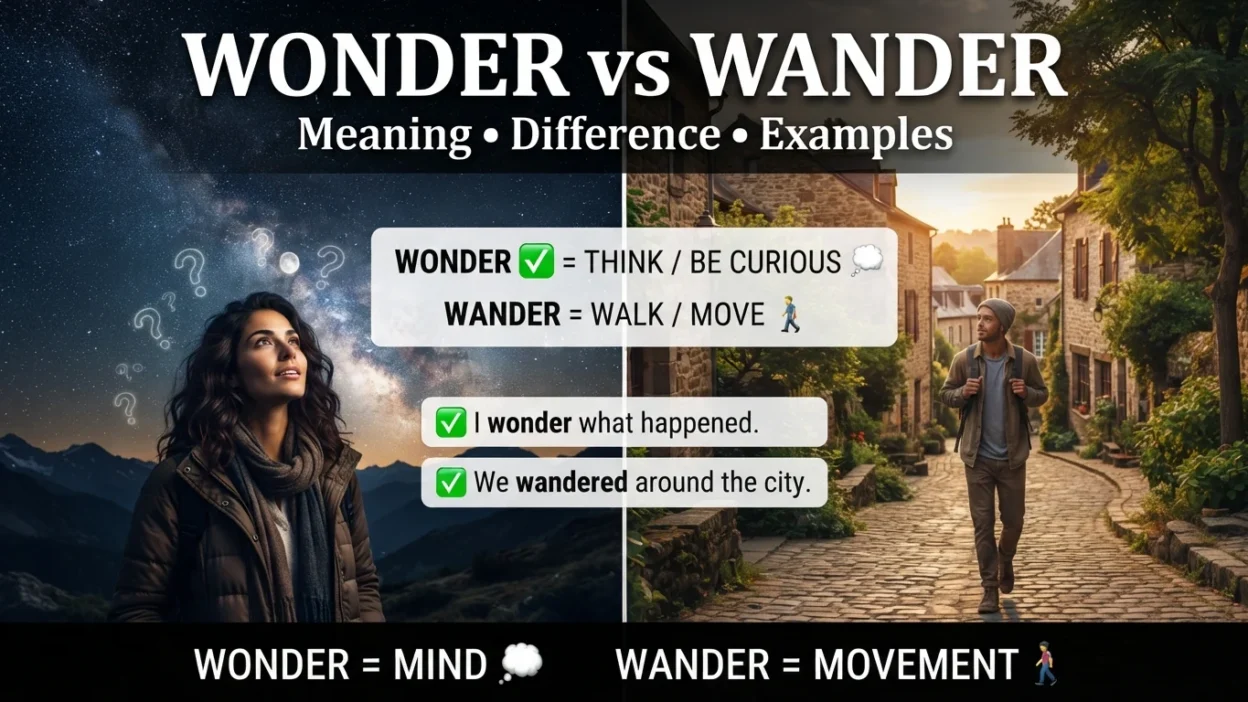
Wonder means to feel curious, think about something, or feel amazed by something.
Wander means to move or travel around without a clear destination or direction.
Simple Rule
- Wonder = Think or feel curious
- Wander = Move around without a clear direction
Examples
- I wonder what happened.
- We wandered around the city for hours.
A useful memory trick is:
Wonder = Mind 💭
Wander = Movement 🚶
What Does “Wonder” Mean?
Wonder has several related meanings, but they generally involve curiosity, thought, or amazement.
As a verb, wonder can mean to think about something because you don’t know the answer.
Examples:
- I wonder where she went.
- He wondered why the meeting was canceled.
- I wonder what will happen next.
It can also describe a feeling of amazement.
Example:
- The children looked at the stars in wonder.
As a noun, wonder can refer to a feeling of surprise or admiration.
Example:
- The natural beauty of the mountains filled us with wonder.
What Does “Wander” Mean?
Wander means to move around without a specific destination, purpose, or direction.
Examples:
- We wandered through the old market.
- She likes to wander around the city.
- He wandered through the park for an hour.
The word can also describe someone’s thoughts moving from one subject to another.
Example:
- My mind started to wander during the lecture.
So, wander isn’t always about physically walking. It can also describe thoughts, attention, or conversation moving without a fixed direction.
Wonder vs Wander Comparison Table
| Feature | Wonder | Wander |
|---|---|---|
| Main meaning | Think, question, or feel amazed | Move without a clear destination |
| Common use | Curiosity and thoughts | Walking, traveling, or drifting |
| Part of speech | Verb and noun | Verb and noun |
| Example | I wonder why he left. | We wandered around the town. |
| Memory clue | Mind 💭 | Movement 🚶 |
The key distinction is simple: wonder is usually about the mind, while wander is usually about movement.
Examples of “Wonder”
Here are some natural examples of wonder.
Example 1: Curiosity
I wonder what time the train arrives.
Example 2: Asking Yourself
She wondered whether she had made the right decision.
Example 3: Surprise
I wonder at the beauty of the night sky.
Example 4: Amazement
The ancient building is a wonder of engineering.
Example 5: Polite Question
I was wondering if you could help me.
The last example is especially common in polite English.
Examples of “Wander”
Now let’s look at wander.
Example 1: Walking
We wandered around the village after dinner.
Example 2: Exploring
They spent the afternoon wandering through the museum.
Example 3: Losing Direction
The child wandered away from the group.
Example 4: Thoughts
My mind tends to wander when I’m tired.
Example 5: Conversation
His explanation began to wander away from the main topic.
In each example, something is moving without following a strict or fixed path.
Wonder vs Wander in Everyday English
Both words are common, but they appear in different situations.
You might use wonder when:
- Asking yourself a question
- Thinking about the future
- Expressing curiosity
- Showing amazement
- Making a polite request
You might use wander when:
- Walking without a destination
- Exploring somewhere casually
- Losing your direction
- Describing unfocused thoughts
- Moving away from the main subject
Compare:
I wonder where the restaurant is.
Here, you’re thinking or asking yourself a question.
I wandered around looking for the restaurant.
Here, you’re physically moving around without finding the destination.
Common Mistakes
Mistake 1: Writing “Wander” When You Mean “Wonder”
Incorrect:
I wander what she is doing.
Correct:
I wonder what she is doing.
The first sentence describes movement, while the second expresses curiosity.
Mistake 2: Writing “Wonder” When You Mean “Wander”
Incorrect:
We wondered around the city all afternoon.
Correct:
We wandered around the city all afternoon.
You’re describing physical movement, so wandered is correct.
Mistake 3: Confusing “Wandering Mind” and “Wondering Mind”
These expressions are different.
My mind is wandering.
This means your thoughts are drifting away from the subject.
I’m wondering about my future.
This means you’re thinking about or questioning what might happen.
Mistake 4: Assuming They Have the Same Pronunciation
The words sound similar, but they are not identical.
Wonder: /ˈwʌndər/
Wander: /ˈwɒndər/ in many British pronunciations and /ˈwɑːndər/ in American English.
The vowel sound is different.
Wonder vs Wander Pronunciation
Pronunciation can make these words easier to distinguish.
Wonder
Sounds roughly like:
WUN-der
Example:
I wonder what happened.
Wander
Sounds roughly like:
WON-der
Example:
We wandered through the streets.
The difference can be subtle depending on the speaker’s accent, so context is also important.
Wonder vs Wander: A Simple Memory Trick
A quick way to remember the difference is to connect each word with a concept.
Wonder = Mind
When you wonder, your mind is asking questions.
Think:
Wonder → Why? What? How?
Example:
I wonder why she left.
Wander = Movement
When you wander, you move without a fixed destination.
Think:
Wander → Walk
Example:
We wandered through the park.
The first letters aren’t enough to distinguish them, so remembering wonder = thinking and wander = moving is more useful.
American vs British English
Both wonder and wander are standard words in American and British English.
Their meanings are essentially the same in both varieties.
The main difference you may notice is pronunciation.
In many British accents, the vowel in wander is different from the vowel in wonder, making the distinction easier to hear.
In many American accents, the difference is also present, although the exact sound varies by regional accent.
There is no major difference in spelling or grammar between American and British English for these words.
Wonder vs Wander in Writing
Choosing the right word is particularly important in written English because readers cannot rely on pronunciation or context from your voice.
Compare:
I wonder through the forest every weekend.
This is incorrect if you mean walking.
Correct:
I wander through the forest every weekend.
On the other hand:
I wander what he thinks about it.
is incorrect if you mean you’re curious.
Correct:
I wonder what he thinks about it.
A single letter can completely change the meaning.
FAQs
1. What is the difference between wonder and wander?
Wonder means to think, question, or feel amazed, while wander means to move around without a clear destination or direction.
2. Is “I wonder” correct?
Yes. I wonder is commonly used to express curiosity or uncertainty.
Example:
I wonder where they went.
3. Is “wander around” correct?
Yes. Wander around is a common expression meaning to move around without a particular destination.
Example:
We wandered around the shopping center.
4. What does “my mind wandered” mean?
It means your thoughts moved away from the subject you were supposed to be focusing on.
Example:
My mind wandered during the long lecture.
5. What does “I was wondering” mean?
It usually means I was thinking about or considering something, and it is also commonly used to make a polite request.
Example:
I was wondering if you could help me.
6. Are wonder and wander pronounced differently?
Yes. Their vowel sounds are different, although the exact pronunciation depends on the speaker’s accent.
7. Which word means walking without a destination?
Wander means moving or walking without a specific destination.
8. Which word means being curious?
Wonder means being curious or thinking about something you don’t know.
Final Summary
The difference between wonder vs wander becomes simple when you remember what each word is connected to. Wonder is about the mind: curiosity, questions, thoughts, and amazement. Wander is about movement: walking, traveling, or drifting without a specific direction. Although the words look and sound similar, they cannot normally be used interchangeably.
If you’re asking yourself a question, use wonder. If you’re describing someone walking or moving without a clear destination, use wander. The same distinction applies to figurative uses: your mind can wander, while you can wonder about something. Keeping these two ideas separate will prevent most spelling and vocabulary mistakes.

Liam James is a language enthusiast and content writer at Verseslay, specializing in word comparisons, grammar debates, and vocabulary insights. He helps readers understand language nuances through clear, engaging, and practical explanations.