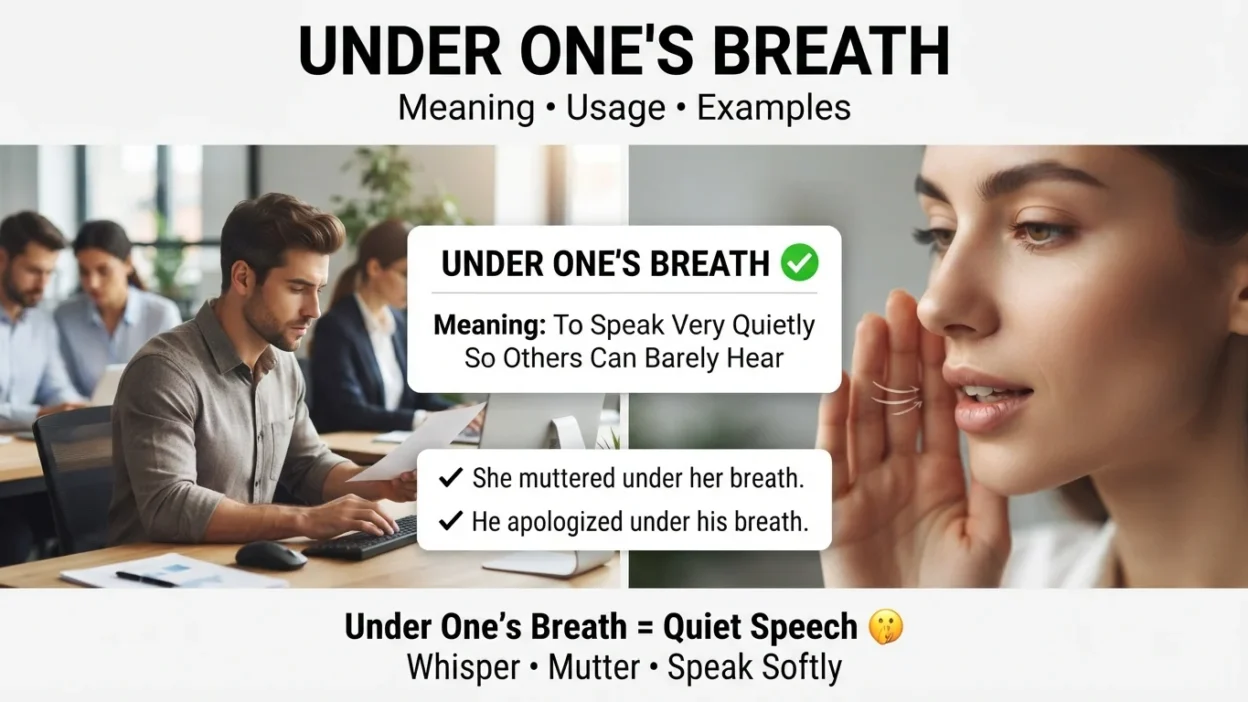
Have you ever heard someone say that a person muttered something under their breath? If you’re learning English, this expression might seem confusing because it doesn’t literally mean speaking beneath your breath. Instead, it’s a common idiom used to describe speaking so quietly that others can barely hear what is being said.
Understanding under one’s breath will help you follow conversations, movies, novels, and everyday English more naturally. In this guide, you’ll learn the meaning of the idiom, its origin, pronunciation, examples, common mistakes, and practical tips for using it correctly in both spoken and written English.
Quick Answer: What Does “Under One’s Breath” Mean?
The idiom under one’s breath means to speak very quietly, softly, or in a low voice so that other people cannot easily hear what is being said.
It often suggests that the speaker is:
- Whispering
- Muttering
- Complaining quietly
- Expressing frustration
- Saying something privately
Examples
- He apologized under his breath.
- She muttered something under her breath after the meeting.
- Tom complained under his breath when the work was assigned to him.
Simple Rule
Use under one’s breath whenever someone speaks quietly enough that only they or someone nearby can hear.
What Does “Under One’s Breath” Mean?
The phrase is an English idiom that describes speaking in a very soft voice, usually without intending everyone around to hear.
People often speak under their breath when they:
- Feel annoyed
- Want to avoid confrontation
- Express disagreement quietly
- Talk to themselves
- Make a private comment
For example:
She thanked him under her breath.
This means she spoke very quietly, almost like a whisper.
The expression focuses on how someone speaks, not what they say.
Origin of the Idiom
The idiom comes from the idea of speaking so quietly that the words seem to remain close to one’s breath rather than being projected aloud.
For centuries, English speakers have used the expression to describe soft speech that is difficult for others to hear.
Although the exact historical origin isn’t certain, the phrase has appeared in English literature for hundreds of years and remains common today.
Modern English speakers use it naturally in conversations, books, movies, and journalism.
Examples of “Under One’s Breath”
Here are several natural examples.
Example 1: Frustration
He complained under his breath after receiving extra work.
Example 2: Anger
She muttered under her breath when the bus left without her.
Example 3: Embarrassment
He apologized under his breath before walking away.
Example 4: Private Comment
The student whispered the answer under her breath.
Example 5: Conversation
A: Did he say something?
B: Yes, but it was under his breath.
Comparison Table
| Expression | Meaning | Typical Situation | Example |
|---|---|---|---|
| Under one’s breath | Speak very quietly | Private comments | She muttered under her breath. |
| Whisper | Speak softly | Secret conversations | He whispered the answer. |
| Murmur | Speak in a low voice | Calm conversation | She murmured a greeting. |
| Mutter | Speak unclearly and quietly | Complaints or frustration | He muttered angrily. |
| Speak softly | Use a quiet voice | Polite conversation | Please speak softly. |
While these expressions are related, under one’s breath often implies that the speaker doesn’t want others to hear clearly.
When Should You Use “Under One’s Breath”?
Use this idiom when someone speaks:
- Quietly
- Almost silently
- To themselves
- In annoyance
- In embarrassment
- So only nearby people can hear
Examples include:
- Quiet complaints
- Soft apologies
- Whispered remarks
- Private reactions
- Low-voiced comments
It works well in both spoken and written English.
Common Situations
You’ll often hear this idiom when someone:
- Complains quietly at work
- Talks to themselves
- Reacts to bad news
- Makes a sarcastic remark
- Expresses disappointment
- Tries not to be overheard
Example:
She cursed under her breath after dropping her phone.
The listener understands she spoke very quietly.
Common Mistakes
Mistake 1: Taking the Idiom Literally
Incorrect understanding:
Someone is physically speaking beneath their breath.
Correct understanding:
It simply means speaking very quietly.
Mistake 2: Using It for Loud Speech
Incorrect:
He shouted under his breath.
Correct:
He muttered under his breath.
The idiom always refers to quiet speech.
Mistake 3: Forgetting the Possessive Pronoun
The idiom changes depending on the speaker.
Correct:
- Under my breath
- Under your breath
- Under his breath
- Under her breath
- Under our breath
- Under their breath
Mistake 4: Using It for Normal Conversation
People speaking at an ordinary volume are not speaking under their breath.
The expression only applies when the voice is unusually quiet.
Similar Expressions
Several English expressions have similar meanings.
These include:
- Whisper quietly
- Mutter softly
- Speak in a low voice
- Murmur
- Say quietly
- Speak softly
- Barely whisper
- Talk to oneself
Each has a slightly different nuance, but all relate to quiet speech.
Under One’s Breath vs Whisper
Many learners wonder whether these expressions are identical.
Whisper
A whisper is intentionally quiet speech.
Example:
She whispered the secret.
Under One’s Breath
This often suggests someone quietly mutters without expecting everyone to hear.
Example:
He grumbled under his breath.
A whisper is often meant for another person.
Speaking under one’s breath is often meant for oneself or only those very close by.
American vs British English
The idiom under one’s breath is common in both American and British English.
The meaning remains exactly the same.
Whether you’re reading an American novel or a British newspaper, the expression describes someone speaking very quietly.
No significant spelling or usage differences exist between the two varieties of English.
Real-Life Examples
You’ll often encounter this idiom in:
- Movies
- Television shows
- Detective novels
- Workplace conversations
- School settings
- Family discussions
Examples:
“He muttered something under his breath before leaving.”
“She laughed under her breath during the meeting.”
“The player complained under his breath after the referee’s decision.”
These examples sound natural in everyday English.
FAQs
1. What does “under one’s breath” mean?
It means to speak very quietly so that other people cannot easily hear.
2. Is “under one’s breath” an idiom?
Yes. It is a common English idiom with a figurative meaning.
3. Is it the same as whispering?
Not exactly. Whispering is intentionally quiet speech, while speaking under one’s breath often involves muttering or quietly talking to oneself.
4. Can I use this idiom in formal writing?
Yes. It appears in novels, journalism, and other forms of writing. However, it is more common in general and narrative English than in highly technical or legal documents.
5. Is the idiom used in American and British English?
Yes. It is widely used and understood in both varieties of English.
6. What emotions are often associated with speaking under one’s breath?
Common emotions include frustration, annoyance, embarrassment, disappointment, sarcasm, or secrecy.
7. Can someone speak kindly under their breath?
Yes. The idiom describes the volume of speech, not the emotion. A person can quietly apologize, thank someone, or offer encouragement under their breath.
8. What is another way to say “under one’s breath”?
Alternatives include quietly, softly, in a low voice, muttering, or whispering, depending on the context.
Final Summary
The idiom under one’s breath describes speaking in a very quiet voice so that others can barely hear what is being said. It is commonly used when someone mutters, whispers, or makes a private comment, often expressing frustration, annoyance, embarrassment, or secrecy. Because it focuses on the manner of speaking rather than the content, it remains a versatile expression in everyday English.
Whether you’re reading a novel, watching a movie, or having a casual conversation, you’ll frequently encounter this idiom. Remember that it doesn’t refer to speaking literally beneath your breath. Instead, it simply describes very soft, almost private speech. Mastering this expression will make your English sound more natural and help you understand authentic conversations with greater confidence.

Liam James is a language enthusiast and content writer at Verseslay, specializing in word comparisons, grammar debates, and vocabulary insights. He helps readers understand language nuances through clear, engaging, and practical explanations.