
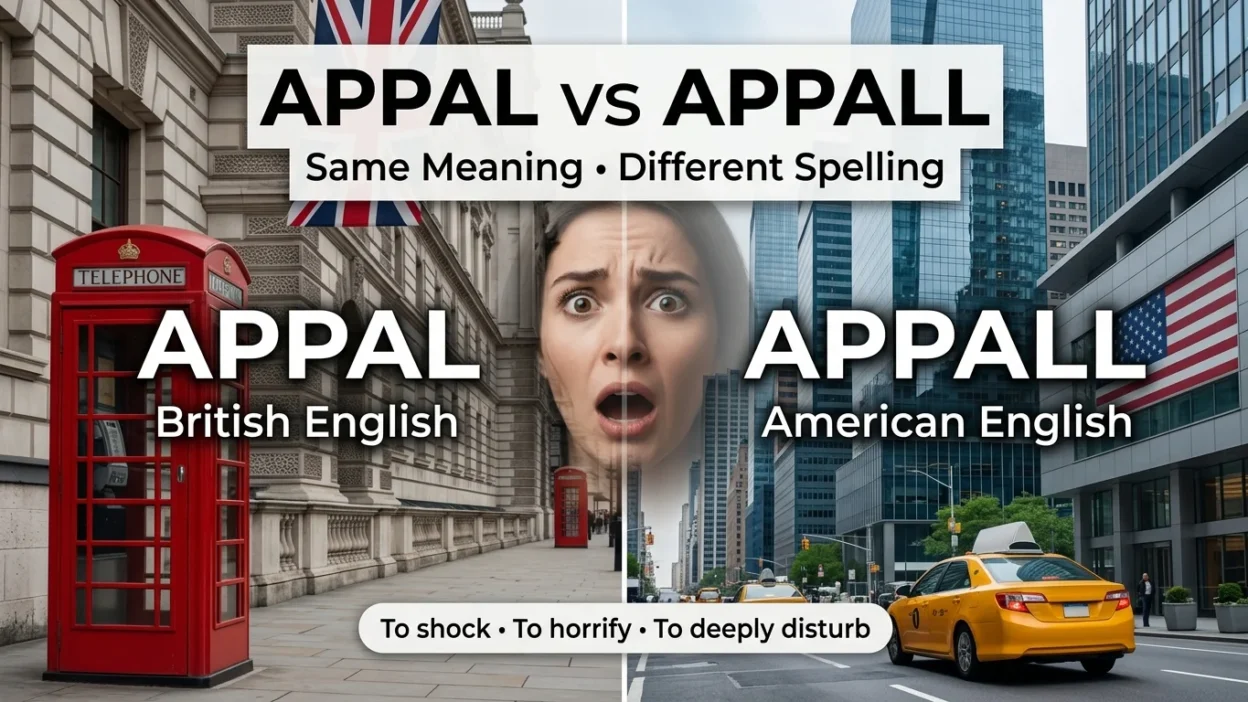
The words appal vs appall are a classic example of a spelling difference that can make English learners hesitate. Both words have the same basic meaning, and both are pronounced the same way, but the spelling you choose can depend on the variety of English you are using.
If you have seen appal in British English and appall in American English, you may wonder whether one is incorrect. The answer is no. Both spellings are legitimate. The main difference is American vs British English spelling conventions. This guide explains exactly when to use each form, with examples, common mistakes, pronunciation tips, and an easy comparison.
Quick Answer: Appal vs Appall
The short answer is:
- Appal = British English spelling
- Appall = American English spelling
- Both mean to shock, horrify, or deeply upset someone
- Both are pronounced the same way
For example:
The terrible news appalled everyone.
In American English, appall is the standard spelling.
In British English, you may see:
The terrible news appalled everyone.
Notice something important: although the base forms differ, some related forms can look identical.
The easiest way to remember the distinction is:
British English → appal
American English → appall
What Does Appal Mean?
Appal is a verb meaning to shock, horrify, or deeply disturb someone.
It describes a strong negative emotional reaction to something unpleasant, shocking, cruel, or unacceptable.
For example:
The violence appalled the community.
She was appalled by the treatment of the animals.
The amount of waste at the site appalled the visitors.
The word is stronger than simply saying that something was surprising or unpleasant.
If something appals you, it causes a strong feeling of horror, disgust, or shock.
What Does Appall Mean?
Appall has exactly the same basic meaning as appal.
It means:
- To horrify
- To shock deeply
- To disgust
- To greatly disturb
- To cause strong dismay
For example:
The conditions in the building appalled the inspectors.
I was appalled by his behavior.
The news appalled people around the world.
The difference between appal and appall is therefore not meaning. It is primarily a spelling difference associated with regional English.
Appal vs Appall Comparison Table
| Feature | Appal | Appall |
|---|---|---|
| Meaning | Shock or horrify | Shock or horrify |
| Standard variety | British English | American English |
| Pronunciation | Same | Same |
| Part of speech | Verb | Verb |
| Example | The story appalled me. | The story appalled me. |
| Difference | Spelling | Spelling |
The most important point is that appal and appall are not two different words with different meanings. They are spelling variants of the same verb.
Why Does Appal Have One L?
British English often uses spelling patterns that differ from American English.
For example:
- travelled vs traveled
- labelled vs labeled
- cancelled vs canceled
- modelling vs modeling
The word appal follows a British spelling convention in which the final consonant is not doubled in the same way as the American form.
American English generally uses:
appall
British English generally uses:
appal
This is one reason spelling can vary even though pronunciation and meaning remain unchanged.
Appal vs Appall in American English
If you are writing for an American audience, appall is the standard choice.
Examples:
The decision appalled many citizens.
I was appalled by the condition of the building.
The cruelty of the act appalled everyone who heard about it.
For American English writing, using appal may look unusual or may be interpreted as a British spelling.
Appal vs Appall in British English
In British English, appal is the traditional spelling of the base verb.
Examples:
The shocking report appalled the public.
The conditions appalled the inspectors.
She was appalled by what she saw.
However, you may still encounter appall in British contexts, particularly because American English is widely used online and in international media.
For formal British writing, appal is the safer traditional choice.
Pronunciation of Appal and Appall
One of the easiest things about this word pair is that pronunciation does not normally create a distinction.
Appal and appall are pronounced essentially the same.
The spelling difference does not create a meaningful difference in pronunciation.
This means that when speaking, nobody can usually tell whether you have chosen the British or American spelling.
The difference becomes visible when you write the word.
Examples With Appal
Here are some natural examples using the British spelling appal:
The level of pollution appalled the residents.
She was appalled by the cruel treatment of the animals.
The report appalled everyone at the meeting.
His behavior was enough to appal even his closest friends.
The conditions in the prison appalled the investigators.
These sentences all describe a strong emotional response.
Examples With Appall
Here are equivalent examples using the American spelling appall:
The level of pollution appalled the residents.
She was appalled by the cruel treatment of the animals.
The report appalled everyone at the meeting.
His behavior was enough to appall even his closest friends.
The conditions in the prison appalled the investigators.
The meaning remains unchanged.
Common Mistakes With Appal and Appall
Mistake 1: Thinking They Have Different Meanings
A common mistake is assuming that appal and appall describe different degrees of shock.
They do not.
Both words mean to shock or horrify someone deeply.
The difference is mainly regional spelling.
Mistake 2: Mixing British and American Spelling
If you are writing an article in British English, you may want to consistently use appal.
If your article follows American English conventions, use appall.
The important thing is consistency.
For example, if your writing uses:
colour, travelled, centre
you are probably following British English conventions, so appal fits naturally.
If you use:
color, traveled, center
then appall is generally the appropriate form.
Mistake 3: Assuming Appal Is Incorrect
Some American English speakers may see appal and assume it is misspelled.
It is not.
Appal is a standard British English spelling.
Similarly, British readers should not assume that appall is necessarily incorrect. It is the standard American spelling.
Mistake 4: Using Appalled Incorrectly
The adjective appalled describes the emotional state of a person.
For example:
I was appalled by the news.
This means the news caused me strong shock or horror.
You would not normally say:
I was appal by the news.
The correct form is:
I was appalled by the news.
Appalled vs Appalling
Two related forms are particularly useful.
Appalled describes how someone feels.
Appalling describes something that causes horror, shock, or disgust.
For example:
I was appalled by the decision.
Here, appalled describes the person’s reaction.
The decision was appalling.
Here, appalling describes the decision.
This distinction is useful when writing naturally.
More Examples
The workers were appalled by the conditions.
The working conditions were appalling.
She was appalled by his behavior.
His behavior was appalling.
Synonyms for Appal and Appall
Depending on the context, useful synonyms include:
- Horrify
- Shock
- Stun
- Disgust
- Dismay
- Disturb
- Upset
- Alarm
- Repulse
- Frighten
However, these words are not always exact replacements.
For example, shock can describe something surprising without necessarily involving horror or disgust.
Appall usually carries a strong sense of horror, disgust, or deep dismay.
Appal vs Appall: Which One Should You Use?
The answer depends on your audience.
Use appal when:
- You are writing in British English.
- Your publication follows British spelling.
- You are using other British forms such as colour and travelling.
Use appall when:
- You are writing in American English.
- Your audience primarily uses American spelling.
- Your content follows American spelling conventions.
If your website is intended for an international audience, either form can be understood. However, maintaining one spelling system throughout your article creates a more professional impression.
FAQs
1. What is the difference between appal and appall?
There is no meaningful difference in definition. Appal is the traditional British English spelling, while appall is the standard American English spelling.
2. Does appal mean horrify?
Yes. Appal means to shock, horrify, or deeply disturb someone.
3. Is appall American or British?
Appall is the standard American English spelling. It is also understood in British English, but appal is the traditional British form.
4. Is appal a correct English word?
Yes. Appal is a correct British English spelling of the verb.
5. Are appal and appall pronounced the same?
Yes. They are generally pronounced the same way. The main difference is spelling.
6. Should I use appal or appall?
Choose based on your variety of English. Use appal for British English and appall for American English.
7. What is the past tense of appal?
The past tense is appalled.
For example:
The news appalled everyone.
The same past-tense spelling is used with the American form:
The news appalled everyone.
8. What is the difference between appalled and appalling?
Appalled describes someone’s emotional reaction, while appalling describes something that causes strong shock, horror, or disgust.
For example:
She was appalled by the behavior.
The behavior was appalling.
Final Summary
The difference between appal vs appall is much simpler than it may initially appear. Both words have the same meaning: to shock, horrify, or deeply disturb someone. They are also pronounced the same way. The main difference is the spelling convention used by different varieties of English.
Appal is the traditional British English spelling, while appall is the standard American English spelling. Neither form is inherently wrong. The best choice depends on the audience and spelling system you are following.