If you have ever wondered about die vs dice, you are not alone. These two words are closely connected to games, probability, and chance, but many English learners are unsure about which one to use when talking about one playing cube or several.
The good news is that the difference is simple. Die is the singular form, while dice is traditionally the plural form. However, modern English, especially American English, often uses dice as both singular and plural in everyday conversation. Understanding this distinction will help you use the words naturally and correctly.
Quick Answer: Die vs Dice
The traditional rule is:
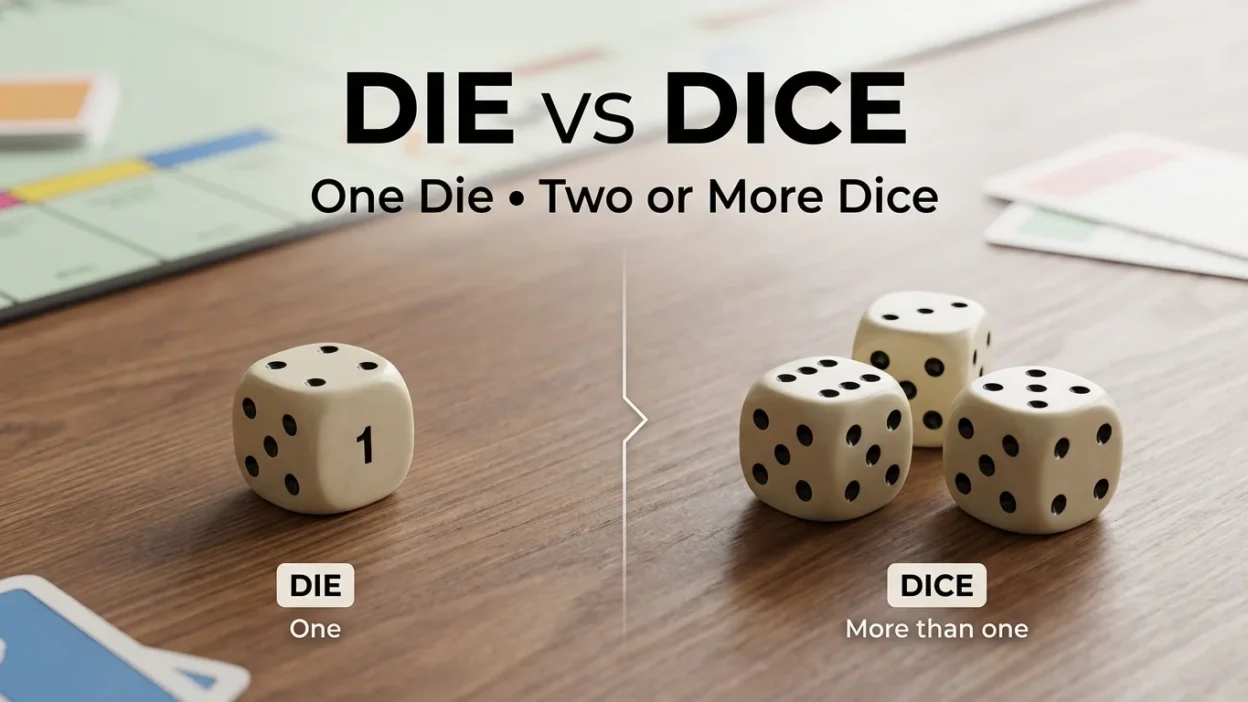
- Die = one cube used for rolling
- Dice = two or more cubes used for rolling
Examples:
I rolled one die.
I rolled two dice.
However, in informal modern English, especially American English, dice is often used as a singular noun too.
For example:
Roll the dice.
This can refer to one die or multiple dice depending on the context.
The safest formal distinction is:
1 = die
2 or more = dice
What Does Die Mean?
Die is the traditional singular noun for one small object marked with numbers or symbols that is used in games of chance.
A standard die usually has six sides, numbered from one to six.
For example:
I rolled a die and got a six.
The player threw one die across the table.
Each player receives a die at the beginning of the game.
Here, die refers to a single object.
The plural is traditionally dice.
What Does Dice Mean?
Dice is traditionally the plural form of die.
For example:
I rolled two dice.
The game requires three dice.
The dice landed on the table.
If you have more than one playing cube, dice is the traditional plural form.
For example:
one die
two dice
three dice
This follows the same type of singular-plural pattern seen in some words borrowed from Latin:
one die → two dice
Die vs Dice Comparison Table
| Feature | Die | Dice |
|---|---|---|
| Traditional number | One | Two or more |
| Meaning | A single numbered gaming object | More than one die |
| Example | I rolled one die. | I rolled two dice. |
| Formal usage | Singular | Plural |
| Informal modern usage | Less common | Sometimes singular or plural |
| Common context | Board games, probability | Board games, gambling, gaming |
The key traditional rule is straightforward:
Die = singular
Dice = plural
Die and Dice in Board Games
The words are frequently used when discussing board games.
For example:
Roll the die to determine how many spaces you can move.
Roll the dice and move your piece.
The player picked up two dice.
One die fell off the table.
In traditional grammar, the number of objects determines which word you use.
If there is only one:
The die landed on four.
If there are two:
The dice landed on four and five.
Why Do People Say Roll the Dice?
You may hear someone say:
Roll the dice.
Even when they are holding only one cube.
This is because dice has increasingly become accepted as a singular noun in informal modern English.
The phrase roll the dice is also widely established as an idiomatic expression meaning to take a risk or make a decision with an uncertain outcome.
For example:
Starting a new business was a chance to roll the dice.
Here, dice does not necessarily refer literally to a physical pair of gaming objects.
It means taking a risk.
Is Dice Singular or Plural?
This is where modern English can become confusing.
Traditionally:
Die = singular
Dice = plural
But in contemporary everyday English, dice is often treated as both singular and plural.
For example:
I bought a new set of dice.
Clearly plural.
But you may also hear:
I need a dice for the game.
This use is common in informal speech, particularly in American English, although some speakers and style guides still prefer die as the singular form.
If you want to follow the traditional grammatical distinction, use:
a die
and:
two dice
That is the clearest choice in formal writing.
American vs British English
The distinction between die and dice is interesting because everyday usage varies.
In both American and British English, die remains the traditional singular form and dice the traditional plural.
However, dice is increasingly used as a singular noun in informal English.
American English especially has common expressions such as:
Roll the dice.
I need another dice.
Some British speakers also use dice as a singular noun, particularly in casual gaming contexts.
If you are writing formal, academic, or carefully edited English, the traditional distinction is still the safest:
one die
two dice
Die as a Verb
There is another completely different meaning of die.
As a verb, die means to stop living.
For example:
Plants can die without enough water.
The character dies at the end of the story.
The fish died overnight.
This meaning has nothing to do with the gaming noun die.
The context normally makes the intended meaning clear.
For example:
Roll the die.
Here, die is a noun.
The plant may die.
Here, die is a verb.
Die vs Dice in Probability
The singular and plural distinction is especially useful when discussing probability and mathematics.
For example:
When a fair die is rolled, there are six possible outcomes.
The possible results are:
1, 2, 3, 4, 5, and 6
When two dice are rolled, the number of possible ordered outcomes increases to 36.
For example:
One die has six possible results.
Two dice can produce 36 ordered combinations.
This is why mathematics and probability textbooks often maintain the traditional distinction between die and dice.
Common Mistakes With Die and Dice
Mistake 1: Calling One Die Dice in Formal Writing
Informal:
I rolled one dice.
Traditional formal usage:
I rolled one die.
If you are writing carefully, use die for one.
Mistake 2: Using Die for More Than One
Incorrect:
I rolled two die.
Correct:
I rolled two dice.
The traditional plural of die is dice.
Mistake 3: Assuming Dice Is Always Wrong for One
That is too strict for modern English.
Although die is the traditional singular form, dice is commonly used as a singular noun in informal speech and gaming communities.
Therefore, saying that dice can never be singular does not accurately reflect modern usage.
Mistake 4: Confusing the Noun Die With the Verb Die
Compare:
Roll the die.
Here, die means one gaming object.
The character will die.
Here, die is a verb meaning to stop living.
The spelling is identical, but the grammatical function and meaning are completely different.
Is Die Always Singular?
Traditionally, yes.
When die refers to a gaming object, it is the singular form:
one die
The traditional plural is:
dice
However, die can also appear as a verb, where singular or plural subjects affect the surrounding grammar rather than changing the word itself.
For example:
The player dies.
The players die.
Here, dies is the third-person singular form of the verb.
Is Dice Always Plural?
Traditionally, yes, when referring to gaming objects.
But modern usage is more flexible.
In informal English, dice can function as a singular noun.
For example:
Roll one dice.
This is widely understandable and increasingly common, although traditionalists may prefer:
Roll one die.
For formal writing, the traditional distinction remains a good choice.
Related Terms
Here are some words commonly associated with die and dice:
- Roll
- Game
- Board game
- Probability
- Chance
- Random
- Outcome
- Number
- Six-sided die
- Pair of dice
- Gaming
- Tabletop game
These related terms can help you understand how the words are normally used.
How to Remember Die vs Dice
The easiest rule is:
Die = one
Dice = more than one
Think of these examples:
1 die
2 dice
3 dice
You can also remember the phrase:
One die, many dice.
This simple pattern is enough for most formal English situations.
FAQs
1. What is the difference between die and dice?
Traditionally, die is the singular form and dice is the plural form.
2. Is dice singular or plural?
Traditionally, dice is plural. However, modern informal English increasingly uses dice as both singular and plural.
3. What is the plural of die?
When die means a gaming object, its traditional plural is dice.
4. Can I say one dice?
You can hear one dice in informal modern English, especially in gaming contexts. However, one die is the traditional and safest choice for formal writing.
5. Is die used in American English?
Yes. American English uses die as the traditional singular form and dice as the traditional plural.
6. Is die used in British English?
Yes. British English also traditionally distinguishes die as singular and dice as plural.
7. Is roll the dice grammatically correct?
Yes. Roll the dice is a standard and extremely common expression. It can refer literally to rolling dice or figuratively to taking a risk.
8. Is die also a verb?
Yes. Die can be a verb meaning to stop living. This is completely different from the noun die meaning one gaming object.
Final Summary
The traditional difference between die vs dice is simple: die is singular, while dice is plural. If you have one gaming cube, you can say one die. If you have two or more, you can say two dice or three dice. This distinction is particularly useful in formal writing, educational materials, and discussions of probability.
Modern English, however, is more flexible than the traditional rule suggests. Dice is now commonly used as a singular noun in informal speech and gaming contexts. Because of this, you may hear one dice, although one die remains the traditional form and is the better choice when you want precise, formal English.