Have you ever hesitated while speaking or writing because you weren’t sure whether to say in the street or on the street? You’re not alone. These two phrases are very similar, but they aren’t always interchangeable. The correct choice often depends on the variety of English you’re using and the meaning you want to convey.
Understanding in the street vs on the street can make your English sound more natural and accurate. Whether you’re an English learner, a writer, or someone who simply wants to improve grammar, this guide explains the difference with easy examples, common mistakes, comparison tables, and practical tips for everyday use.
Quick Answer
Both in the street and on the street are grammatically correct, but they are used differently.
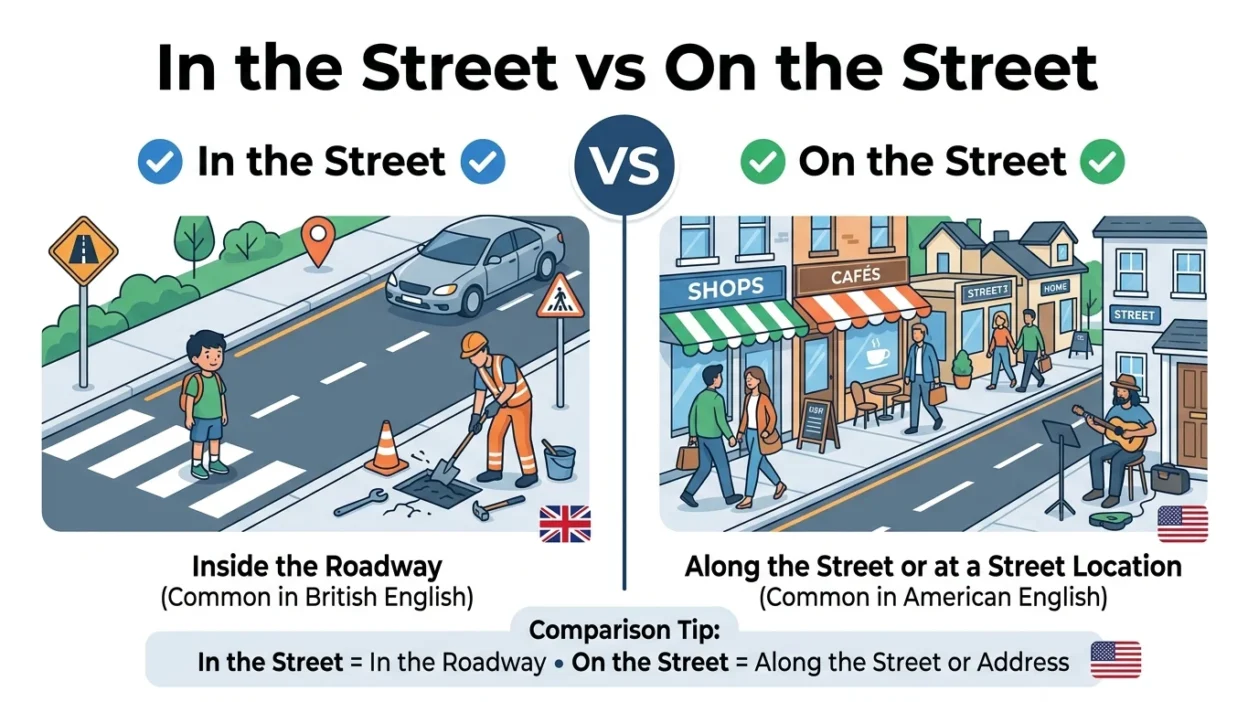
- In the street usually means within the roadway or traffic area and is more common in British English.
- On the street generally means along or beside a street, referring to location, address, or being outdoors. It is more common in American English.
Examples
- The children shouldn’t play in the street. ✅
- There’s a new café on the street. ✅
- She lives on Maple Street. ✅
The context and regional variety of English determine which phrase sounds more natural.
What Does “In the Street” Mean?
In the street refers to being within the roadway itself, where cars, bicycles, or other traffic travel.
It often emphasizes that someone or something is physically occupying the street.
Simple Definition
In the street means:
Examples
- The children were playing in the street.
- There was a large puddle in the street after the rain.
- A fallen tree blocked traffic in the street.
- Don’t stand in the street while cars are coming.
- Workers repaired a water pipe in the street.
In these examples, the focus is on the actual roadway.
What Does “On the Street” Mean?
On the street has several common meanings.
Most often, it refers to:
- Being somewhere along a street
- Having an address on a street
- Being outdoors in a public area
- Living without permanent housing (depending on context)
- Information circulating informally (“word on the street”)
Examples
- They opened a new bakery on the street.
- My office is on the street near the station.
- She lives on Oak Street.
- We met on the street yesterday.
- Street musicians performed on the street.
Here, the emphasis is the general location rather than being in the roadway.
In the Street vs On the Street: Key Difference
Although both expressions mention a street, they describe different ideas.
| Feature | In the Street | On the Street |
|---|---|---|
| Main meaning | Inside the roadway | Along or beside a street |
| Focus | Physical position in the road | General location or address |
| British English | More common | Also used |
| American English | Less common | More common |
| Typical situations | Traffic, accidents, children playing | Shops, buildings, addresses, public places |
The easiest way to remember the difference is:
- In the street = in the roadway.
- On the street = along the street or at a street location.
When Should You Use “In the Street”?
Use in the street when you’re talking about something physically located within the road.
Common situations include:
- Traffic accidents
- Children playing
- Road repairs
- Fallen objects
- Vehicles stopped in traffic
Examples
- A dog ran in the street.
- Snow covered the cars parked in the street.
- Police blocked the traffic in the street.
- A cyclist fell in the street.
- Workers painted lines in the street.
When Should You Use “On the Street”?
Use on the street when referring to location, businesses, homes, or public activity.
Common situations include:
- Addresses
- Shops
- Restaurants
- Walking
- Public events
- Street performances
Examples
- There’s a pharmacy on the street.
- We walked together on the street.
- She rents an apartment on the street near the park.
- A food festival was held on the street.
- Many people gathered on the street to celebrate.
British English vs American English
One of the biggest differences involves regional preference.
British English
British speakers often say:
- The children are playing in the street.
- There was an accident in the street.
This usage emphasizes being within the roadway.
American English
American speakers usually prefer:
- The children are playing on the street.
- We live on Elm Street.
- There’s a coffee shop on the street.
Even when referring to being outdoors near the road, on the street sounds more natural in American English.
Comparison Table
| Situation | British English | American English |
|---|---|---|
| Children playing | In the street | On the street (more common) |
| Address | On the street | On the street |
| Business location | On the street | On the street |
| Roadway emphasis | In the street | In the street or on the street, depending on context |
Different Meanings of “On the Street”
This phrase has several idiomatic uses.
1. Living Without a Home
- Many charities help people living on the street.
Here, it means being homeless.
2. Publicly Available
- The new phone will be on the street next week.
In business slang, it may mean officially released.
3. Common Rumors
This means informal public opinion or rumors.
Common Mistakes to Avoid
English learners often confuse these expressions.
1. Using “In the Street” for Addresses
Incorrect:
- I live in the street called King Road.
Correct:
- I live on King Road.
- My house is on King Road.
2. Using “On the Street” for Roadway Hazards
Less precise:
- There was broken glass on the street.
If the glass is actually in the roadway, in the street may be clearer, especially in British English.
3. Ignoring Regional Differences
If you’re writing for a British audience, in the street may sound more natural when referring to the roadway.
For an American audience, on the street is often preferred.
Related Expressions
Learning similar phrases can improve your vocabulary.
Examples include:
- on the road
- in the road
- on the sidewalk
- at the corner
- across the street
- down the street
- along the street
- around the corner
- in public
- on the avenue
These expressions frequently appear in everyday English.
Tips to Remember the Difference
Here’s a simple trick.
Think about your position.
If you’re inside the roadway, use in the street.
If you’re talking about a location along a street, use on the street.
Also remember:
- Houses are on streets.
- Cars drive in the street.
- Shops are on streets.
- Road repairs happen in the street.
This simple rule works in most situations.
FAQs
Which is correct: “in the street” or “on the street”?
Both are correct. The right choice depends on the context and whether you’re using British or American English.
Is “in the street” more British?
Yes. British English more commonly uses in the street when referring to the roadway.
Is “on the street” more American?
Yes. American English generally prefers on the street for most everyday situations.
How do I describe my address?
Use on.
Example:
- I live on Pine Street.
Can “on the street” mean homeless?
Yes. It can refer to someone living without permanent housing.
What does “word on the street” mean?
It means rumors, informal information, or what people are generally saying.
Can I use both expressions in the same article?
Yes, as long as each one matches its intended meaning and context.
Summary
Understanding in the street vs on the street becomes much easier once you recognize the difference between physical position and general location. In the street usually refers to being within the roadway, making it especially common in British English when discussing traffic, accidents, or people standing in the road. On the street, meanwhile, is the preferred choice for addresses, businesses, public locations, and many everyday situations, particularly in American English.
Neither expression is universally right or wrong. The best choice depends on the meaning you want to express and the audience you’re writing for. Knowing this distinction will help your English sound more natural, whether you’re writing an essay, speaking with native speakers, or creating professional content.