Have you ever come across the words imitated and intimated and wondered whether they mean the same thing? Because they look and sound somewhat similar, many English learners—and even experienced writers—occasionally mix them up. However, these two words have entirely different meanings and are used in very different contexts.
Understanding the difference between imitated vs intimated will help you avoid awkward mistakes in both speaking and writing. Whether you’re preparing for an English exam, writing a professional email, or simply expanding your vocabulary, this guide explains each word with clear definitions, examples, comparison tables, and practical tips.
Quick Answer
The difference between imitated and intimated is straightforward:
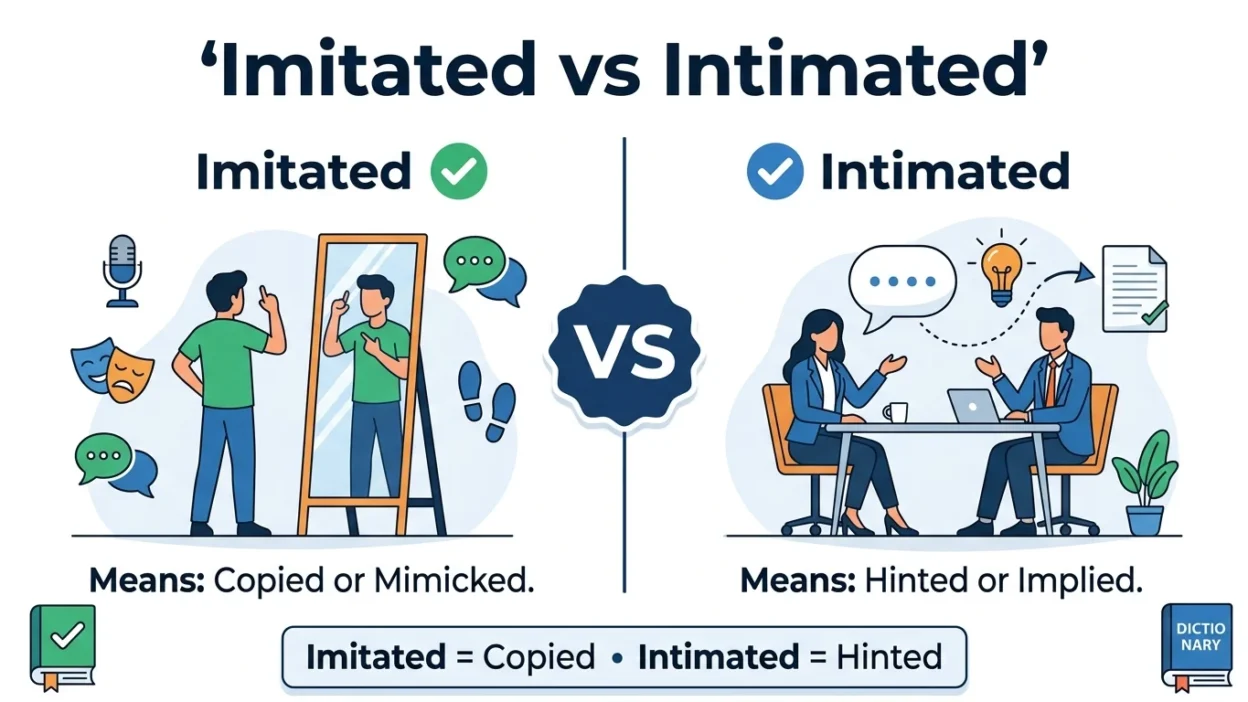
- Imitated means copied, mimicked, or reproduced someone’s actions, appearance, or behavior.
- Intimated means hinted, suggested, or implied something indirectly.
Examples
- She imitated her teacher’s voice. ✅
- The manager intimated that changes were coming. ✅
Although the words have similar spellings, they are not interchangeable.
What Does “Imitated” Mean?
Imitated is the past tense and past participle of the verb imitate.
It means to copy or mimic someone or something.
People imitate:
- behavior
- speech
- accents
- writing styles
- movements
- artistic techniques
- sounds
Simple Definition
Imitated means:
Examples
- The child imitated her mother’s cooking.
- He imitated the comedian’s voice.
- Students imitated the experiment shown by the teacher.
- The actor perfectly imitated the president’s mannerisms.
- Birds often imitated human sounds.
In each example, someone is copying another person or thing.
What Does “Intimated” Mean?
Intimated is the past tense and past participle of intimate (verb).
As a verb, intimate means to suggest or hint at something indirectly without stating it openly.
This use is common in:
- formal writing
- business communication
- journalism
- legal documents
- literature
Simple Definition
Intimated means:
Examples
- The director intimated that a promotion was possible.
- She intimated her dissatisfaction without complaining directly.
- The report intimated future policy changes.
- The witness intimated that more evidence existed.
- He intimated that he might resign.
Unlike imitated, no copying occurs.
Imitated vs Intimated: Key Difference
Although the words look alike, they describe completely different actions.
| Feature | Imitated | Intimated |
|---|---|---|
| Meaning | Copied or mimicked | Hinted or implied |
| Verb | Imitate | Intimate |
| Common context | Behavior, speech, actions | Suggestions, hints, indirect communication |
| Everyday use | Very common | Less common |
| Formal writing | Common | Common |
A simple way to remember them is:
- Imitated = Copied
- Intimated = Hinted
When Should You Use “Imitated”?
Use imitated whenever someone copies another person’s:
- speech
- appearance
- behavior
- actions
- style
- movements
- voice
- techniques
Examples
- The student imitated the teacher’s handwriting.
- Young athletes often imitated famous players.
- She imitated her favorite singer perfectly.
- The robot imitated human movement.
- The artist imitated classical painting techniques.
These examples all involve copying.
When Should You Use “Intimated”?
Use intimated when someone communicates indirectly.
Rather than stating something openly, they give a hint.
Examples
- The CEO intimated that layoffs were possible.
- She intimated her concerns during the meeting.
- The professor intimated that the exam would be difficult.
- His smile intimated approval.
- The letter intimated future legal action.
These examples all involve implying rather than directly saying something.
Side-by-Side Examples
Seeing both words together makes the difference easier to understand.
| Sentence | Correct Word |
|---|---|
| The child copied his father. | Imitated |
| The report hinted at new policies. | Intimated |
| She copied the artist’s technique. | Imitated |
| The manager suggested changes indirectly. | Intimated |
| The actor copied the celebrity’s accent. | Imitated |
| The speaker implied that more news was coming. | Intimated |
Notice that imitated involves copying, while intimated involves suggesting.
Common Mistakes to Avoid
Because the spellings are similar, learners sometimes confuse these words.
1. Using “Intimated” Instead of “Imitated”
Incorrect:
- He intimated his brother’s voice.
Correct:
- He imitated his brother’s voice.
2. Using “Imitated” Instead of “Intimated”
Incorrect:
- The report imitated future economic problems.
Correct:
- The report intimated future economic problems.
3. Assuming They Are Synonyms
They are not.
One means copy.
The other means hint.
4. Confusing “Intimated” with the Adjective “Intimate”
Many learners know intimate as an adjective meaning:
- close
- personal
However, the verb to intimate has a completely different meaning:
Related Words and Synonyms
Synonyms for Imitated
Depending on the context, you can also use:
- copied
- mimicked
- reproduced
- mirrored
- duplicated
- echoed
- replicated
- modeled after
Synonyms for Intimated
Common alternatives include:
- hinted
- implied
- suggested
- indicated
- alluded to
- inferred
- signaled
- insinuated
Using these alternatives naturally enriches your vocabulary.
American vs British English
There is no significant difference between American and British English regarding these words.
Both varieties use:
- imitated to mean copied
- intimated to mean hinted
However, intimated is relatively formal in both American and British English.
In everyday conversation, speakers often prefer:
- hinted
- suggested
- implied
instead of intimated.
Tips to Remember the Difference
A simple memory trick makes these words easier to remember.
Think of the First Letter
Imitated
Think:
I = Imitate = I Copy
Intimated
Think:
Intimate conversation often includes hints.
Or simply remember:
- Imitated = Mimicked
- Intimated = Implied
Associating each word with a familiar synonym helps prevent confusion.
Related LSI Keywords
To better understand this topic, you’ll often encounter related terms such as:
- imitate meaning
- intimate verb
- implied meaning
- copied vs hinted
- English vocabulary
- confusing English words
- grammar guide
- word differences
- English usage
- commonly confused words
These related phrases support a deeper understanding without changing the meanings of the two target words.
FAQs
What is the difference between imitated and intimated?
Imitated means copied or mimicked, while intimated means hinted or implied indirectly.
Is “intimated” a common English word?
Yes, but it is more common in formal writing than in everyday conversation.
Can I use “imitated” instead of “intimated”?
No. They have different meanings and cannot replace each other.
Which word is more common?
Imitated is much more common in everyday English.
Does “intimated” mean “communicated”?
Yes, but only indirectly. It refers to suggesting or implying rather than stating something openly.
Are these words used differently in American and British English?
No. Both varieties use them with the same meanings.
What is an easy way to remember the difference?
Remember:
- Imitated = Copied
- Intimated = Hinted
This simple rule works almost every time.
Summary
Understanding imitated vs intimated becomes easy once you focus on the meaning rather than the spelling. Imitated refers to copying someone’s actions, speech, appearance, or behavior, making it a common word in everyday English. Intimated, on the other hand, means suggesting or implying something indirectly and is more frequently found in formal writing, journalism, legal documents, and professional communication.
Although these words look similar, they serve very different purposes and should never be used interchangeably. Learning the distinction will improve your vocabulary, strengthen your grammar, and help you communicate more accurately in both spoken and written English.