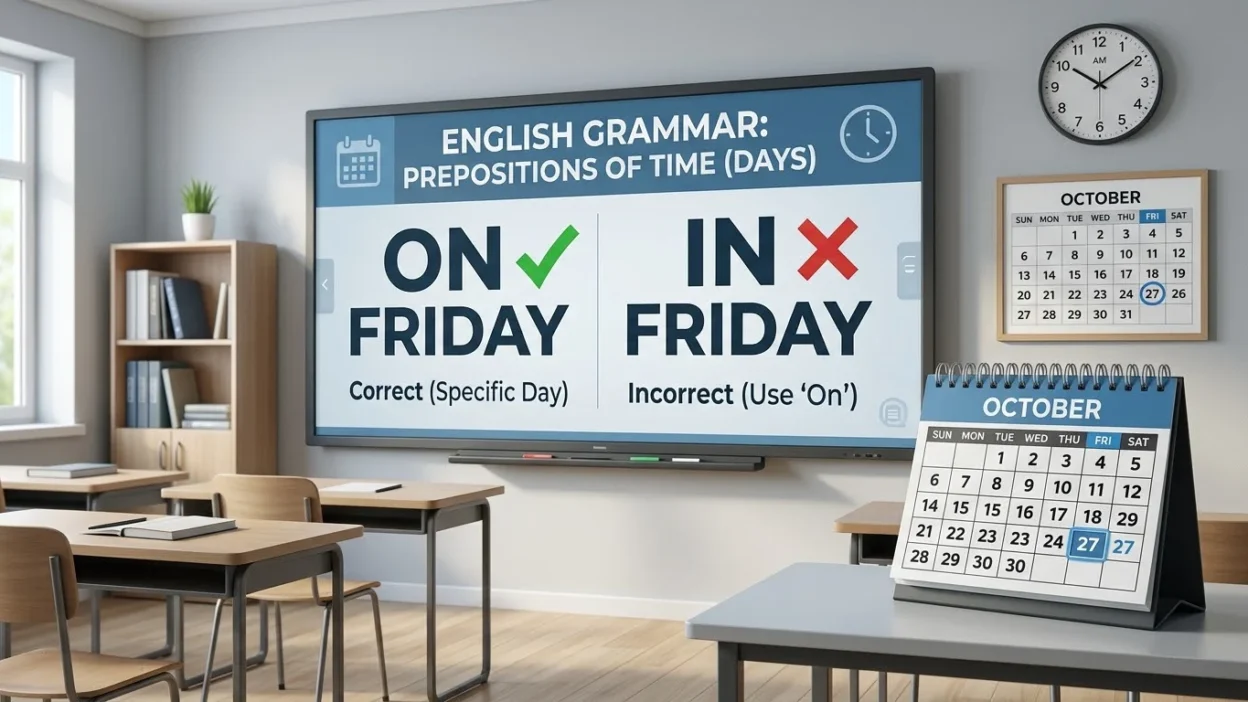
Choosing the right preposition for days of the week can be confusing, especially when on Friday and in Friday seem like they might follow the same pattern. If you have ever wondered whether to say I will meet you on Friday or I will meet you in Friday, there is a simple rule that can clear things up.
The correct expression is on Friday. We use the preposition on with specific days and dates. In Friday is not standard English when you are talking about something happening on that particular day. Once you understand this basic preposition rule, you can use it confidently in everyday conversations, emails, messages, and formal writing.
Quick Answer
On Friday is the correct expression when referring to something that happens on Friday.
In Friday is incorrect in standard English when Friday refers to a day of the week.
- ✅ I will see you on Friday.
- ✅ The meeting is on Friday.
- ❌ I will see you in Friday.
- ❌ The meeting is in Friday.
The general rule is simple:
Use on + day or date.
Examples:
- on Friday
- on Monday
- on Sunday
- on July 4
- on my birthday
Why Do We Say On Friday?
We use on because English normally uses on with specific days and dates.
A day can be viewed as a particular point or occasion within the calendar, so on is the natural preposition.
For example:
- I have a meeting on Friday.
- She arrived on Monday.
- We are going shopping on Saturday.
- The school will reopen on Tuesday.
This rule applies to all days of the week.
You would not normally change the preposition simply because the day changes.
Why Is In Friday Incorrect?
In is generally used for longer periods of time rather than a specific day.
We commonly use in with:
- Months: in October
- Years: in 2026
- Seasons: in winter
- Decades: in the 1990s
- Centuries: in the 21st century
For example:
- I was born in October.
- They moved here in 2020.
- We usually travel in summer.
- The company expanded in the 1990s.
Because Friday is a specific day, we use on, not in.
Therefore:
I will visit you on Friday. ✅
I will visit you in Friday. ❌
On Friday Meaning
On Friday means something happens during the day or period known as Friday.
For example:
We have an English test on Friday.
This tells the listener that the test will take place on Friday.
The expression can refer to a future, present, or past event depending on the sentence.
Future
I will call you on Friday.
Past
I met him on Friday.
Habitual
We play badminton on Friday.
The exact meaning comes from the context and the verb tense.
On Friday Examples
Here are some natural examples using on Friday:
- I will finish the work on Friday.
- She has an appointment on Friday.
- We are going to Lahore on Friday.
- The students will take their test on Friday.
- He called me on Friday.
- Our school remains open on Friday.
- The wedding ceremony is on Friday.
- I usually visit my parents on Friday.
- They announced the results on Friday.
- Can we meet on Friday?
All of these sentences use on correctly because Friday is a specific day.
On Friday vs In Friday Comparison
| Expression | Correct? | Usage | Example |
|---|---|---|---|
| on Friday | ✅ Yes | Specific day | I will come on Friday. |
| in Friday | ❌ No | Not standard for a specific day | I will come in Friday. |
| on Fridays | ✅ Yes | Repeated or habitual events | We exercise on Fridays. |
| in the week | ✅ Yes | A period within a week | I will finish it in the week. |
| in the month | ✅ Yes | A period within a month | It happened in the month of May. |
The important distinction is that on Friday identifies a particular day, while in is generally used with broader periods.
On Friday vs On Fridays
There is also a small but useful difference between on Friday and on Fridays.
On Friday
On Friday usually refers to one particular Friday.
Example:
We have a meeting on Friday.
This normally refers to the upcoming or previously mentioned Friday.
On Fridays
On Fridays usually refers to Fridays in general or a repeated habit.
Example:
We play cricket on Fridays.
This means the activity happens regularly on Fridays.
Compare:
I will visit you on Friday.
This refers to one Friday.
I visit you on Fridays.
This suggests a regular habit.
On Friday Morning, Afternoon, and Evening
We also use on when talking about a particular part of a particular day.
Examples:
- on Friday morning
- on Friday afternoon
- on Friday evening
- on Friday night
For example:
I have a meeting on Friday morning.
We are leaving on Friday evening.
She called me on Friday night.
However, there is an important distinction with the word night. English can also use expressions such as at night when speaking about nighttime generally.
For example:
I usually read at night.
But for a specific Friday night:
I watched a movie on Friday night.
American English vs British English
There is no meaningful American-versus-British difference in the basic rule for on Friday.
Both American English and British English use on with specific days.
American English:
I will see you on Friday.
British English:
I will see you on Friday.
The same applies to other days:
- on Monday
- on Tuesday
- on Wednesday
- on Thursday
- on Saturday
- on Sunday
So, unlike spelling differences such as color/colour or jewelry/jewellery, on Friday is standard in both major varieties of English.
Common Mistakes With On Friday and In Friday
1. Saying In Friday
One of the most common mistakes is using in before Friday.
Incorrect:
I will come in Friday.
Correct:
I will come on Friday.
Remember: on + specific day.
2. Confusing In With On
Learners sometimes remember that English uses prepositions for time but have difficulty deciding which one to use.
A helpful basic pattern is:
- at → specific time
- on → day or date
- in → month, year, season, or longer period
For example:
at 5 p.m.
on Friday
in October
in 2026
3. Forgetting the Preposition
In informal speech, learners sometimes leave out the preposition.
Incorrect in standard English:
I will meet you Friday.
In American English, however, simply saying Friday without on is common in informal speech, particularly in expressions such as See you Friday.
For learners, on Friday is the safest standard construction.
4. Confusing On Friday With By Friday
These expressions have different meanings.
I will finish the work on Friday.
This means the work will be finished on Friday.
I will finish the work by Friday.
This means Friday is the deadline, and the work may be completed before Friday or no later than Friday.
This distinction is important in professional communication.
On Friday vs By Friday
The difference becomes especially useful in emails and workplace conversations.
Please send the report on Friday.
This asks for the report to be sent on Friday.
Please send the report by Friday.
This means Friday is the latest acceptable time.
You can also use before Friday when you specifically mean any time earlier than Friday.
For example:
Please submit your assignment before Friday.
Easy Rule to Remember
If you are talking about a specific day, use on.
On + day
- on Monday
- on Tuesday
- on Wednesday
- on Thursday
- on Friday
- on Saturday
- on Sunday
If you are talking about a month, year, season, or longer period, use in.
In + longer period
- in January
- in 2026
- in winter
- in the morning
If you are talking about an exact clock time, use at.
At + exact time
- at 7 a.m.
- at noon
- at midnight
- at 5:30 p.m.
This simple at/on/in time-preposition pattern can help you avoid many common grammar mistakes.
FAQs
Is it correct to say on Friday?
Yes. On Friday is the standard and correct expression when referring to a specific Friday.
Is in Friday grammatically correct?
No, not when you mean that something happens on Friday. Standard English uses on Friday, not in Friday.
Should I say on Friday or in Friday?
You should say on Friday when referring to the day. For example, I will call you on Friday.
Do American and British English use on Friday?
Yes. Both American English and British English normally use on Friday.
Can I say on Fridays?
Yes. On Fridays is correct when talking about something that happens regularly or repeatedly on Fridays.
For example:
We have a staff meeting on Fridays.
What is the difference between on Friday and by Friday?
On Friday identifies the day something happens. By Friday gives Friday as the latest deadline.
Is I will see you Friday correct?
Yes, this can be heard in informal American English, where on may be omitted before a day. However, I will see you on Friday is the standard form and works well in formal and general writing.
What preposition is used before Friday?
The standard preposition is on.
For example:
on Friday
Summary
The correct expression is on Friday, not in Friday, when you are talking about a specific day of the week. English uses on with days and dates, while in is generally used with longer periods such as months, years, seasons, and decades. For example, we say on Friday, but in October and in 2026.
There is no important difference between American and British English in this rule. Both varieties normally use on Friday. Once you remember the simple pattern at = exact time, on = day/date, in = longer period, choosing the correct time preposition becomes much easier.
Actionable Takeaway
Whenever you mention a specific day, use on: on Friday, on Monday, on Sunday. If you are mentioning a month, year, or season, use in: in October, in 2026, in winter.
Remember: On Friday is correct; in Friday is not standard English.

Liam James is a language enthusiast and content writer at Verseslay, specializing in word comparisons, grammar debates, and vocabulary insights. He helps readers understand language nuances through clear, engaging, and practical explanations.