The phrase after which can look confusing because it combines a preposition with a relative pronoun. However, once you understand its basic structure, using it correctly becomes quite simple. It is especially common in formal writing, academic English, reports, and professional communication.
After which generally means after that, following which, or after the event or thing just mentioned. It connects one event or action to another and helps make writing smoother and more precise. In this guide, we will explain after which usage with clear examples, common mistakes, sentence structures, and practical tips.
Quick Answer
After which is used to refer back to something mentioned earlier and introduce an event that happens afterward.
It usually means:
- After that
- Following that
- After the event mentioned
- After the thing previously described
Examples:
- We had dinner, after which we went for a walk.
- She completed her degree, after which she moved abroad.
- The meeting ended, after which everyone returned to work.
- He apologized, after which they continued their conversation.
After which is particularly common in formal or polished English.
What Does After Which Mean?
After which means after the thing or event just mentioned.
The word which refers back to a noun, event, situation, or entire preceding clause.
Consider this sentence:
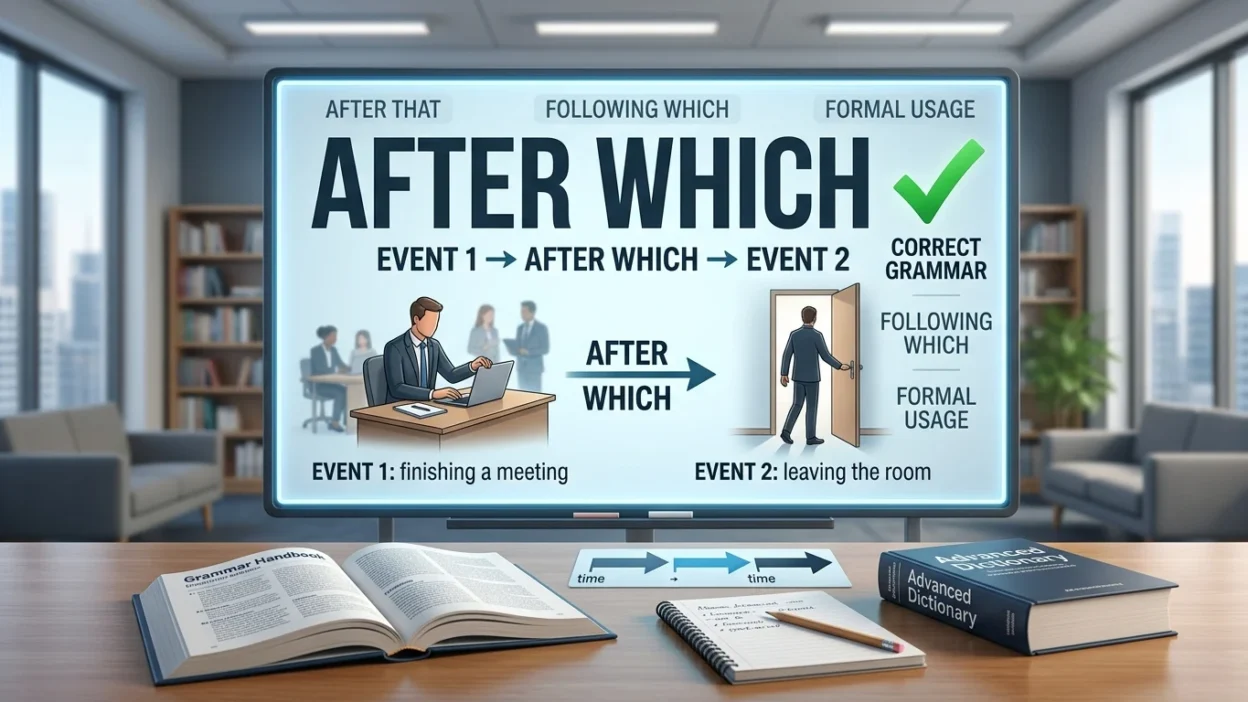
We finished the meeting, after which we went home.
Here, which refers to the meeting, and after which means after the meeting.
Another example:
She submitted her application, after which she received a confirmation email.
In this sentence, which refers to the action of submitting the application.
So, the basic idea is:
Event 1 → after which → Event 2
This structure clearly shows that Event 2 happened after Event 1.
How to Use After Which in a Sentence
The most common structure is:
Main clause, after which + subject + verb
Examples:
- He finished his work, after which he went home.
- We completed the project, after which the client reviewed it.
- She passed the examination, after which she celebrated with her family.
- The doctor examined the patient, after which treatment began.
Notice that after which usually follows a comma when it introduces a new clause after a complete preceding clause.
After Which vs After That
After which and after that often communicate the same basic idea, but their grammatical structure and tone are different.
| Expression | Meaning | Tone | Example |
|---|---|---|---|
| After which | After the thing/event just mentioned | More formal | He left, after which I called her. |
| After that | After the thing/event just mentioned | More conversational | He left, and after that I called her. |
| Following which | After the thing/event just mentioned | Formal | He resigned, following which an investigation began. |
| Then | At that time/afterward | Simple and flexible | He left, then I called her. |
After that is very common in everyday conversation.
After which is often preferred when writing formally or when you want to connect two related events elegantly.
Examples of After Which Usage
Example 1: Daily Activities
I finished breakfast, after which I went to work.
The second event happened after breakfast.
Example 2: Education
She completed her studies, after which she started looking for a job.
Here, which refers to completing her studies.
Example 3: Business
The company held a meeting, after which the management announced its decision.
The announcement came after the meeting.
Example 4: Travel
We arrived at the hotel, after which we checked into our rooms.
Checking in happened after arrival.
Example 5: Medical Context
The doctor examined the patient, after which several tests were recommended.
The tests were recommended following the examination.
Example 6: Storytelling
He opened the door, after which everyone became silent.
The silence followed the action of opening the door.
After Which at the Beginning of a Sentence
After which can sometimes appear at the beginning of a sentence, but this structure is more formal and usually requires a clear reference to something previously mentioned.
For example:
The company introduced a new policy. After which, several employees raised concerns.
However, this version is often considered less polished because the second sentence begins with a fragment-like structure.
A better version is:
The company introduced a new policy, after which several employees raised concerns.
For formal writing, keeping after which connected to the preceding clause is usually clearer.
Can After Which Refer to a Whole Situation?
Yes. Which does not always refer to a single noun. It can refer to an entire preceding situation or event.
Example:
The company announced that it would close the branch, after which several employees began looking for new jobs.
Here, which refers broadly to the announcement or situation described in the first clause.
Another example:
The weather suddenly changed, after which the outdoor event was canceled.
The phrase after which refers to the change in weather and its immediate context.
After Which in Formal Writing
After which is particularly useful in formal writing because it creates a smooth connection between two events.
For example:
The committee reviewed the proposal, after which a final decision was made.
This sounds more formal than:
The committee reviewed the proposal, and then a final decision was made.
Both are correct, but after which provides a more polished written style.
It is often useful in:
- Academic writing
- Business reports
- Legal writing
- Official documents
- News writing
- Professional emails
- Formal narratives
After Which vs Which After
Learners sometimes confuse these structures.
After which means that something happened following a previously mentioned event.
Example:
He completed the training, after which he started working independently.
The phrase which after normally does not work in the same way.
Incorrect:
He completed the training, which after he started working independently.
Correct:
He completed the training, after which he started working independently.
The preposition after comes before which in this construction.
After Which vs After That: A Simple Rule
Use after which when you want a more formal or grammatically connected structure.
Use after that when you want a simple, conversational expression.
Compare:
She finished the report, after which she sent it to her manager.
She finished the report, and after that she sent it to her manager.
Both are correct.
The first sounds more concise and formal.
The second sounds more conversational.
Common Mistakes With After Which
Mistake 1: Forgetting the Reference
After which needs something before it to refer back to.
Unclear:
After which, we went home.
Better:
The meeting ended, after which we went home.
The second version clearly tells the reader what happened first.
Mistake 2: Using Which After Instead
Incorrect:
The meeting ended, which after we went home.
Correct:
The meeting ended, after which we went home.
Mistake 3: Confusing After Which With Where
After which refers to something that happened previously.
Where generally refers to a place or location.
Compare:
We visited the museum, after which we went to lunch.
We visited the museum where the exhibition was being held.
The two structures have different functions.
Mistake 4: Using After Which When After That Is More Natural
Although after which is correct, it can sometimes sound unnecessarily formal in casual conversation.
Instead of:
I finished my work, after which I watched television.
A casual speaker might naturally say:
I finished my work, and after that I watched television.
Choose the structure according to your audience and tone.
After Which vs Following Which
Following which has almost the same meaning as after which.
Examples:
The meeting ended, after which the employees returned to their offices.
The meeting ended, following which the employees returned to their offices.
Both are correct.
However, following which can sound even more formal and is common in official, legal, and academic writing.
For general readers, after which is often clearer and more natural.
American vs British English
There is no significant difference between American and British English in the grammar or meaning of after which.
Both varieties use the expression, particularly in formal writing.
The difference is mainly stylistic. In everyday conversation, speakers in both American and British English may prefer simpler alternatives such as:
- after that
- then
- afterward
- later
In formal writing, after which remains a natural and useful construction in both varieties.
Synonyms and Related Expressions
Depending on the sentence, you can replace after which with several alternatives.
Formal alternatives
- Following which
- Subsequently
- Thereafter
- Following that
- Subsequently to the event
Neutral alternatives
- After that
- Then
- Later
- Afterwards
- Following that
For example:
The meeting ended, after which everyone left.
can become:
The meeting ended, and after that everyone left.
or:
The meeting ended, following which everyone left.
The best choice depends on the level of formality you want.
Why After Which Is Useful
One reason after which is valuable is that it helps avoid repetitive sentence structures.
Instead of writing:
The team finished the project. After that, the manager reviewed it. After that, the client approved it.
You can write:
The team finished the project, after which the manager reviewed it. The client then approved it.
This creates a smoother flow and makes the relationship between events clearer.
FAQs
1. What does after which mean?
After which means after that or following the event or thing just mentioned.
2. Is after which grammatically correct?
Yes. After which is a standard and grammatically correct English construction.
3. Should there be a comma before after which?
When after which introduces a following clause after a complete main clause, a comma is commonly used.
Example: The meeting ended, after which everyone went home.
4. Is after which formal?
Yes. After which is generally more formal and polished than after that, making it useful in academic, professional, and official writing.
5. What is the difference between after which and after that?
Both generally mean the same thing. After which connects the second clause directly to something previously mentioned and sounds more formal, while after that is more conversational.
6. Can after which refer to an entire sentence?
Yes. Which can refer to a previously mentioned event, action, or situation rather than only a single noun.
7. Can I use after which in everyday conversation?
Yes, but it may sound somewhat formal. In casual conversation, after that or then may sound more natural.
8. Is after which used in American and British English?
Yes. After which is used in both American and British English, with no important difference in meaning or grammar.
Summary
After which is a useful English expression that means after that or following the event just mentioned. It normally connects two events and clearly shows that the second event happened after the first. The common structure is main clause, after which + subject + verb, as in The meeting ended, after which everyone went home.
The expression is especially useful in formal and professional writing because it creates a smooth connection between ideas without repeatedly using words such as then or after that. Although it is more formal than some everyday alternatives, it is standard in both American and British English and can be used whenever you want to describe a sequence of events clearly.
Actionable Takeaway
Remember this simple pattern:
Event 1, after which + Event 2.
If you want a more formal and polished way to say after that, use after which. For casual conversation, after that or then may sound more natural.