
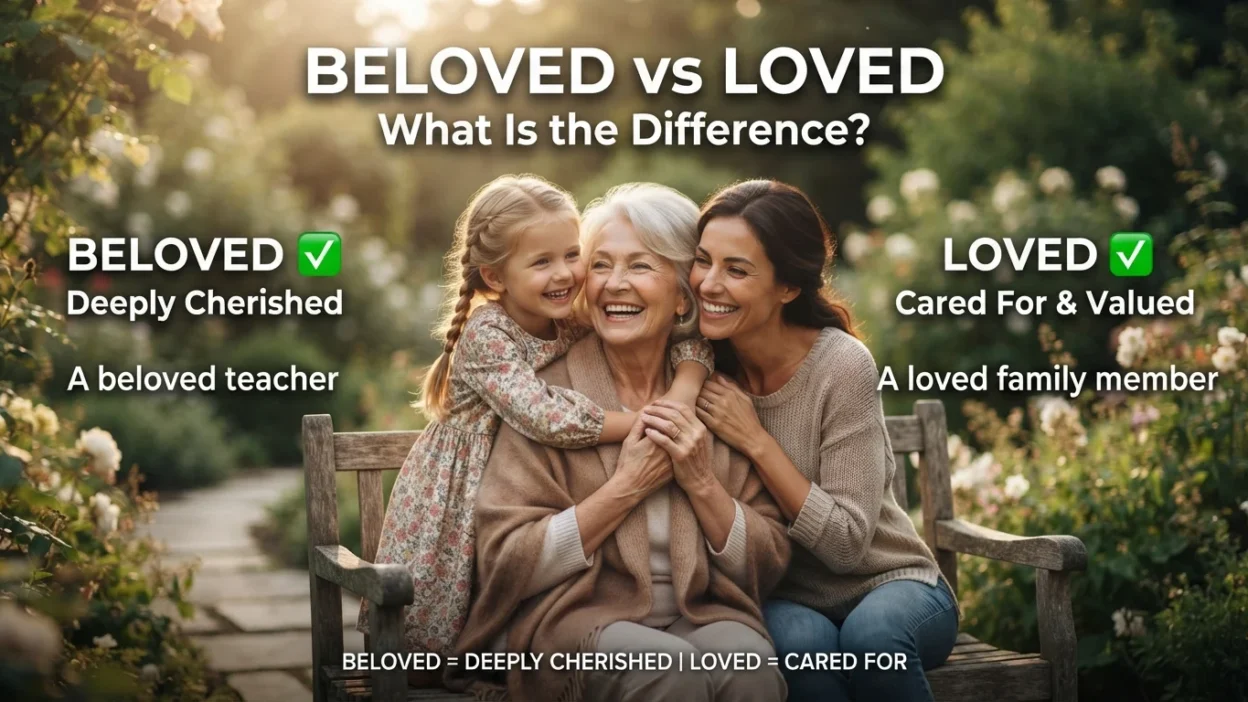
The difference between beloved vs loved is subtle, but the two words can create different feelings and levels of emotional expression. Both words describe strong affection, but beloved often sounds warmer, deeper, and more enduring, while loved is the more common and flexible word used in everyday English.
If you are wondering whether to say someone is loved or beloved, the answer depends on the context, relationship, and tone you want to express. In this guide, we’ll explain the meaning of both words, compare their usage, provide natural examples, discuss American and British English, and highlight common mistakes so you can choose the right word with confidence.
Quick Answer: Beloved vs Loved
Beloved and loved both express affection, but they are not always interchangeable in tone.
Loved = cared for, cherished, or deeply liked by someone.
Beloved = deeply loved, greatly cherished, or held especially dear.
Examples
She is loved by her family.
This simply means her family cares deeply about her.
She is beloved by her family and friends.
This suggests that she is deeply cherished and greatly valued.
Simple Rule
Use loved for general and everyday expressions of affection.
Use beloved when you want to emphasize deep affection, admiration, or a special emotional connection.
What Does “Loved” Mean?
Loved is the past tense and past participle of the verb love.
It can describe strong affection, romantic feelings, family relationships, friendship, admiration, or enjoyment.
For example:
I loved my grandmother very much.
This means the speaker had deep affection for their grandmother.
The word can also describe something that someone enjoys.
She loved the movie.
Here, loved means she enjoyed the movie very much.
Because of its broad meaning, loved is extremely common in everyday English.
You can love:
- A family member
- A friend
- A partner
- A pet
- A book
- A movie
- A song
- A hobby
- A place
- An experience
For example:
He loved spending time with his friends.
They loved their new home.
She loved the beautiful garden.
What Does “Beloved” Mean?
Beloved is an adjective that means deeply loved, cherished, or greatly valued.
It often expresses a stronger or more emotional sense of love than the ordinary word loved.
For example:
She was a beloved teacher.
This means that students and others deeply respected, admired, and cherished her.
Another example:
The beloved family dog passed away.
Here, beloved emphasizes how deeply the dog was loved by the family.
The word often appears in emotional, literary, formal, or commemorative language.
Common expressions include:
- Beloved family member
- Beloved friend
- Beloved teacher
- Beloved leader
- Beloved author
- Beloved pet
- My beloved grandmother
- His beloved wife
Beloved vs Loved: Comparison Table
| Feature | Beloved | Loved |
|---|---|---|
| Basic meaning | Deeply loved or cherished | Loved or cared for |
| Emotional intensity | Often stronger | General to strong |
| Tone | Warm, emotional, literary, or formal | Natural and everyday |
| Part of speech | Usually adjective; can also be a noun | Past tense/past participle of “love” |
| Common usage | Beloved friend, beloved teacher | Loved by everyone |
| Everyday conversation | Less common | Very common |
| Example | She was a beloved teacher. | She was loved by her students. |
The key difference is often tone and emphasis.
Loved is broad and natural.
Beloved adds a sense of deep affection, special importance, or emotional closeness.
Beloved vs Loved: The Main Difference
The easiest way to understand the difference is to think about degree and tone.
If you say:
He is loved by his family.
You are saying that his family has strong affection for him.
If you say:
He is beloved by his family.
You are emphasizing that he is especially cherished and deeply valued.
Both sentences are positive, but beloved often sounds more emotionally powerful.
However, this does not mean that beloved always means more love in a measurable way. The difference is mainly about how the speaker expresses the feeling.
Examples of “Loved”
Here are some natural examples of loved.
Example 1: Family
She was deeply loved by her parents.
This expresses strong family affection.
Example 2: Friendship
He is loved by all his friends.
This means his friends care about him deeply.
Example 3: Romantic Relationship
She loved him for many years.
This describes romantic or deep personal affection.
Example 4: Enjoyment
I loved that movie.
Here, loved means enjoyed very much.
Example 5: General Affection
The child felt loved and supported by her family.
This describes the emotional experience of receiving love and care.
Examples of “Beloved”
Now let’s look at examples using beloved.
Example 1: Family Member
She was my beloved grandmother.
This expresses deep affection and emotional closeness.
Example 2: Teacher
He was a beloved teacher who inspired thousands of students.
This suggests that many students deeply respected and cherished him.
Example 3: Public Figure
The beloved author left behind a remarkable collection of books.
This indicates that many readers admired and valued the author.
Example 4: Pet
Their beloved dog had been part of the family for many years.
The word emphasizes the strong emotional bond between the pet and the family.
Example 5: Place
The park was a beloved part of the community.
This means the community greatly valued and cherished the park.
Is “Beloved” Stronger Than “Loved”?
In many contexts, beloved can sound stronger or more emotionally expressive than loved.
Compare:
She was loved by her students.
She was beloved by her students.
The first sentence says that students cared for her.
The second suggests that students held her in especially high affection and regard.
However, context matters. The word loved can also express extremely deep emotion.
For example:
She was deeply loved by everyone who knew her.
This can be just as emotionally powerful as beloved.
Words such as deeply, truly, and greatly can strengthen the meaning of loved.
“My Beloved” vs “My Loved One”
These expressions are related but have different uses.
My Beloved
My beloved is an affectionate and often romantic or poetic expression.
For example:
My beloved, I will always remember you.
It can also be used in literature, poetry, songs, and emotional writing.
My Loved One
Loved one is a noun phrase referring to someone you love or care deeply about.
For example:
She spent the weekend with her loved ones.
This usually refers to family members, close friends, or romantic partners.
You generally would not use loved one to describe a person simply because you enjoy something about them.
Beloved as a Noun
Although beloved is most commonly used as an adjective, it can also function as a noun in certain contexts.
For example:
He wrote a letter to his beloved.
Here, beloved refers to a person who is deeply loved, often a romantic partner.
This use is more poetic or literary than everyday conversational English.
In ordinary conversation, people are more likely to say:
my partner
my wife
my husband
my loved one
depending on the relationship.
American English vs British English
There is no major difference in meaning between beloved and loved in American and British English.
Both varieties use beloved to describe someone or something deeply cherished.
Both also commonly use loved for everyday expressions of affection.
The main difference is not regional but stylistic.
For example:
American English: She was a beloved teacher.
British English: She was a beloved teacher.
The sentence works naturally in both varieties.
The same applies to:
He is loved by his family.
The phrase is standard in both American and British English.
Common Mistakes
Mistake 1: Thinking “Beloved” Is Always Romantic
Not necessarily.
You can describe a teacher, parent, friend, pet, author, or community place as beloved.
For example:
She was a beloved teacher.
This does not suggest romance.
Mistake 2: Using “Beloved” in Every Situation
Although beloved is correct, it can sound overly emotional or formal in casual conversation.
For example:
My beloved sandwich was delicious.
This is grammatically possible but sounds humorous or dramatic.
In everyday English, you would normally say:
I really loved that sandwich.
Mistake 3: Assuming “Loved” Is Less Meaningful
The word loved can express extremely deep affection.
For example:
He was deeply loved by his family.
This is a powerful emotional statement.
Therefore, loved is not necessarily weak. It is simply more common and flexible.
Mistake 4: Confusing “Beloved” With “Belove”
Beloved is the correct word.
Belove is not normally used as a modern standard English word.
Correct:
She was a beloved member of the community.
How to Choose Between Beloved and Loved
Ask yourself what kind of tone you want.
Choose loved when you want:
- Natural everyday English
- A simple expression of affection
- A flexible word for people or things
- A conversational tone
Choose beloved when you want:
- A warmer emotional tone
- To emphasize deep affection
- A literary or poetic style
- To describe someone greatly cherished
- A commemorative or formal tone
For example:
I loved my grandfather.
This is natural and personal.
My grandfather was beloved by everyone in the village.
This sounds more emotional and emphasizes his special place in the community.
FAQs
1. What is the difference between beloved and loved?
Loved means cared for or deeply liked, while beloved usually emphasizes that someone or something is deeply cherished or greatly valued.
2. Is beloved stronger than loved?
Often, beloved sounds more emotionally intense or special, but loved can also express very deep affection, especially when combined with words like deeply or truly.
3. Can I use beloved for a friend?
Yes. You can describe a close or highly valued friend as a beloved friend, especially in emotional, formal, or commemorative writing.
4. Is beloved a romantic word?
It can be romantic, especially in expressions such as my beloved, but it is not exclusively romantic. A teacher, parent, pet, author, or community leader can also be beloved.
5. Is “loved” more common than “beloved”?
Yes. Loved is much more common in everyday English because it is a basic form of the verb love. Beloved is more specialized and often carries a stronger emotional or literary tone.
6. What does “my beloved” mean?
My beloved means a person whom I deeply love or cherish. It is often romantic or poetic, although the exact meaning depends on context.
7. Are beloved and loved different in American and British English?
No significant difference exists in their basic meanings. Both words are used in American and British English with essentially the same meanings.
8. Which word should I use in everyday conversation?
In most everyday situations, loved is the more natural choice. Use beloved when you want to emphasize deep affection or create a more emotional, literary, or formal tone.
Final Summary
The difference between beloved vs loved is mainly about tone, emphasis, and context. Loved is the common and flexible word used to express affection, care, or enjoyment. It works naturally in everyday conversation and can describe relationships with family, friends, partners, pets, and even things you enjoy, such as books or movies.
Beloved carries a warmer and often more powerful emotional feeling. It means deeply loved, cherished, or greatly valued and is especially common in literary, formal, commemorative, and emotional contexts. However, beloved is not limited to romantic relationships. You can have a beloved teacher, beloved friend, beloved pet, or beloved family member.