The difference between do not vs don’t is simple, but choosing the right form can make your English sound more natural and appropriate for the situation. Both expressions have the same basic meaning: they are used to form a negative command or to say that someone does not do something.
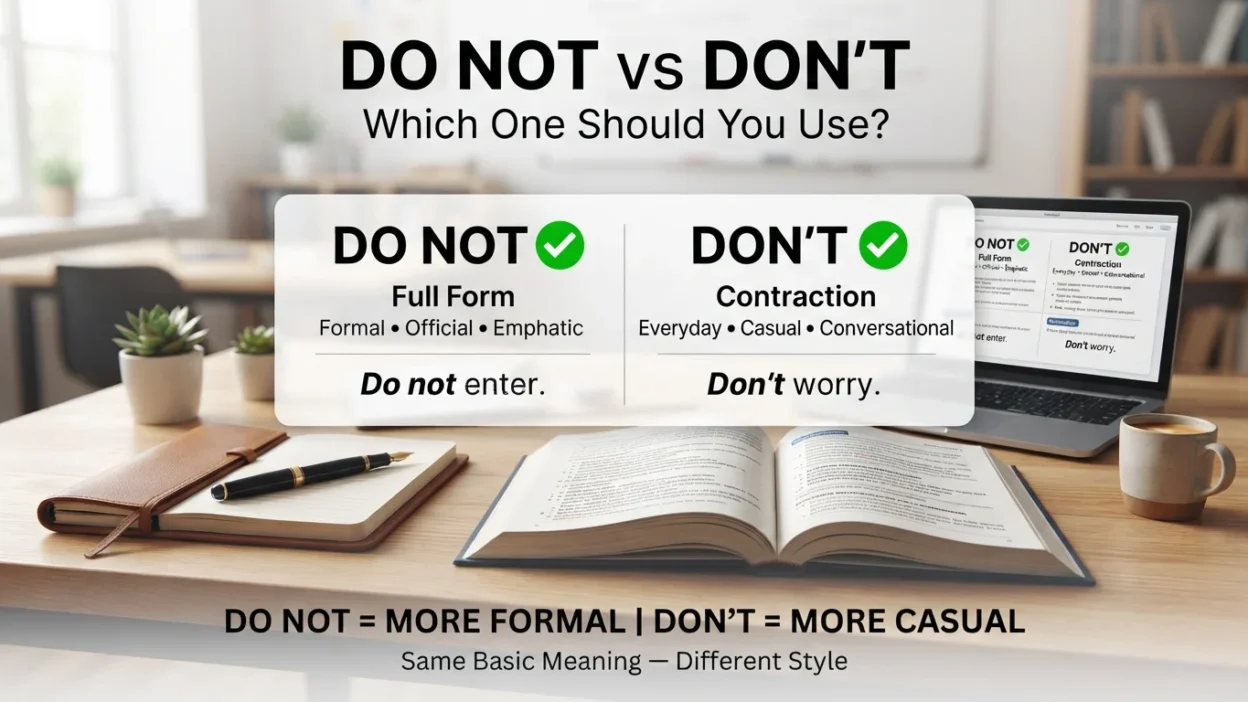
The main difference is formality and style. Do not is the full form and often sounds more formal, serious, or emphatic. Don’t is the contraction of do not and is much more common in everyday conversation and informal writing. Understanding when to use each one will help you communicate more naturally and confidently.
Quick Answer: Do Not vs Don’t
Do not and don’t mean the same thing in most situations.
Do not = the full form, often used in formal, official, or emphatic language.
Don’t = the contraction of do not, commonly used in everyday speech and informal writing.
Examples
Do not touch the equipment.
Don’t touch the equipment.
Both sentences tell someone not to touch the equipment. However, do not can sound more formal or authoritative, while don’t sounds more conversational.
Simple Rule
Use do not when you want a more formal, serious, or emphatic tone.
Use don’t for natural everyday conversation and informal communication.
What Does “Do Not” Mean?
Do not is the full negative form of the auxiliary verb do.
It is used to make negative statements and negative commands.
For example:
I do not understand the question.
This means:
I don’t understand the question.
In commands, do not is used to tell someone not to do something.
For example:
Do not enter this room.
Do not open the door.
Do not use your phone during the exam.
The full form often appears in signs, instructions, warnings, official notices, and formal writing.
What Does “Don’t” Mean?
Don’t is the contraction of do not.
It has exactly the same basic meaning but usually sounds more natural and conversational.
For example:
I don’t know the answer.
Don’t worry about it.
Don’t touch that.
They don’t like spicy food.
In everyday English, don’t is extremely common.
The apostrophe in don’t is important because it shows that letters have been omitted from do not.
Do not → Don’t
Do Not vs Don’t: Comparison Table
| Feature | Do Not | Don’t |
|---|---|---|
| Meaning | Negative form of “do” | Contraction of “do not” |
| Meaning difference | Usually none | Usually none |
| Formality | More formal | More informal |
| Everyday speech | Less common | Very common |
| Formal writing | Common | Less common in very formal contexts |
| Signs and warnings | Very common | Also possible |
| Emphasis | Can sound stronger | Usually more conversational |
| Example | Do not enter. | Don’t enter. |
The two forms are grammatically related and generally communicate the same message. The main difference is tone, formality, and emphasis.
Do Not vs Don’t in Negative Statements
Both forms can be used to say that someone does not do something.
For example:
I do not like coffee.
I don’t like coffee.
Both are grammatically correct.
The second sentence sounds more natural in everyday conversation.
Another example:
She does not understand the instructions.
She doesn’t understand the instructions.
Notice that does not becomes doesn’t, not don’t, because the subject is she.
This is an important distinction.
With “I,” “You,” “We,” and “They”
Use do not or don’t:
I don’t know.
You don’t need to worry.
We don’t agree.
They don’t live here.
With “He,” “She,” and “It”
Use does not or doesn’t:
He doesn’t know.
She doesn’t agree.
It doesn’t work.
You should not say:
She don’t know.
In standard English, the correct form is:
She doesn’t know.
Do Not vs Don’t in Commands
Both forms can be used to give negative commands.
For example:
Do not touch the display.
Don’t touch the display.
Both mean that the person should avoid touching the display.
However, the tone can be different.
Do not touch the display.
This sounds formal, official, or authoritative.
Don’t touch the display.
This sounds more conversational and direct.
You might see do not on an official warning sign:
DO NOT ENTER
But a parent might say:
Don’t touch that!
The context determines which form sounds most natural.
When to Use “Do Not”
There are several situations where do not is often preferred.
1. Formal Writing
In formal writing, the full form can sound more professional.
For example:
Please do not hesitate to contact us.
This is a common phrase in professional communication.
2. Official Instructions
Official instructions often use do not.
For example:
Do not remove this label.
Do not operate the machine without permission.
3. Warnings
Warnings frequently use the full form.
For example:
Do not enter the restricted area.
Do not use this product if damaged.
4. Strong Emphasis
The full form can add emphasis.
For example:
I do not want you to do that.
The speaker may be stressing the word not.
Compare:
I don’t want you to do that.
This sounds more conversational.
I do not want you to do that.
This can sound more serious or emphatic.
When to Use “Don’t”
Don’t is usually the better choice in everyday conversation.
For example:
Don’t worry.
Don’t be late.
I don’t understand.
We don’t need anything else.
It is also common in informal emails, text messages, social media posts, and friendly conversations.
For example:
Don’t forget to call me.
I don’t think that’s a good idea.
Don’t worry about the meeting.
Using contractions in these situations often makes your English sound more natural.
Common Mistakes
Mistake 1: Writing “Dont” Without an Apostrophe
Incorrect:
Dont worry.
Correct:
Don’t worry.
The apostrophe is necessary because don’t is a contraction of do not.
Mistake 2: Using “Don’t” With “He” or “She”
Incorrect:
She don’t like it.
Correct:
She doesn’t like it.
Incorrect:
He don’t understand.
Correct:
He doesn’t understand.
Remember:
I/You/We/They → don’t
He/She/It → doesn’t
Mistake 3: Thinking “Do Not” Is Always Better
Some learners believe that do not is always more grammatically correct.
That’s not true.
Don’t is completely correct in normal conversational English.
For example:
I don’t know.
There is nothing grammatically wrong with this sentence.
Mistake 4: Avoiding “Don’t” in Everyday Conversation
If you always use do not in casual conversation, your English may sound overly formal.
For example:
Do not worry about it.
This is correct, but:
Don’t worry about it.
sounds more natural in most casual situations.
Mistake 5: Using “Do Not” When You Mean “Does Not”
Remember that do not is not used with third-person singular subjects.
Incorrect:
She do not like coffee.
Correct:
She does not like coffee.
Or:
She doesn’t like coffee.
Do Not vs Don’t in American English
American English commonly uses contractions in everyday speech.
For example:
I don’t know.
Don’t worry.
We don’t need it.
In formal American English, writers may use the full form when they want a more formal or emphatic tone.
For example:
Please do not share this information.
There is no major grammatical difference between American and British English when it comes to do not and don’t.
The main difference is stylistic and depends on the context.
Do Not vs Don’t in British English
British English also uses both forms.
Don’t is extremely common in everyday speech.
For example:
I don’t know.
Don’t worry.
They don’t live here.
The full form do not is also used in formal writing, instructions, warnings, and for emphasis.
For example:
Do not enter.
Therefore, the basic rule is the same in both American and British English.
Is “Do Not” More Polite Than “Don’t”?
Not necessarily.
The level of politeness depends on the sentence and context.
For example:
Don’t forget to send the email.
This can sound friendly and natural.
Please do not forget to send the email.
This sounds more formal.
However, simply using do not does not automatically make a sentence more polite.
For example:
Do not speak to me like that.
This sounds strong and serious.
The tone depends on the words around the expression, the situation, and the speaker’s intention.
How to Remember the Difference
A simple way to remember the difference is:
Do not = Full form
Don’t = Short form
Think of don’t as the everyday version of do not.
For example:
Formal: Please do not disturb me.
Casual: Please don’t disturb me.
The meaning is essentially the same, but the style is different.
If you’re writing an official notice, a formal document, or a serious warning, do not may be the better choice.
If you’re chatting with a friend, speaking casually, or writing an informal message, don’t will usually sound more natural.
FAQs
1. Is “do not” the same as “don’t”?
Yes. Don’t is the contraction of do not, and the two generally have the same meaning.
2. Is “don’t” grammatically correct?
Yes. Don’t is a standard and widely accepted contraction of do not.
3. Should I use “do not” or “don’t” in formal writing?
In very formal writing, do not is often preferred. However, contractions are not always incorrect in formal writing; the choice depends on the style and purpose of the document.
4. Which is more common in everyday English?
Don’t is much more common in everyday conversation and informal communication.
5. Is “do not” more emphatic than “don’t”?
It can be. For example, “I do not agree” may sound more deliberate or emphatic than “I don’t agree.” The difference depends on context and stress.
6. Is “do not” used in American and British English?
Yes. Both American and British English use do not and don’t.
7. Can I use “don’t” in an official warning?
Yes, but do not is often preferred because it sounds more formal and authoritative.
For example:
DO NOT ENTER
is a very common official warning.
8. What is the difference between “don’t” and “doesn’t”?
Don’t is used with I, you, we, and they.
Doesn’t is used with he, she, and it.
Examples:
They don’t understand.
She doesn’t understand.
Final Summary
The difference between do not vs don’t is mainly about form and style rather than meaning. Do not is the full form, while don’t is its contraction. Both are grammatically correct, and both can be used to create negative statements or negative commands. For example, “Do not enter” and “Don’t enter” communicate essentially the same instruction.
The main distinction is tone and context. Do not often sounds more formal, official, serious, or emphatic, while don’t is more natural in everyday conversation and informal writing. The same basic rules apply in both American and British English.