Have you ever come across the terms emersion and immersion and wondered whether they mean the same thing? At first glance, these words look remarkably similar, which often leads to confusion. However, despite sharing a common linguistic root, they have very different meanings and are used in distinct contexts.
Understanding the difference between emersion vs immersion is important for clear communication, especially in academic writing, language learning, science, education, and everyday conversations. This guide explains both terms in simple language, provides practical examples, highlights common mistakes, and helps you confidently choose the correct word every time.
Quick Answer
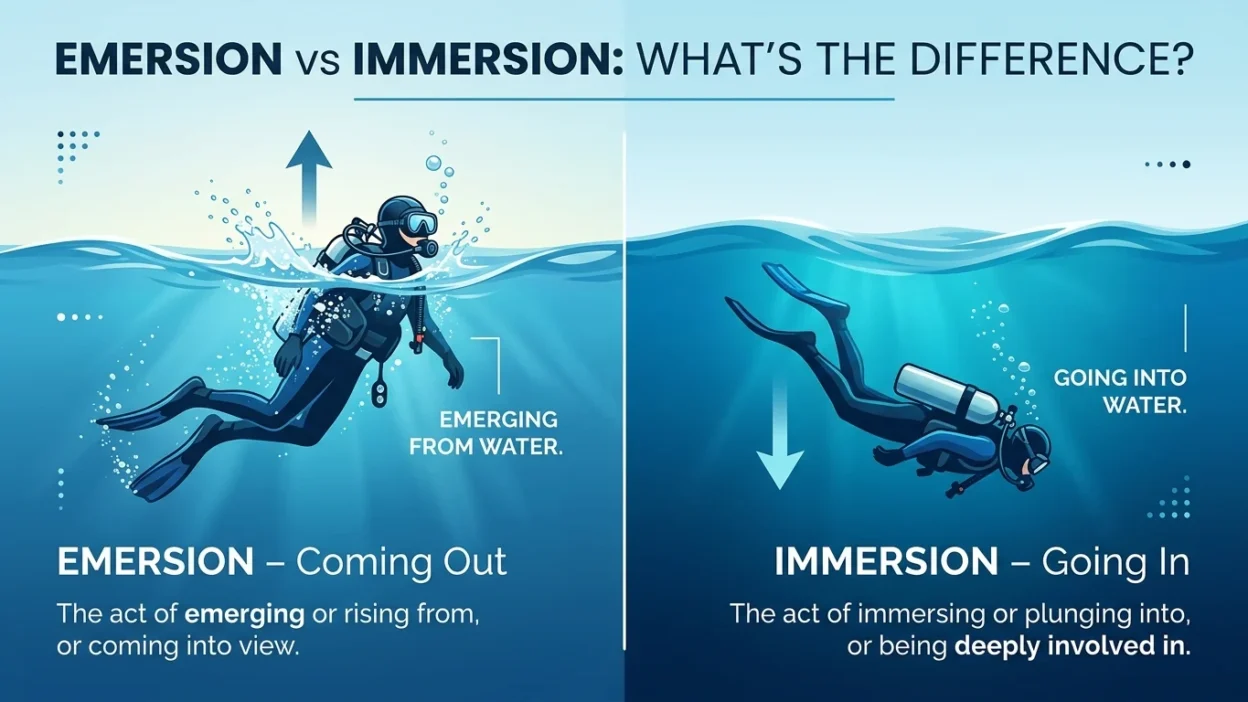
The difference between emersion and immersion is straightforward:
- Immersion means being completely surrounded, involved, or submerged in something.
- Emersion means emerging from, rising out of, or coming into view after being submerged.
Think of it this way:
- Going underwater = Immersion
- Coming back above water = Emersion
While immersion is commonly used in everyday English, emersion is much less common and is often found in scientific or technical contexts.
What Does Immersion Mean?
Immersion refers to the act of being deeply involved, completely surrounded, or fully absorbed in something.
The word comes from the Latin immergere, meaning “to plunge into” or “to submerge.”
Common Uses of Immersion
- Language learning
- Education
- Virtual reality
- Gaming
- Cultural experiences
- Water-related activities
Examples of Immersion
- She improved her Spanish through complete language immersion.
- The virtual reality headset created a strong sense of immersion.
- Cultural immersion helped travelers understand local traditions.
- The diver experienced total immersion beneath the water.
In modern English, immersion often describes a deep level of engagement rather than physical submersion.
Immersion in Language Learning
One of the most common uses of immersion is in education.
For example:
- Living in a country where the language is spoken.
- Taking classes conducted entirely in that language.
- Speaking the target language throughout the day.
This approach is known as language immersion and is widely considered one of the most effective learning methods.
What Does Emersion Mean?
Emersion means emerging from a liquid, surface, or hidden position. It is essentially the opposite of immersion.
The term originates from the Latin emergere, meaning “to rise out” or “to emerge.”
Common Uses of Emersion
Emersion is most frequently used in:
- Biology
- Marine science
- Botany
- Astronomy
- Environmental studies
Examples of Emersion
- The turtle’s emersion from the water lasted only a few seconds.
- Scientists observed the emersion of aquatic plants during low tide.
- The moon’s emersion from behind the Earth was carefully recorded.
- The diver’s emersion signaled the end of the underwater exploration.
Unlike immersion, emersion is rarely used in casual conversation.
Emersion vs Immersion: Key Differences
| Feature | Emersion | Immersion |
|---|---|---|
| Meaning | Coming out of something | Going into something |
| Direction | Upward or outward | Downward or inward |
| Common Usage | Scientific and technical fields | Everyday and professional contexts |
| Water Example | Rising above water | Going underwater |
| Language Learning | Not used | Frequently used |
| Popularity | Relatively uncommon | Very common |
The easiest way to remember the difference is:
Immersion = In
Emersion = Exit
Examples of Emersion vs Immersion in Sentences
Understanding both words in context makes them easier to remember.
Immersion Examples
- The museum created an immersive experience for visitors.
- Students benefited from total language immersion.
- The game provides excellent immersion through realistic graphics.
- Deep immersion in research helped her complete the project.
Emersion Examples
- The whale’s emersion attracted the attention of tourists.
- Researchers documented the emersion of submerged vegetation.
- The astronaut observed the emersion of the spacecraft from Earth’s shadow.
- The diver’s emersion was carefully monitored.
Why People Confuse Emersion and Immersion
Several factors contribute to confusion between these terms.
Similar Spelling
The words differ by only one letter, making them easy to mix up.
Shared Origins
Both words come from related Latin roots connected to movement and water.
Similar Contexts
Both terms can appear in discussions about water, diving, marine life, and science.
Unequal Popularity
Because immersion is much more common, many people assume emersion is simply a spelling mistake.
Common Mistakes to Avoid
Here are some frequent errors people make.
Mistake 1: Using Emersion for Deep Involvement
Incorrect:
- I achieved language emersion while studying abroad.
Correct:
- I achieved language immersion while studying abroad.
Mistake 2: Using Immersion for Emerging
Incorrect:
- The whale’s immersion from the ocean was spectacular.
Correct:
- The whale’s emersion from the ocean was spectacular.
Mistake 3: Assuming They Are Interchangeable
Although related, these words are not synonyms.
Always consider the direction of movement:
- Going into = Immersion
- Coming out = Emersion
Memory Trick for Remembering the Difference
A simple memory aid can help.
Immersion = In
The word starts with “Im,” which can remind you of “In.”
Think:
- Immersion = Going in
- Immersed = Submerged
Emersion = Emerge
Both words start with “Emer.”
Think:
- Emersion = Emerge
- Coming out or appearing
This trick helps many learners instantly choose the correct term.
Immersion in Modern English
Today, immersion is used far beyond physical submersion.
You may hear phrases such as:
- Immersive learning
- Immersive technology
- Immersive storytelling
- Cultural immersion
- Virtual immersion
These expressions describe experiences that fully capture a person’s attention and involvement.
As technology advances, the concept of immersion continues to grow, particularly in virtual reality, augmented reality, and digital education.
Emersion in Scientific Fields
Emersion remains important in specialized disciplines.
Marine Biology
Scientists study the emersion of marine animals during tidal changes.
Botany
Researchers examine how aquatic plants respond during periods of emersion.
Astronomy
Astronomers use the term when a celestial object reappears from behind another object.
Environmental Science
Emersion can affect ecosystems, habitats, and species behavior.
Because of its technical nature, emersion appears less often in everyday writing.
American vs British English
When comparing American English and British English, there is no significant difference in the meanings of emersion and immersion.
Both varieties of English use the words in essentially the same way.
However:
- Immersion is common in both American and British English.
- Emersion remains relatively rare in both varieties and is primarily used in scientific or academic contexts.
Therefore, the distinction between the two words is based on meaning rather than regional spelling or usage differences.
Frequently Asked Questions
Is emersion the opposite of immersion?
Yes. In many contexts, emersion is considered the opposite of immersion. Immersion involves entering or being submerged, while emersion involves emerging or rising out.
Which word is more commonly used?
Immersion is far more common in everyday English, education, technology, and business communication.
Can emersion be used for language learning?
No. The correct term is language immersion, not language emersion.
Is emersion a real English word?
Yes. Emersion is a legitimate English word, although it is less common and mainly used in scientific fields.
What is cultural immersion?
Cultural immersion means becoming deeply involved in another culture through direct participation and experience.
What does immersive mean?
Immersive describes something that creates a strong feeling of involvement or engagement.
Is emersion used outside science?
Occasionally, but it is much less common. Most modern uses occur in biology, astronomy, marine science, and environmental studies.
How can I remember the difference?
Remember:
- Immersion = In
- Emersion = Emerge
This simple association usually prevents confusion.
Summary
The debate around emersion vs immersion becomes much simpler once you understand the direction involved. Immersion means going into, being surrounded by, or becoming deeply involved in something. It is widely used in education, technology, culture, gaming, and everyday communication. In contrast, emersion means coming out of, emerging from, or rising above something and is mainly found in scientific and technical fields.
Although these words look similar, they are not interchangeable. Choosing the correct term depends on whether something is entering a state of involvement or submersion (immersion) or emerging from it (emersion). Understanding this distinction improves writing accuracy, strengthens communication skills, and helps avoid common language mistakes.
Actionable Takeaway
Whenever you’re unsure, ask yourself one simple question: Is something going in or coming out?
- If it is going in, use immersion.
- If it is coming out, use emersion.
Using this quick rule will help you choose the correct word confidently in both professional and everyday writing.