If you have ever wondered about day off vs off day, you are not alone. These two expressions look almost identical, but they can communicate two very different ideas. Knowing which one to use can make your everyday English sound much more natural.
The good news is that the difference is simple once you understand the context. Day off usually means a day when you do not have to work or attend your usual duties. Off day usually describes a day when someone is performing poorly, feeling less energetic than usual, or simply not having a good day.
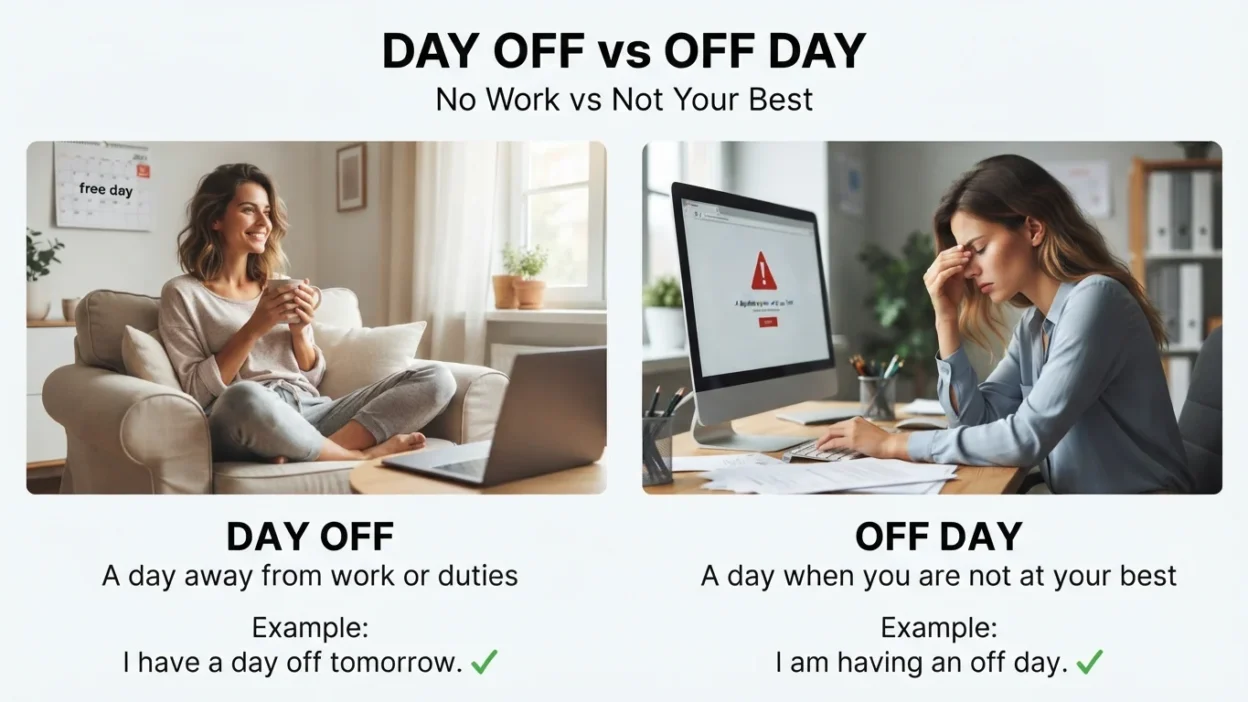
Quick Answer: Day Off vs Off Day
The basic difference is:
- Day off = a scheduled or permitted day away from work, school, or regular duties
- Off day = a day when someone or something is not performing normally or well
Examples:
I have a day off tomorrow.
This means you do not have to work tomorrow.
I am having an off day today.
This means you are not feeling or performing as well as usual.
A simple way to remember the difference is:
Day off = no work
Off day = not your best day
What Does Day Off Mean?
Day off is a very common English expression. It refers to a day when you are free from your normal work, school, or other regular responsibilities.
For example:
I have a day off on Friday.
She took a day off to visit her family.
We usually get one day off each week.
He is enjoying his day off at home.
A day off may be part of your regular schedule, a vacation arrangement, a public holiday, or approved leave from work.
It does not necessarily mean that you are doing nothing. You might spend your day off relaxing, traveling, shopping, meeting friends, or taking care of personal matters.
What Does Off Day Mean?
Off day has a different meaning.
It usually describes a day when someone is not performing at their normal level or does not feel as good, focused, energetic, or successful as usual.
For example:
I am having an off day today.
This means you are not feeling or performing normally.
The player had an off day and missed several easy shots.
Here, the player performed worse than usual.
Everyone has an off day sometimes.
This means everyone occasionally has a day when things do not go as well as expected.
The expression can refer to physical performance, work, mood, concentration, sports, or general circumstances.
Day Off vs Off Day Comparison Table
| Feature | Day Off | Off Day |
|---|---|---|
| Meaning | A day away from regular duties | A day of poor or unusual performance |
| Main idea | Not working | Not performing normally |
| Common context | Jobs, school, schedules, leave | Mood, sports, work, performance |
| Example | I have a day off tomorrow. | I am having an off day. |
| Usually positive or negative? | Usually neutral or positive | Usually negative or disappointing |
| Similar expression | Rest day, leave day | Bad day, difficult day |
The key difference is whether off describes your schedule or your performance.
Examples of Day Off
Here are some natural examples of day off:
I am taking a day off tomorrow.
My day off is Monday.
She requested a day off from work.
We spent our day off at the beach.
He used his day off to catch up on sleep.
Can I take a day off next week?
I finally have a day off after working for several days.
In all these examples, day off means freedom from normal duties.
Examples of Off Day
Now consider these examples:
I am having an off day today.
The team had an off day and lost the match.
She seemed distracted because she was having an off day.
The chef had an off day, and the meal was not as good as usual.
Even experienced professionals have an off day sometimes.
My computer seems to be having an off day too.
The final example is informal and humorous. We can sometimes use off day for things that seem to be performing poorly or behaving unusually.
Day Off From Work
One of the most common uses of day off is in the workplace.
For example:
I have a day off from work tomorrow.
She asked her manager for a day off.
My day off is Saturday this week.
He took a day off because he needed to handle some personal matters.
The phrase day off work and day off from work are both common.
You can also use take a day off:
I need to take a day off next Friday.
This means you want to be away from work or your normal duties for that day.
Day Off From School
The expression is not limited to employment.
You can also have a day off from school:
The students have a day off tomorrow.
We had a day off from school because of the holiday.
The children were excited about their day off.
This usage is especially common when schools close for holidays, special events, weather conditions, or other reasons.
Having an Off Day at Work
An off day can also happen at work.
For example:
I am sorry about the mistake. I am just having an off day.
This suggests that the person normally performs better but is having difficulty today.
Another example:
The manager was having an off day and made several unusual decisions.
Here, off day describes temporary poor performance rather than a scheduled break.
Off Day in Sports
Off day is especially common in sports.
For example:
The striker had an off day and failed to score.
The team had an off day during the final.
He was having an off day and missed several chances.
A professional athlete can have an off day even when they are normally excellent.
This does not mean the athlete was taking a break. It means they performed below their usual standard.
That distinction is very important.
Compare:
The player had a day off.
The player was not scheduled to play or train.
The player had an off day.
The player participated but performed poorly.
Can Off Day Mean a Day Off?
Usually, no.
Although the expressions look similar, off day should not normally be used when you mean a scheduled break.
If you mean that you are not working, say:
I have a day off tomorrow.
Not:
I have an off day tomorrow.
However, in some varieties of English and informal contexts, off day can occasionally be used differently. For clear standard English, especially when discussing work schedules, day off is the safest choice for a free day.
Common Mistakes With Day Off and Off Day
Mistake 1: Using Off Day for a Scheduled Break
Incorrect for most standard contexts:
Friday is my off day.
Better:
Friday is my day off.
If you are talking about your work schedule, day off is the clearer expression.
Mistake 2: Saying Someone Had a Day Off When They Performed Poorly
If an athlete played but performed badly, saying they had a day off could suggest they did not participate.
Better:
He had an off day.
This tells the reader that he participated but was not at his best.
Mistake 3: Confusing Rest With Poor Performance
A day off can be intentional and enjoyable.
An off day is generally something you experience rather than something you schedule.
For example:
I took a day off to relax.
This is intentional.
I am having an off day.
This describes how you are feeling or performing.
Day Off vs Holiday vs Vacation
These expressions are related but not identical.
A day off is usually one day away from regular duties.
A holiday can refer to a public holiday or a period away from work, depending on the variety of English.
A vacation generally refers to a longer period away from work or school, especially in American English.
For example:
I have a day off tomorrow.
Monday is a public holiday.
We are going on vacation next month.
American vs British English
The expression day off is standard in both American and British English.
For example:
I have a day off tomorrow.
is natural in both varieties.
The expression off day is also understood in both American and British English, especially when describing poor performance or an unusually difficult day.
There can be some regional differences in related workplace vocabulary.
For example, Americans commonly talk about vacation, while British speakers often use holiday for time away from work.
However, the basic distinction between day off and off day remains essentially the same.
Related Expressions and Synonyms
For day off, related expressions include:
- Rest day
- Free day
- Leave day
- Time off
- Break from work
- Day away from work
For off day, related expressions include:
- Bad day
- Difficult day
- Poor-performance day
- Rough day
- Not feeling yourself
- Not at your best
These alternatives are not always exact synonyms, so context still matters.
FAQs
1. What is the difference between day off and off day?
Day off means a day when you are free from your normal work, school, or duties. Off day means a day when you are not performing or feeling as well as usual.
2. Is it correct to say I have an off day tomorrow?
If you mean that you do not have to work tomorrow, I have a day off tomorrow is clearer and more standard.
3. What does I am having an off day mean?
It means you are having a day when you do not feel, behave, or perform as well as you normally do.
4. Is day off correct for work?
Yes. Day off is the standard expression for a scheduled or approved break from work.
5. Can an athlete have an off day?
Yes. An athlete can have an off day when they participate but perform below their normal level.
6. Is off day American or British English?
Off day is understood in both American and British English. Its use for poor performance or an unusually difficult day is common in both varieties.
7. Is day off the same as vacation?
Not exactly. A day off usually refers to one day away from regular duties, while a vacation normally refers to a longer period away from work or school.
8. What is an easy way to remember day off vs off day?
Remember:
Day off = you are off work.
Off day = you are not at your best.
Final Summary
The difference between day off vs off day is mainly about whether you are talking about your schedule or your performance and feelings. A day off is a day when you are free from work, school, or other regular responsibilities. You can plan it, request it, enjoy it, or receive it as part of your schedule.
An off day, on the other hand, describes a day when you are not performing, feeling, or functioning as well as normal. It is commonly used for people, athletes, teams, and even situations that seem to be going badly. The expressions may look similar, but their meanings are quite different.

Liam James is a language enthusiast and content writer at Verseslay, specializing in word comparisons, grammar debates, and vocabulary insights. He helps readers understand language nuances through clear, engaging, and practical explanations.