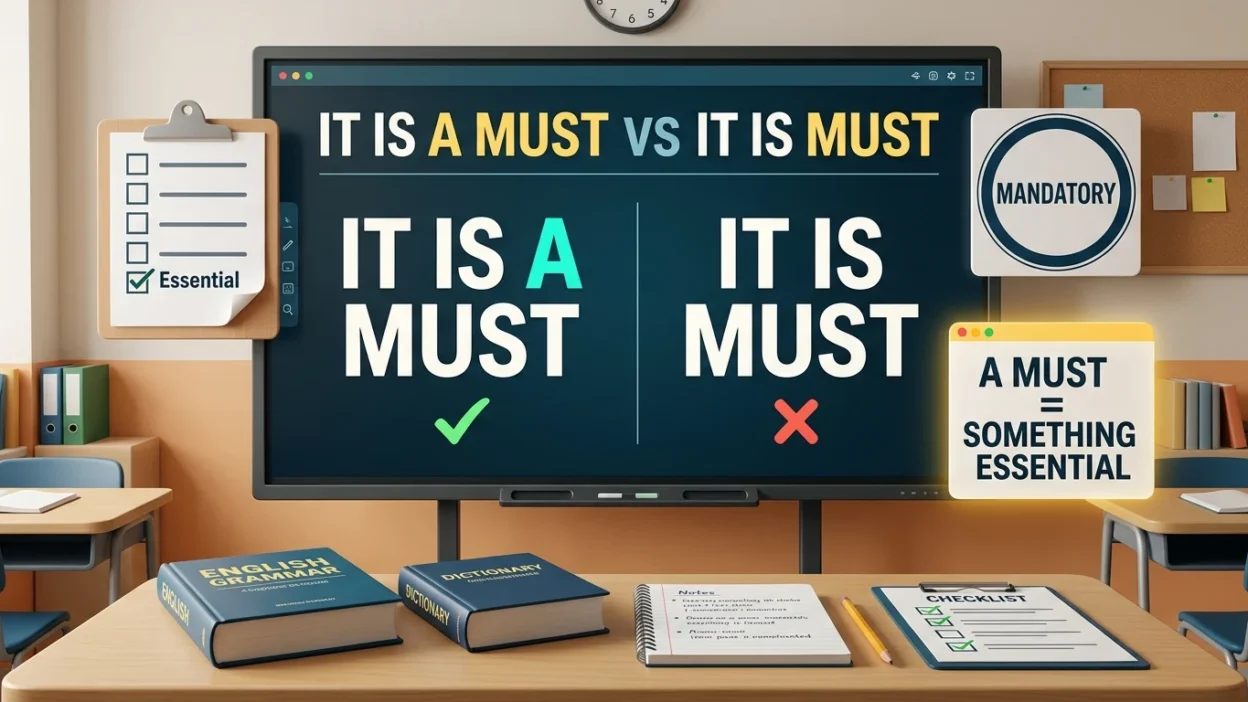
Have you ever wondered whether you should say it is a must or it is must? These two expressions look almost identical, but only one is grammatically natural in standard English. The difference comes down to how the word must functions in each expression.
The good news is that the correct choice is easy to remember. It is a must is a natural and widely accepted expression meaning something is essential, necessary, or highly recommended. It is must, without an article, is generally incorrect when you are trying to use must as a noun after is.
Quick Answer
The correct expression is it is a must.
- It is a must = correct and natural.
- It is must = generally incorrect in standard English.
- A must is a noun phrase meaning something essential or necessary.
- Must by itself is usually a modal verb, as in You must finish your work.
So, if you want to say that something is essential, say:
It is a must.
Not:
It is must.
It Is a Must Meaning
It is a must means that something is essential, necessary, extremely important, or strongly recommended.
Here, must is being used as a noun, not as a modal verb. Because it is a singular countable noun in this expression, it normally needs the article a.
For example:
- A passport is a must when traveling internationally.
- Regular practice is a must for improving your English.
- Good communication skills are a must for this position.
- A helmet is a must when riding a motorcycle.
The expression can also have the sense of something that is highly desirable or worth experiencing: - This restaurant is a must for food lovers.
- The museum is a must for anyone visiting the city.
In these examples, a must means something that should not be missed or something that is considered essential.
Why Is It a Must Correct?
The key is grammatical function.
When must is used as a modal verb, it does not take an article:
- You must study.
- We must leave now.
- She must complete the assignment.
But in it is a must, the word must functions as a noun. Therefore, the article a is required.
Compare: - You must attend the meeting. → modal verb
- Attending the meeting is a must. → noun
This distinction explains why it is must sounds incomplete or grammatically incorrect in standard English.
Is It Must Correct?
In the intended meaning of something being essential or necessary, it is must is generally incorrect.
For example:
❌ It is must to wear a seat belt.
✅ It is a must to wear a seat belt.
Even better, depending on the sentence:
✅ Wearing a seat belt is a must.
However, there are grammatical situations where must can appear after another word without an article, but that does not make it is must a correct replacement for it is a must.
If you are using must as a noun meaning something essential, use a must.
It Is a Must vs It Is Must
| Expression | Correct? | Meaning | Example |
|---|---|---|---|
| It is a must | ✅ Yes | It is essential or highly recommended | This book is a must for students. |
| It is must | ❌ Generally no | Not a standard noun construction | It is must to follow the rules. |
| It must be | ✅ Yes | It is necessary / certain | It must be completed today. |
| It is necessary | ✅ Yes | It is required or essential | It is necessary to follow the rules. |
| It is essential | ✅ Yes | It is extremely important | It is essential to follow the rules. |
| One particularly important point is the difference between it is a must and it must be. They may express similar ideas, but their grammatical structures are completely different. |
Examples of It Is a Must
Here are some natural examples:
- A valid ID is a must for entry.
- Patience is a must when teaching young children.
- A good dictionary is a must for serious language learners.
- Experience is a must for this job.
- Comfortable shoes are a must when traveling.
- A backup plan is a must for an outdoor event.
- This book is a must for anyone interested in history.
- A healthy breakfast is a must for many people.
Notice that a must can follow a noun or be used with it is: - It is a must.
- A dictionary is a must.
- Experience is a must.
It Is a Must to Do Something
The expression can be followed by an infinitive phrase:
- It is a must to check the details before submitting the form.
- It is a must to wear protective equipment.
- It is a must to practice regularly.
However, native speakers often prefer more direct alternatives in formal writing: - You must check the details before submitting the form.
- You must wear protective equipment.
- It is essential to check the details before submitting the form.
So while it is a must to… is understandable and grammatically possible, must, need to, or it is essential to may sound more natural depending on the context.
It Is a Must vs Must Be
These expressions are often confused because they both communicate necessity.
It is a must
This uses must as a noun:
- Regular exercise is a must.
- It is a must for all applicants.
Must be
This uses must as a modal verb:
- All applicants must be present.
- The form must be completed.
The second structure is often more concise and direct.
Common Mistakes
1. Leaving Out the Article A
One of the most common errors is:
❌ It is must.
The correct form is:
✅ It is a must.
Because must is functioning as a noun here, the article a is needed.
2. Confusing It Is a Must With It Must Be
These are different structures:
- It is a must. → It is essential.
- It must be completed. → Completion is required.
Do not combine the two patterns.
3. Adding To After Must in the Wrong Structure
A common learner error is:
❌ You must to study.
The correct form is:
✅ You must study.
After the modal verb must, use the base form of the verb without to.
However:
✅ It is a must to study regularly.
Here, must is a noun, so the structure is different.
4. Using It Is Must in Formal Writing
Even if the intended meaning is understandable, it is must is not standard natural English for expressing necessity. Use it is a must, it is necessary, or it is essential instead.
5. Overusing It Is a Must
Although it is a must is correct, it can sound somewhat promotional or conversational when repeated too often.
For professional or academic writing, alternatives such as essential, necessary, required, or mandatory may be more precise.
American vs British English
There is no significant difference between American and British English regarding the basic grammar of it is a must.
Both varieties use a must as a noun to describe something essential, necessary, or highly desirable.
For example, both American and British speakers can naturally say:
- A passport is a must for international travel.
- This book is a must for beginners.
The main variation is stylistic. In formal writing in either variety, it is essential, it is necessary, or it is required may sound more polished.
Alternatives to It Is a Must
Depending on the context, you can use several alternatives:
- It is essential.
- It is necessary.
- It is required.
- It is mandatory.
- It is important.
- You must…
- You need to…
- It is highly recommended.
- It should not be missed.
For example:
It is a must for every teacher.
can become:
It is essential for every teacher.
Or:
Every teacher should have it.
The best alternative depends on how formal, direct, or conversational you want to sound.
How to Remember the Difference
Use this simple rule:
Must + base verb = modal verb
- You must study.
- We must leave.
- They must follow the rules.
A must = noun meaning something essential - It is a must.
- Experience is a must.
- This book is a must.
So whenever you mean something essential, remember the article a:
a must ✅
must ❌ when used as that noun after is
FAQs
Is it a must or it is must?
It is a must is correct. It is must is generally incorrect when you mean something is essential or necessary.
Why do we say it is a must?
Because must is functioning as a noun in this expression. The singular noun phrase therefore normally requires the article a.
Is it a must grammatically correct?
Yes. It is a must is grammatically correct and commonly used in informal and neutral English.
Can I say it is a must to do something?
Yes, but alternatives such as you must, you need to, or it is essential to may sound more natural depending on the context.
What is the difference between it is a must and it must be?
It is a must means something is essential. It must be uses must as a modal verb to express necessity, obligation, or strong certainty.
Is it is a must formal English?
It is standard English, but it can sound conversational or promotional. In formal writing, it is essential or it is necessary may be preferable.
Is it is a must used in American English?
Yes. It is a must and a must are used in American English.
What can I say instead of it is a must?
You can say it is essential, it is necessary, it is required, it is mandatory, or simply you must, depending on the context.
Summary
The correct expression is it is a must, not it is must, when you want to say that something is essential, necessary, or highly recommended. The reason is that must is acting as a noun in a must, and a singular noun used this way requires the article a. This makes it is a must a grammatically sound and natural expression.
Remember that must also functions as a modal verb, as in you must follow the rules. In that structure, no article is used. Keeping these two grammatical functions separate makes the difference easy to understand and helps you avoid one of the common mistakes made by English learners.
Actionable Takeaway
When must means something essential, use a must: It is a must. When must comes directly before a verb, use it as a modal: You must study.