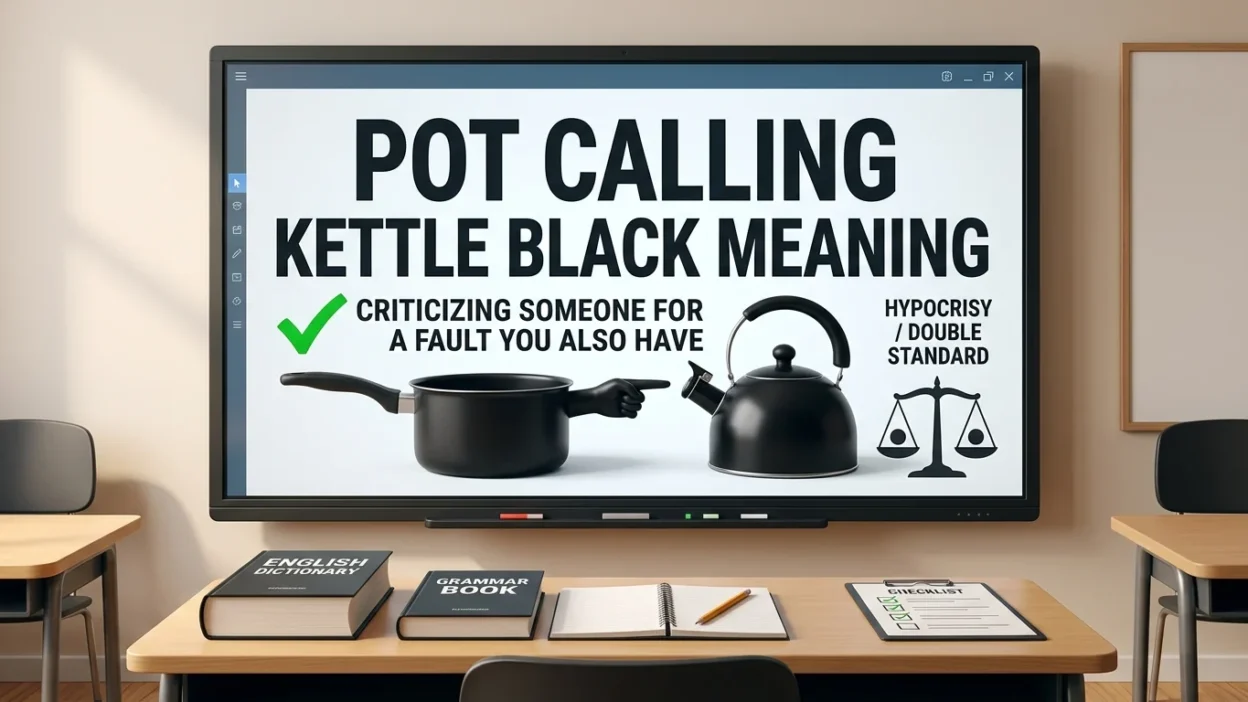
Have you ever criticized someone for a habit or behavior that you also have? If so, someone might tell you that you are the pot calling the kettle black. This colorful English idiom is commonly used when a person points out a fault in someone else while having the same or a very similar fault themselves.
The pot calling kettle black meaning is therefore closely connected with hypocrisy, double standards, and self-contradiction. It is usually said in a humorous, sarcastic, or critical way when someone criticizes another person without recognizing that the same criticism could apply to them.
Quick Answer
The pot calling the kettle black means criticizing someone for a fault that you also have yourself.
In simple words, it means:
- You say I am always late, but you are late every day. That is the pot calling the kettle black.
The idiom often suggests hypocrisy, double standards, or a lack of self-awareness.
Pot Calling Kettle Black Meaning
The phrase the pot calling the kettle black describes a situation in which someone criticizes another person for a particular weakness, mistake, or undesirable behavior even though the critic has the same weakness or behaves in a similar way.
Imagine a black cooking pot criticizing a black kettle for being black. The pot has exactly the same characteristic it is criticizing.
That literal image explains the figurative meaning very well.
For example:
- Mark accused Sarah of being disorganized, but his own desk was always a mess. That was the pot calling the kettle black.
Here, Mark’s criticism is ironic because he has the same problem.
The expression can apply to many everyday situations, including lateness, dishonesty, laziness, spending habits, complaining, impatience, poor communication, and many other behaviors.
What Does Calling the Kettle Black Mean?
The phrase is usually used in its complete form:
the pot calling the kettle black
People sometimes shorten it in casual conversation, but the full expression is the most recognizable form.
When someone says:
You are calling the kettle black.
they mean that you are criticizing another person for a fault that you also possess.
The expression is especially useful when pointing out a double standard.
Simple Examples
Here are some easy examples to understand the idiom:
- Tom tells everyone to stop using their phones, but he is always on his phone. That is the pot calling the kettle black.
- She criticized her brother for spending too much money, even though she shops constantly. She was calling the kettle black.
- You cannot accuse me of interrupting when you never let anyone finish speaking. That is the pot calling the kettle black.
- The manager complained that employees were always late, even though he regularly arrived late himself.
- He called his friend selfish while refusing to help anyone. Talk about the pot calling the kettle black.
These examples all have the same basic pattern: Person A criticizes Person B for behavior that Person A also demonstrates.
Pot Calling Kettle Black in Everyday Conversations
This idiom is common in informal conversations because it can make a criticism sound humorous or sarcastic.
For example:
Person A: You need to stop complaining all the time.
Person B: You complain more than anyone I know. You’re the pot calling the kettle black.
The expression can soften a disagreement by adding humor, but it can also sound confrontational depending on the tone.
If you are speaking in a sensitive situation, a gentler alternative might be better:
- That criticism applies to you too.
- You do the same thing sometimes.
- I think we both have that problem.
These alternatives communicate the same basic idea without sounding as sarcastic.
Pot Calling Kettle Black: Common Situations
The idiom can be used in many contexts.
Workplace
A manager criticizes employees for missing deadlines while frequently submitting reports late themselves.
That is the pot calling the kettle black.
Family
A parent tells a child not to spend too much time on their phone while constantly checking their own phone.
That is a classic case of the pot calling the kettle black.
Friendships
A friend complains that everyone interrupts him, but he constantly interrupts others.
He is calling the kettle black.
Social Media
Someone criticizes others for posting too many selfies while posting selfies every day.
That is the pot calling the kettle black.
Pot Calling Kettle Black vs Hypocrisy
These concepts are closely related, but they are not exactly identical.
Hypocrisy means claiming to have certain moral standards or beliefs while behaving in a way that contradicts them.
The pot calling the kettle black specifically focuses on criticizing someone for a fault that the critic also has.
For example:
- A person who tells everyone to be honest but regularly lies may be acting hypocritically.
- If that same person criticizes another person for lying, you could describe the situation as the pot calling the kettle black.
So the idiom is a specific type of situation involving hypocrisy or a double standard.
Pot Calling Kettle Black vs Double Standard
A double standard occurs when different rules or expectations are applied to similar situations or people.
The idiom often highlights a double standard because the critic is judging someone else for behavior they tolerate or display themselves.
However, the two expressions are not exact synonyms.
| Expression | Meaning | Example |
|---|---|---|
| Pot calling the kettle black | Criticizing someone for a fault you also have | He calls me lazy, but he never works. |
| Hypocrisy | Claiming one standard while behaving differently | She says honesty matters but often lies. |
| Double standard | Applying different standards to similar situations | He expects others to be punctual but is always late. |
| Self-contradiction | Saying or doing something that conflicts with your own behavior | He tells others to save money while wasting his own. |
Common Mistakes
1. Thinking It Is About Cooking
The phrase uses a literal image of a black pot and black kettle, but its meaning is figurative. It is not normally used to discuss kitchen equipment.
2. Using It for Any Criticism
Not every criticism is an example of this idiom.
The person making the criticism should generally have the same or a similar fault.
If someone who is always punctual criticizes another person for being late, that is not the pot calling the kettle black.
3. Forgetting the Similarity
The important part of the idiom is that the critic is guilty of the same behavior.
Without that similarity, the expression does not fit.
4. Assuming It Always Means Deliberate Hypocrisy
Sometimes people criticize others without realizing they have the same fault. The idiom can still apply even when the person is unaware of the contradiction.
5. Using It in Very Formal Writing
The expression is an idiom and is generally more natural in conversation, informal writing, journalism, storytelling, and opinion-based contexts.
In formal academic writing, alternatives such as hypocritical criticism, a double standard, or self-contradictory criticism may be more appropriate.
American vs British English
The pot calling the kettle black is well established in both American and British English.
There is no significant difference in meaning or spelling between the two varieties.
The expression is widely understood in other English-speaking countries as well.
American and British speakers may both use it when someone criticizes another person for a fault they themselves have.
For example:
- You’re complaining about his lateness? That’s the pot calling the kettle black.
The expression remains informal and conversational in both varieties.
Is It Pot Calling the Kettle Black or the Pot Calling Kettle Black?
The standard form is:
the pot calling the kettle black
The articles the are normally included when referring to the established idiom.
You may occasionally see shortened or altered versions in casual speech, but the complete form is the safest and most recognizable version.
Origin of the Idiom
The expression has a long history and is generally associated with the idea of a cooking pot criticizing a kettle for being black when both could become blackened by soot from a fire.
An early version appeared in Spanish literature in the early seventeenth century, while an English form became established later.
The image works because both objects can have the same blackened appearance. The criticism is therefore ironic: the critic possesses the very quality being criticized.
Because idioms develop over time, the exact historical path of the modern English wording is not as simple as a single documented first use, but the underlying comparison has been used for centuries.
Synonyms and Related Expressions
Depending on the situation, you can use:
- hypocritical
- hypocrisy
- double standard
- self-contradictory
- guilty of the same thing
- criticizing someone for what you do yourself
- look who’s talking
- that’s rich
- practice what you preach
- don’t criticize others for what you do yourself
Look who’s talking is especially useful in casual conversation when someone is criticizing another person for something they also do.
FAQs
What does the pot calling the kettle black mean?
It means criticizing someone for a fault or behavior that you also have yourself. The expression usually points to hypocrisy or a double standard.
What is a simple example of the pot calling the kettle black?
If someone who is always late criticizes another person for being late, that is the pot calling the kettle black.
Is the pot calling the kettle black an idiom?
Yes. It is a common English idiom used to describe hypocritical or self-contradictory criticism.
Is pot calling kettle black rude?
It can sound sarcastic or confrontational, depending on the context and tone. In friendly conversations, it may be used humorously.
What is another way to say pot calling the kettle black?
You can say look who’s talking, you do the same thing, that’s hypocritical, or you’re holding someone to a double standard, depending on the situation.
Is the idiom used in American English?
Yes. It is commonly understood and used in American English.
Is the pot calling the kettle black the same as hypocrisy?
They are closely related but not identical. The idiom describes a specific situation where someone criticizes another person for a fault they also have.
Can I use this idiom in formal writing?
You can, but it is generally more conversational. In formal writing, hypocrisy, double standard, or self-contradictory criticism may be more appropriate.
Summary
The pot calling kettle black meaning is simple: it describes a person criticizing someone else for a fault that the critic also has. The expression is often used to point out hypocrisy, inconsistency, or a double standard. Its humorous image of a black pot criticizing a black kettle makes the idea easy to remember.
The idiom is common in both American and British English and works especially well in everyday conversations, informal writing, and situations where someone is being criticized for behavior they themselves demonstrate. Remember that the critic and the person being criticized should generally share the same or a similar fault for the idiom to fit naturally.
Actionable Takeaway
Use the pot calling the kettle black when someone criticizes another person for something they are guilty of themselves. Think: criticizing others for your own fault.