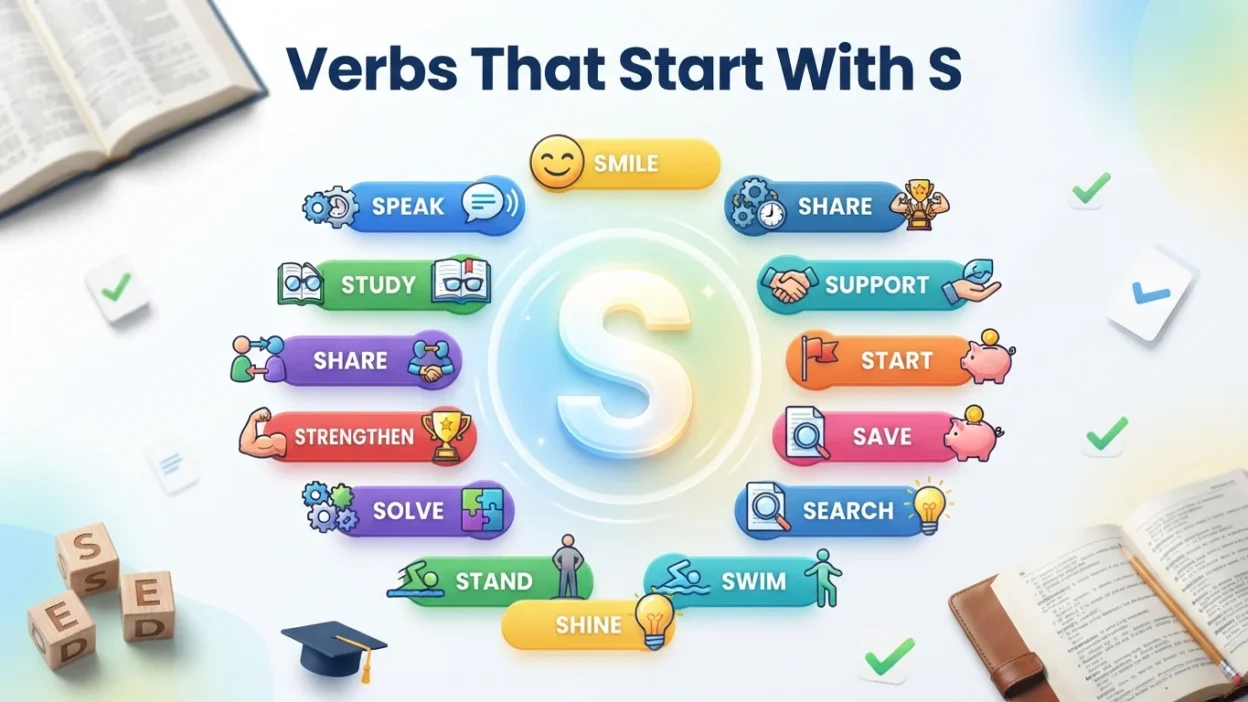
If you’re writing an essay, improving your vocabulary, preparing for an English exam, or looking for stronger action words, learning verbs that start with S can instantly make your communication more expressive.
From everyday verbs like say, see, and start to advanced words like stabilize, strengthen, and synchronize, S verbs appear constantly in spoken and written English.
In this guide, you’ll discover a carefully organized list of verbs that start with S, along with meanings, example sentences, common mistakes, and practical tips for using them correctly.
If you’re a student, teacher, writer, or English learner, this resource will help expand your vocabulary and improve your writing naturally.
Quick Answer
Verbs that start with S are action words beginning with the letter S. They describe actions, processes, or states of being.
Some of the most common examples include:
- Say
- See
- Sell
- Send
- Smile
- Speak
- Stand
- Start
- Stop
- Study
- Save
- Support
- Share
- Shine
- Sleep
These verbs are widely used in everyday conversations, academic writing, business communication, and storytelling.
What Are Verbs That Start With S?
A verb is a word that describes an action, occurrence, or state.
When that verb begins with the letter S, it belongs to the category of verbs that start with S.
These verbs help us describe:
- Physical actions
- Mental processes
- Communication
- Emotions
- Movement
- Business activities
- Daily routines
Because S is one of the most frequently used letters in English, many important verbs begin with it.
Common Verbs That Start With S
Here are some of the most frequently used S verbs.
| Verb | Meaning | Example |
|---|---|---|
| Say | Speak words | Please say your name. |
| See | View with the eyes | I can see the mountains. |
| Sell | Exchange for money | They sell fresh fruit. |
| Send | Deliver | I’ll send an email. |
| Share | Give part of something | Please share your ideas. |
| Shine | Give off light | The stars shine brightly. |
| Shoot | Fire or throw | He can shoot accurately. |
| Show | Display | Show me your homework. |
| Sing | Produce music | Birds sing every morning. |
| Sit | Rest on a seat | Please sit here. |
| Sleep | Rest | Babies sleep often. |
| Smile | Express happiness | She smiled warmly. |
| Speak | Talk | We speak English. |
| Spend | Use money or time | Don’t spend too much. |
| Stand | Be upright | Please stand still. |
| Start | Begin | Let’s start now. |
| Stay | Remain | Stay safe. |
| Stop | End an action | Stop running. |
| Study | Learn | Students study daily. |
| Swim | Move through water | They swim every weekend. |
These are among the most practical verbs in English.
Positive Verbs That Start With S
Positive action verbs add energy and optimism to your writing.
- Smile
- Support
- Strengthen
- Simplify
- Succeed
- Save
- Share
- Serve
- Spark
- Secure
- Stabilize
- Shine
- Soar
- Solve
- Sustain
Example Sentences
- Always support your teammates.
- She succeeded through hard work.
- Great leaders serve others.
- Small habits can strengthen your confidence.
These verbs are especially useful in motivational writing and professional communication.
Action Verbs That Start With S
These verbs describe physical or visible actions.
- Sweep
- Skip
- Stretch
- Spin
- Sprint
- Slide
- Swing
- Scratch
- Shake
- Sail
- Scatter
- Search
- Separate
- Stack
- Slice
Examples
- The children skipped across the playground.
- He searched for his keys.
- Please stack the books neatly.
Action verbs make your writing more vivid and engaging.
Academic and Professional S Verbs
These verbs are commonly used in schools, workplaces, and business writing.
- Submit
- Summarize
- Specify
- Solve
- Schedule
- Structure
- Standardize
- Simplify
- Synthesize
- Supervise
- Strengthen
- Secure
- Study
- Survey
- Support
Example Sentences
- Please submit your report by Friday.
- Researchers summarized their findings.
- Managers supervise daily operations.
These words are valuable for formal communication.
Advanced Verbs That Start With S
If you want to sound more sophisticated, consider these advanced verbs.
- Synchronize
- Sanction
- Segregate
- Solidify
- Suppress
- Substitute
- Speculate
- Stimulate
- Scrutinize
- Safeguard
- Sustain
- Streamline
- Surpass
- Suspend
- Standardize
Examples
- The software will synchronize automatically.
- New policies streamlined the process.
- Education helps stimulate creativity.
These verbs often appear in academic, technical, and business contexts.
Verbs That Start With S for Kids
Children can easily learn these simple S verbs.
- Sing
- Smile
- Skip
- Sit
- Sleep
- Swim
- Share
- See
- Say
- Stand
- Start
- Stop
- Shake
- Show
- Sweep
These beginner-friendly verbs help build a strong vocabulary foundation.
Comparison Table: Everyday vs Advanced S Verbs
| Everyday Verbs | Advanced Verbs |
|---|---|
| Say | Specify |
| See | Scrutinize |
| Start | Synchronize |
| Stop | Suppress |
| Show | Stimulate |
| Smile | Sustain |
| Share | Streamline |
| Save | Safeguard |
| Stand | Standardize |
| Speak | Speculate |
Using a mix of common and advanced verbs improves both readability and writing quality.
Common Mistakes When Using S Verbs
Learning verbs is easier when you know what mistakes to avoid.
1. Using the Wrong Verb Tense
Incorrect:
- She start yesterday.
Correct:
- She started yesterday.
2. Confusing Similar Verbs
For example:
- Say
- Speak
- Tell
Each has different grammar rules.
3. Forgetting Subject-Verb Agreement
Incorrect:
- He study every day.
Correct:
- He studies every day.
4. Overusing Simple Verbs
Instead of always writing:
- Say
Sometimes choose:
- Explain
- State
- Mention
- Announce
A varied vocabulary makes writing more engaging.
Tips for Learning More S Verbs
Expanding your vocabulary doesn’t have to be difficult.
Try these strategies:
- Read books and articles regularly.
- Learn five new verbs each day.
- Create your own example sentences.
- Use flashcards for review.
- Practice speaking aloud.
- Keep a vocabulary journal.
- Group verbs by topic or meaning.
Consistent practice helps you remember new words more effectively.
American vs British English
Most verbs that start with S have the same spelling and meaning in both American and British English.
However, some related vocabulary or verb usage may vary slightly.
Examples:
- Specialize (American and British spelling is the same, though British English also accepts specialise).
- Standardize (American English), standardise (British English).
- Summarize (American English), summarise (British English).
These differences involve -ize and -ise spelling conventions rather than changes in meaning. Regardless of the variety of English you use, the verbs themselves function the same grammatically.
Why Learning Verbs That Start With S Matters
A strong verb vocabulary helps you:
- Write more clearly.
- Speak with confidence.
- Improve essays and assignments.
- Perform better in English exams.
- Communicate professionally.
- Expand your creative writing skills.
- Enhance your business communication.
The more action verbs you know, the more naturally you can express your ideas.
FAQs
What are verbs that start with S?
They are action or state words beginning with the letter S, such as say, see, start, and support.
What is the most common S verb?
Some of the most common are say, see, start, stop, show, and speak.
Are all S words verbs?
No. Many S words are nouns, adjectives, or adverbs. Only words expressing actions, occurrences, or states are verbs.
What are positive verbs that start with S?
Examples include support, strengthen, share, serve, save, shine, and succeed.
What are action verbs that start with S?
Common action verbs include swim, skip, slide, shake, scratch, search, and slice.
Do American and British English use different S verbs?
Most S verbs are the same. Some verbs differ only in spelling, such as summarize/summarise and standardize/standardise.
How can I learn new S verbs quickly?
Practice using them in sentences, read regularly, and review vocabulary with flashcards or word lists.
Summary
Learning verbs that start with S is an excellent way to strengthen your English vocabulary and improve both written and spoken communication.
From everyday verbs like say, see, start, and stop to advanced choices like synchronize, streamline, and scrutinize, these action words help you express ideas more accurately and confidently.
Building familiarity with a wide range of S verbs also makes your writing more engaging and precise.
If you’re preparing for exams, writing professional documents, creating content, or simply expanding your vocabulary, mastering S verbs will give you greater flexibility in your language.
The more you read, practice, and use these verbs in real-life situations, the more natural they’ll become in your everyday English.
Actionable Takeaway
Choose five new verbs that start with S from this guide and use each one in your own sentence today. Then challenge yourself to replace simple verbs like say or show with stronger alternatives when appropriate. Small daily practice sessions will steadily build a richer vocabulary and make your English more fluent and expressive.