If you have ever wondered whether to say in which or where, you are not alone. These two expressions often appear in similar sentences, especially when describing places, situations, conditions, or circumstances. The good news is that the difference becomes much easier once you understand what each one does grammatically.
In everyday English, where is usually the simpler and more natural choice when you are talking about a place. In which, however, is often more formal and can be used when the noun before it is not necessarily a physical place. Understanding this small distinction can make your writing sound clearer, more precise, and more natural.
Quick Answer
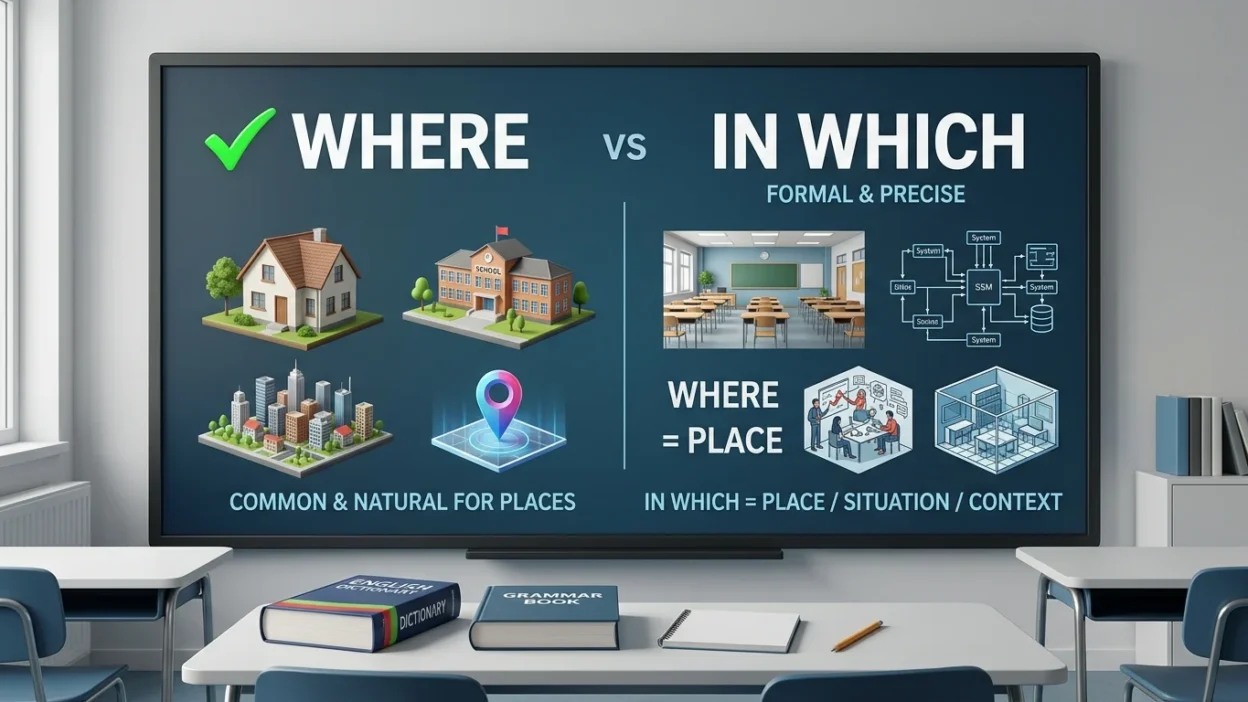
Where is generally used to refer to a place or location.
- This is the house where I grew up.
- Do you know where she lives?
In which is a more formal relative expression. It can refer to a place, situation, system, period, or other context.
- This is the house in which I grew up.
- We entered a situation in which nobody knew what to do.
When referring to a physical place, where is often more natural in everyday English, while in which can sound more formal or academic.
What Does Where Mean?
Where is commonly used as a relative adverb to introduce information about a place or location. It can refer to physical locations as well as, in some contexts, situations or circumstances.
For example:
- This is the school where I studied.
- That is the restaurant where we had dinner.
- I remember the day when we first met.
- We reached a point where we had to make a decision.
In the first two examples, where clearly refers to a physical location.
The third example uses when because the noun is a time, while the fourth uses where in a more figurative sense to describe a situation or stage.
What Does In Which Mean?
In which consists of the preposition in followed by the relative pronoun which.
It is often used to connect a noun with additional information about it. Because it includes a preposition, it can be more precise than simply using which.
For example:
- This is the room in which we held the meeting.
- They created a system in which everyone could participate.
- We entered a period in which prices increased rapidly.
- She described a situation in which nobody felt safe.
Notice that in which does not always refer to a physical location. It can introduce a particular situation, environment, process, or context.
In Which vs Where: The Main Difference
The easiest way to understand the difference is to ask what the expression refers to.
| Expression | Main Use | Style | Example |
|---|---|---|---|
| where | Places and locations | Natural, common | This is the town where I was born. |
| in which | Places, situations, systems, contexts | More formal | This is the town in which I was born. |
| where | Figurative situations | Common | We reached a point where we had no choice. |
| in which | Formal descriptions of situations | Formal | We reached a point in which we had no choice. |
Both expressions can sometimes be grammatically possible, but they do not always sound equally natural.
Where vs In Which for Places
When you are talking about a physical place, where is usually the preferred choice in everyday English.
For example:
- This is the house where I grew up.
- That is the city where she works.
- I visited the village where my grandfather was born.
You can replace where with in which:
- This is the house in which I grew up.
- That is the city in which she works.
- I visited the village in which my grandfather was born.
These sentences are grammatically acceptable, but in which sounds more formal and can feel slightly stiff in casual conversation.
When Should You Use In Which?
In which becomes especially useful when the noun is not simply a physical location.
Consider this sentence:
- We were in a situation in which nobody knew what to do.
Here, situation is not a physical place. The phrase in which means something similar to in that situation.
Other examples include:
- They developed a program in which students could work together.
- We entered a period in which technology changed rapidly.
- He described an environment in which creativity was encouraged.
- The company introduced a system in which employees could submit ideas anonymously.
In these cases, in which clearly expresses the idea of being within a particular situation, system, period, or environment.
Can You Always Replace In Which With Where?
Not always.
Sometimes where can be used naturally in a figurative sense, but replacing in which with where may change the tone or meaning.
For example:
- We need a system in which everyone has equal access.
You might hear:
- We need a system where everyone has equal access.
The second sentence is common and understandable, especially in conversational English. However, in formal or academic writing, in which may be more precise because a system is not literally a physical location.
Similarly:
- They created an environment in which students could learn freely.
In everyday English, you might hear:
- They created an environment where students could learn freely.
Both are understandable, but in which gives the sentence a more formal grammatical structure.
Common Examples of In Which vs Where
Here are some useful examples to make the distinction clearer.
Physical place
Natural everyday English:
- This is the house where I was born.
More formal:
- This is the house in which I was born.
School
- This is the school where I studied.
- This is the school in which I studied.
Both are correct, but the first sounds more natural in conversation.
Situation
- We found ourselves in a situation in which nobody could help us.
- We found ourselves in a situation where nobody could help us.
Both can work, although in which is more formal.
System
- The company introduced a system in which employees could work remotely.
- The company introduced a system where employees could work remotely.
The first is generally preferable in formal writing.
In Which vs Where in Formal Writing
If you are writing an academic essay, research paper, professional report, or formal document, in which can sometimes be a better choice when you are describing a situation, process, system, or context.
For example:
- The study examined conditions in which students performed better.
- The researchers analyzed a process in which several factors interacted.
- The report describes a situation in which resources were limited.
However, do not assume that in which is always better simply because it sounds formal. Good writing should be clear and natural, not unnecessarily complicated.
If where communicates the meaning perfectly and refers naturally to a place, there is usually no need to replace it with in which.
Common Mistakes
Mistake 1: Using in which everywhere
Some learners think in which is more grammatically correct than where.
That is not true.
For example:
- I know the restaurant where they eat.
This is perfectly natural. There is no need to say:
- I know the restaurant in which they eat.
The second sentence is possible, but it sounds unnecessarily formal.
Mistake 2: Thinking where only refers to physical places
Where can sometimes describe a situation, stage, or point.
For example:
- We reached a point where we had to stop.
Here, point is not necessarily a physical location. Where refers to a particular stage or situation.
Mistake 3: Using where in highly formal contexts without considering precision
In everyday speech, this is common:
- The company created a system where employees could share ideas.
In formal writing, this may be better:
- The company created a system in which employees could share ideas.
The second version makes the relationship more explicit.
Mistake 4: Confusing in which with which
These are not always interchangeable.
Compare:
- This is the room in which we met.
- This is the room which we painted.
The first describes where the meeting happened. The second identifies the room that was painted.
In Which vs Where vs Which
These three forms can be confusing, but their basic functions are different.
Where usually connects information to a place or location.
- This is the office where I work.
In which expresses the idea of being within a place, situation, system, or context.
- This is the office in which I work.
Which acts as a relative pronoun and can refer to a noun as the subject or object of a clause.
- This is the office which we renovated.
A simple test is to look for the preposition in. If the meaning requires the idea of being inside or within something, in which may be appropriate.
American vs British English
There is no major American-versus-British English difference in the basic grammar of where and in which.
Both varieties use both expressions.
The main difference is more about style and register than national grammar rules. In both American and British English, where is generally more natural in everyday conversation when referring to a physical location.
In which is more likely to appear in formal, academic, technical, or carefully structured writing.
For example:
- American English: This is the city where I live.
- British English: This is the city where I live.
Both are completely natural.
How to Remember the Difference
Use this simple memory trick:
WHERE = place
IN WHICH = in a place, situation, system, period, or context
When you are talking casually about a physical location, where will usually be your safest and most natural choice.
When you are writing formally or describing a situation, process, system, or context, consider whether in which gives you greater precision.
FAQs
Is where or in which more correct?
Neither is automatically more correct. Where is usually more natural for physical locations, while in which is often more formal and can describe situations, systems, contexts, and places.
Can I use where instead of in which?
Sometimes. For example, both This is the house where I live and This is the house in which I live are correct. However, where is usually more natural in everyday English.
Is in which formal English?
Yes. In which is often associated with formal, academic, professional, and technical writing. It is not incorrect in casual English, but it may sound more formal than necessary.
Is where grammatically correct for a situation?
Yes. Where can be used in a figurative sense to describe a situation, stage, or point.
Example:
- We reached a stage where we needed more information.
Which is better for academic writing, where or in which?
It depends on the sentence. In which can provide greater precision when describing a system, process, situation, or context. However, where is still perfectly appropriate when it naturally expresses the intended meaning.
Can in which refer to a person?
Usually, in which refers to a thing, place, situation, or concept rather than a person. For people, expressions such as in whom may be appropriate depending on the sentence.
Is there a difference between American and British English?
There is no major grammatical difference. Both American and British English use where and in which in essentially the same ways. The choice mainly depends on context and formality.
Is in which always better than where?
No. Using in which everywhere can make your writing unnecessarily formal. Choose the expression that communicates your meaning clearly and naturally.
Summary
The difference between in which vs where is mainly about grammatical function, context, and style. Where is the most natural choice when referring to a physical location, especially in everyday conversation. For example, This is the house where I grew up sounds simple and natural.
In which is more formal and is especially useful when describing a situation, system, process, period, environment, or context. It can also refer to physical places, but it often sounds more formal than where. Neither expression is universally better, so the best choice depends on the meaning you want to communicate and the level of formality required.

Liam James is a language enthusiast and content writer at Verseslay, specializing in word comparisons, grammar debates, and vocabulary insights. He helps readers understand language nuances through clear, engaging, and practical explanations.