
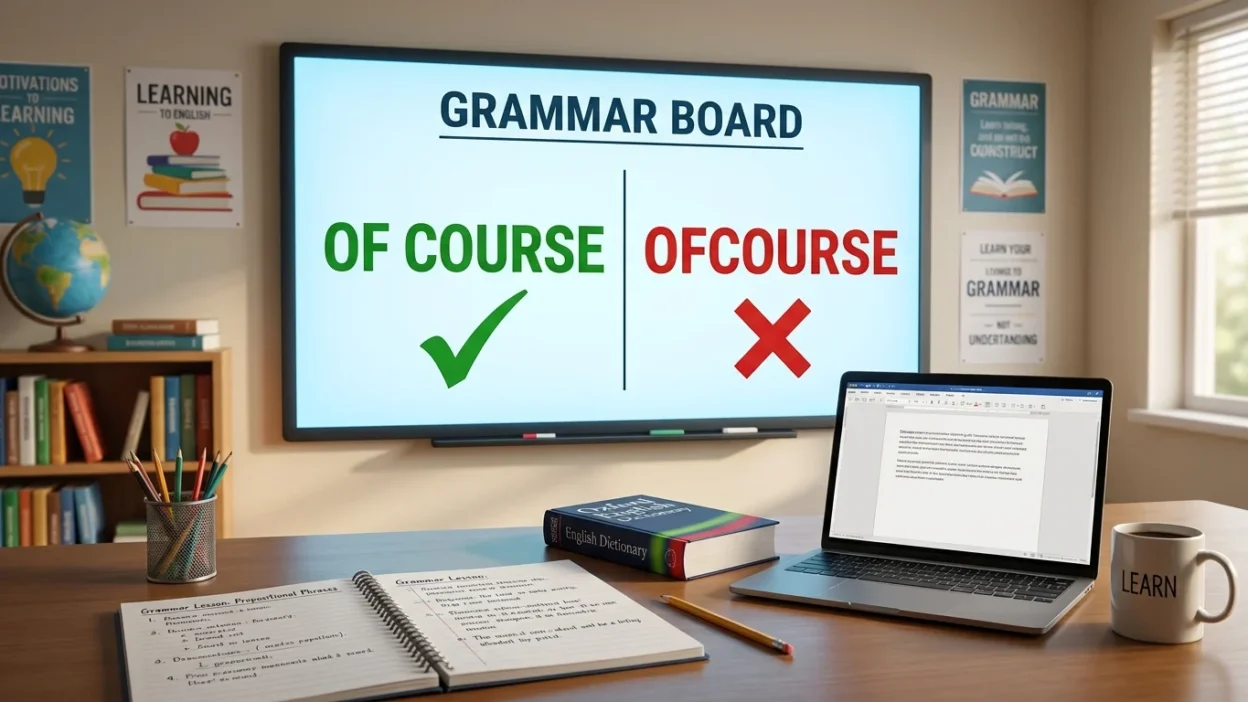
If you have ever wondered whether to write of course or ofcourse, you are not alone. These two forms look almost identical, but only one is considered the standard spelling in modern English. The confusion usually happens because of course is pronounced naturally as one phrase, which can make it seem as though it should be written as a single word.
The correct form is of course — two separate words. It is one of the most common expressions in English and can mean certainly, naturally, or yes, depending on the context. In this guide, we will explain the difference between of course vs ofcourse, show you how to use the expression correctly, discuss common mistakes, and provide useful examples for everyday and formal English.
Quick Answer
The correct spelling is of course.
Of course = correct
Ofcourse = incorrect in standard English
The phrase of course is written as two separate words.
Examples:
- Of course, I can help you.
- She is of course welcome to join us.
- Of course we remember him.
- You can come with us, of course.
There is no standard English situation where ofcourse should normally be written as one word.
What Does Of Course Mean?
Of course is a common English phrase used to express certainty, agreement, willingness, or something that is considered obvious or expected.
Its exact meaning depends on the context.
For example:
Of course, I will help you.
Here, it means certainly or yes, I am happy to help.
Another example:
She is of course familiar with the rules.
Here, it suggests that the information is expected or unsurprising.
The phrase can therefore have several closely related meanings:
- Certainly
- Naturally
- Obviously
- Without doubt
- Yes
- As expected
Why Is Of Course Written as Two Words?
The expression consists of two separate words:
of + course
The word of is a preposition, while course is a noun.
Together, they form the established phrase of course.
English contains many expressions that look as though they could be combined into one word but are normally written separately.
For example:
- at least
- a lot
- in fact
- of course
- as well
Therefore, even though people may pronounce of course quickly as a connected phrase, its standard written form remains two words.
Of Course vs Ofcourse: Comparison Table
| Form | Correct? | Meaning | Example |
|---|---|---|---|
| of course | Yes | Certainly, naturally, obviously | Of course, I agree. |
| ofcourse | No | Intended to mean of course | Ofcourse, I agree. |
| of-course | Usually no | Not standard for ordinary use | Avoid this form. |
The main rule is extremely simple:
Always write of course as two words.
Examples of Of Course
Here are some natural examples of the correct expression.
Expressing Agreement
Of course, I agree with you.
In this sentence, of course means certainly.
Showing Willingness
Of course, I can help you with that.
Here, the phrase expresses willingness and agreement.
Indicating Something Is Obvious
Of course, water is important for life.
The speaker considers the information obvious or generally known.
Giving Permission
Can I use your laptop?
Of course.
Here, of course is a natural way to say yes.
Adding Expected Information
He was, of course, very happy with the result.
Here, the phrase suggests that his happiness was unsurprising.
Of Course at the Beginning of a Sentence
Of course can appear at the beginning of a sentence, especially when expressing agreement or certainty.
Examples:
- Of course, you can come with us.
- Of course, I remember her.
- Of course, we should check the information first.
- Of course, everyone wants to succeed.
When of course introduces a sentence as an introductory expression, a comma is often used afterward.
For example:
Of course, I understand.
The comma helps separate the introductory expression from the main sentence.
Of Course in the Middle of a Sentence
The phrase can also appear in the middle of a sentence.
Examples:
- She is, of course, an excellent teacher.
- The answer is, of course, obvious.
- We can, of course, discuss the matter later.
When the phrase is inserted as a parenthetical comment, commas can be used around it.
However, punctuation depends on the sentence structure and intended emphasis.
Of Course at the End of a Sentence
You can also place of course at the end.
Examples:
- You can join us, of course.
- I will help you, of course.
- He knew the answer, of course.
In these sentences, the phrase adds emphasis or reinforces the statement.
Is Of Course Formal or Informal?
Of course is suitable for both everyday and formal English.
It is common in:
- Conversations
- Emails
- Articles
- Essays
- Business communication
- Academic writing
- Professional correspondence
However, the tone can change depending on how it is used.
For example:
Of course, I would be happy to assist you.
This sounds polite and professional.
Meanwhile:
Of course!
This sounds casual and conversational.
Common Mistakes With Of Course
Mistake 1: Writing Ofcourse
This is the most common mistake.
Incorrect:
Ofcourse, I understand.
Correct:
Of course, I understand.
Always separate of and course.
Mistake 2: Writing Of-Course
Some writers incorrectly add a hyphen.
Incorrect:
Of-course, I agree.
Correct:
Of course, I agree.
The normal expression does not require a hyphen.
Mistake 3: Confusing Pronunciation With Spelling
When people speak quickly, of course can sound almost like one connected unit.
That does not mean it should be written as one word.
English pronunciation often connects words together, but spelling does not necessarily follow pronunciation.
Mistake 4: Overusing Of Course
Although of course is correct, using it repeatedly can make writing sound repetitive.
For example:
Of course, I agree. Of course, we can help. Of course, this is important. Of course, everyone understands.
A better writing style may replace some repetitions with:
- Certainly
- Naturally
- Clearly
- Obviously
- Indeed
Use alternatives when they fit the context naturally.
Of Course vs Certainly
Of course and certainly can sometimes be used interchangeably, but their tone can differ.
Of course often sounds more conversational and can express agreement or willingness.
Certainly can sound slightly more formal or deliberate.
Compare:
Of course, I can help you.
Certainly, I can help you.
Both are correct, but the first often sounds warmer and more natural in everyday conversation.
Of Course vs Obviously
These expressions can also overlap, but they are not always interchangeable.
Of course can indicate agreement or something expected.
Obviously emphasizes that something is clear or easy to understand.
For example:
Of course, you can ask questions.
This expresses permission or willingness.
Obviously, the machine needs electricity to work.
This emphasizes something considered clear.
Of Course vs Sure
In casual conversation, of course and sure can both express agreement.
For example:
Can I borrow your pen?
Of course.
Sure.
Both are natural.
However, sure is generally more casual, while of course can work in both casual and professional settings.
American vs British English
There is no meaningful spelling difference between American and British English for this expression.
Both use:
of course
Both American and British speakers commonly use the phrase to mean:
- certainly
- naturally
- yes
- obviously
- as expected
The spelling ofcourse is not the standard form in either variety.
Therefore, whether you are writing for an American or British audience, use of course as two words.
Is Ofcourse Ever Correct?
In standard English writing, ofcourse is generally considered a spelling error.
You may occasionally see it in:
- Informal online posts
- Text messages
- Social media
- User-generated content
- Typographical errors
Its appearance in these contexts does not make it the standard spelling.
For professional, academic, educational, or published writing, always use:
of course
How to Remember the Correct Spelling
A simple memory trick is to remember that of course is made from two separate words.
Think:
OF + COURSE = OF COURSE
Do not combine them.
You can also remember the sentence:
Of course, I know the answer.
If you can clearly see the two words in this sentence, you will be less likely to write ofcourse.
Related Expressions and Synonyms
Depending on context, you can sometimes replace of course with:
- Certainly
- Naturally
- Surely
- Obviously
- Indeed
- Without doubt
- Definitely
- Absolutely
- Sure
- Clearly
However, these are not perfect substitutes in every sentence.
For example, absolutely can strongly emphasize agreement, while of course can sound more natural when giving permission.
FAQs
1. Is it of course or ofcourse?
The correct spelling is of course, with a space between the two words.
2. Is ofcourse one word?
No. Ofcourse is not the standard spelling in English. It is usually a spelling mistake or informal typing variation.
3. Should of course have a hyphen?
No. The standard expression is of course, not of-course.
4. What does of course mean?
It can mean certainly, naturally, obviously, yes, or as expected, depending on the context.
5. Is of course formal English?
Yes. Of course can be used in both formal and informal English. Its tone depends on the surrounding sentence.
6. Is of course the same in American and British English?
Yes. The spelling and basic meaning are the same in both varieties.
7. Can I start a sentence with of course?
Yes. For example:
Of course, I can help you.
When used as an introductory expression, a comma often follows it.
8. What is another word for of course?
Depending on the context, alternatives include certainly, naturally, obviously, surely, definitely, and indeed.
Summary
The difference between of course vs ofcourse is very simple: of course is the correct standard spelling, while ofcourse is incorrect in standard English. The expression always appears as two words when it is used in ordinary English writing. It can express certainty, agreement, permission, willingness, or something that is considered obvious or expected.
The phrase is common in both American and British English and can be used in casual conversations as well as professional and formal writing. Although similar words such as certainly, naturally, obviously, and definitely can sometimes replace it, of course remains one of the most natural and flexible expressions for showing agreement or certainty.

Liam James is a language enthusiast and content writer at Verseslay, specializing in word comparisons, grammar debates, and vocabulary insights. He helps readers understand language nuances through clear, engaging, and practical explanations.